

Expanding your student numbers should celebrate musical growth, not trigger steep licensing penalties from your administrative software. Yet, understanding music school management system pricing often feels like untangling a maze of concealed onboarding charges, data migration fees, and rigid user caps. If you are already exhausted by manual billing, scattered timetables, and disjointed parent communications, opaque software contracts only intensify the administrative burden.
You deserve clear, dependable software costs that respect educational budgets and reward expansion. We believe your management platform should do the hard work behind the scenes, freeing your team to focus on teaching and inspiring students. This guide explains how providers structure their licensing tiers, modular components, and setup services, helping you select the right platform without unexpected costs. Ahead, we examine the functional drivers behind modern subscription models and outline a practical framework to calculate the administrative hours your organisation will reclaim.
Key Takeaways
- Understand the difference between student-band tiers and user-seat licensing to navigate music school management system pricing with total clarity.
- Discover how modular software structures allow you to adopt specialised tools for billing, ensembles, and instrument tracking without paying for unnecessary bloat.
- Anticipate the full scope of onboarding by planning for data migration, system configuration, and dedicated staff training early.
- Quantify your operational return on investment by calculating the administrative hours saved on peripatetic teacher timetables and communications.
- Ensure your chosen cloud-based platform supports UK data sovereignty and meets the latest data protection regulations for student records.
Understanding Music School Management System Pricing Models
Generic business software treats customers like identical sales leads. That approach fails tuition providers immediately. Music services, performing arts academies, and private hubs manage dynamic enrolments, shared instrument inventories, and rotating peripatetic staff. Consequently, music school management system pricing reflects licensing frameworks designed around the natural rhythms of arts education rather than static corporate seats.
Most providers structure their core agreements through annual subscription contracts or flexible monthly plans. While monthly arrangements offer low initial commitment, annual terms provide predictable budgeting for local authorities and multi-academy trusts. Selecting the wrong model often leads to unexpected expenses when your tuition rosters fluctuate between terms.
Per-Student Licensing Versus User-Based Tiers
Software vendors generally calculate their base subscription around one of two main metrics:
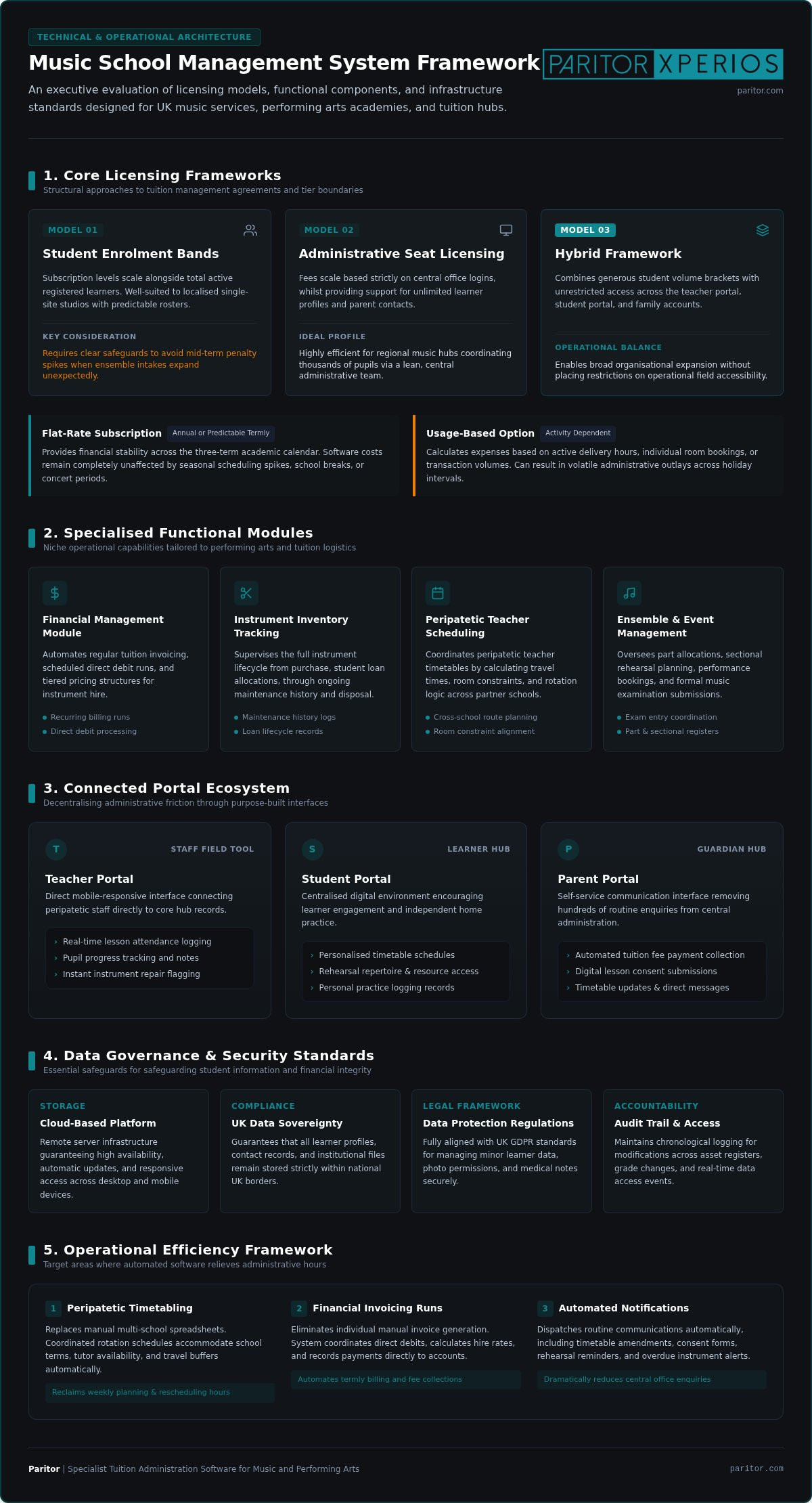
- Student enrolment bands: Your tier depends on total active learners. This works well for small studios, but you must ensure providers do not enforce steep penalties when enrolments surge mid-term.
- Administrative seat models: You pay per office staff login, allowing unlimited student profiles. This setup benefits large hubs with lean administrative teams coordinating thousands of learners.
- Hybrid frameworks: Platforms combine broad student bands with unlimited access across your teacher portal and student portal, balancing scale with operational access.
A transparent model ensures you never pay penalties simply because your ensemble intake grew in January.
Flat-Rate Subscriptions Versus Usage-Based Options
Flat-rate subscriptions offer complete financial predictability. You pay a set fee that covers your platform tier regardless of seasonal scheduling spikes. In contrast, usage-based models track active teaching hours, room bookings, or processing volumes. Because tuition demand changes across the three-term academic calendar, pure usage models can cause volatile operational expenditure. Working with a dedicated cloud-based platform ensures your core licence costs remain stable throughout holiday periods and performance seasons alike.
Core Functional Drivers Behind Music Management Software Costs
Basic administrative platforms often handle general contact records well enough, but specialised arts tuition demands far deeper functional depth. System capabilities dictate where a provider sets tier boundaries. When evaluating music school management system pricing, you will find that self-service portals, specialised scheduling engines, and data compliance standards represent the primary functional drivers separating entry-level tools from enterprise-grade tuition platforms.
Administrative User Accounts and Portal Access
Modern platforms shift daily friction away from central office teams through tailored self-service interfaces. Providing peripatetic staff with a dedicated teacher portal allows tutors to record attendance, track learner progress, and flag instrument repairs directly from their mobile devices. Similarly, an intuitive student portal gives learners real-time access to rehearsal materials and timetables, encouraging independent practice. Linking families through a connected parent portal eliminates hours of routine email enquiries by automating fee collection and lesson consent.
Specialised Functional Modules and Add-Ons
Music operations require niche tools that standard school software cannot deliver. System investment scales based on the operational modules you activate:
- Financial management module: Automates recurring tuition billing, direct debit runs, and tiered instrument hire charges.
- Instrument inventory tracking: Manages the complete instrument lifecycle from initial acquisition, through pupil loans, up to maintenance history and disposal.
- Peripatetic teacher scheduling: Coordinates travel times, room constraints, and rotation logic across dozens of partner schools.
- Ensemble and event management: Allocates parts, schedules sectionals, and tracks examination entries in one centralised space.
Choosing a platform with modular options, such as the suite developed by Paritor, ensures you only invest in the specific workflows your organisation actually uses.
Data Hosting, Security, and Compliance Standards
Infrastructure quality directly influences software licensing investment. Educational institutions require an enterprise-grade cloud-based platform hosted on Microsoft Azure to ensure high availability and dependable data resilience. Managing under-18 student records requires rigorous adherence to statutory standards. UK schools follow updated data protection regulations that demand strict safeguarding controls for minors, as outlined in recent national policy updates on vertexaisearch.cloud.google.com. Maintaining strict data sovereignty within domestic borders and establishing an immutable audit trail for every financial transaction protects your service from costly institutional risk.
Uncovering Implementation Expenses and Setup Considerations
Subscription licence fees represent only one part of your overall investment. When evaluating music school management system pricing, you must consider the total cost of ownership. Many generic directories claim onboarding is an incidental extra, yet educational transitions require deliberate data handling and change management. Setting up a dedicated music tuition platform involves tailored implementation services that configure your system correctly from day one, preventing administrative bottlenecks later.
Legacy Data Migration and System Configuration
Transferring decades of historical tuition records demands meticulous preparation. A smooth onboarding process requires several structured milestones:
- Student record cleansing: Auditing and extracting pupil details, medical notes, and family contact histories from disjointed spreadsheets.
- Asset catalogue mapping: Uploading your complete instrument stock, serial registries, and historical maintenance history into the central system.
- Operational parameter setup: Configuring term schedules, varied hourly lesson rates, sibling discounts, and bespoke rotation rules for timetables.
A reliable vendor works alongside your team through data extraction and validation, ensuring no learner or instrument profile goes missing during migration.
Staff Training and Ongoing User Onboarding
Adoption determines whether software succeeds. Administrative office staff need structured guidance across day-to-day coordination modules, from billing batches to venue hire registers. At the same time, visiting tutors require quick, intuitive onboarding so they can navigate the teacher portal immediately on their smartphones between lessons. Phased rollouts, clear documentation, and dedicated account support prevent operational disruption across your faculty, giving your staff confidence right from the start of term.
System Integrations and Accounting Connections
Tuition hubs do not operate in isolation. Your administrative platform must communicate smoothly with broader municipal or trust systems. That means connecting lesson income directly to municipal accounting packages and standard local authority ledger structures. Software supporting standard financial reporting frameworks and Department for Education E-codes eliminates manual reconciliation across finance teams. Adding direct debit and gateway payment integrations streamlines parent transactions, automating payment reconciliations and keeping your service financially sound without exhausting administrative hours.
Evaluating Return on Investment for Your Music Service
Calculating return on investment requires looking beyond the initial software invoice. Music tuition providers operate under distinct financial constraints, reporting to governors, academy trustees, and local authority committees who expect measurable accountability. Assessing music school management system pricing means weighing licence fees against the tangible operational hours and uncollected revenue your organisation reclaims every term.
Measuring Administrative Hours Reclaimed
Manual administrative work drains educational resources. Coordinators often spend dozens of hours each term building complex peripatetic teacher timetables, cross-referencing room availability, and chasing missing registers. Deploying intelligent automation eliminates this repetitive burden. With system-driven scheduling and automated notifications for missing registers or overdue forms, your central team reclaims valuable time. Staff can direct those recovered working hours straight back into student recruitment, ensemble performance preparation, and curriculum development.
Assessing Financial Recovery and Billing Speed
Revenue leakage frequently occurs when billing systems operate disconnected from registers. When lesson changes happen without updating spreadsheets, tuition fees slip through the cracks. Purpose-built platforms reconcile delivery with invoicing instantly. Automated direct debits accelerate payment collection, dramatically cutting fee arrears and debtor days. Similarly, tracking assets across the entire instrument lifecycle ensures loan agreements and hire charges remain up to date, eliminating the inventory losses that often trouble growing hubs.
Calculating True Cost per Student Hour
A reliable framework for measuring financial return is calculating your cost per student hour. By dividing your total administrative and delivery overheads by the actual teaching hours delivered, you see the true operational impact of modern software. Integrated platforms lower this delivery baseline by consolidating multiple disparate tools into one system. To understand how unified tools drive departmental efficiency, consult our guide to music service management software.
Clear financial reporting provides governing bodies with verifiable proof of efficiency gains. When you are ready to remove administrative bottlenecks and modernise your tuition service, book a consultation with Paritor to assess your operational requirements.
Selecting a Modular Platform Tailored to Your Growth
Monolithic software packages often force organisations to pay for clunky features they will never use. Selecting the right platform means matching software capabilities directly to your tuition structure. When assessing music school management system pricing, modular platforms ensure you only invest in what your service needs today, while maintaining the flexibility to expand tomorrow.
Aligning Software Modules to Organisational Workflows
Begin by identifying the specific administrative tasks that consume your team’s energy each week. If your organisation coordinates youth orchestras, brass bands, or community choirs, adopting dedicated ensemble management software streamlines part allocations and rehearsal registers effortlessly. If you loan brass, woodwind, or stringed instruments across schools, implementing specialised instrument inventory tracking tools protects assets and automates hire agreements. A modular structure allows you to activate specific tools for exams, events, or billing without paying for superfluous capabilities.
Engaging with a Trusted UK Technology Partner
Software is only as dependable as the team supporting it. Partnering with an established UK provider ensures your data resides securely in domestic cloud data centres, satisfying strict compliance requirements under national data protection regulations. Choosing an expert partner with decades of sector experience means your system evolves alongside active user feedback. A collaborative provider acts as an extension of your own team, offering dedicated onboarding specialists who understand the unique scheduling constraints of peripatetic tuition.
Preparing for a Targeted System Demonstration
Before speaking with software vendors, assemble a practical brief reflecting your actual working week. Outline your pupil numbers, visiting teacher travel constraints, and current billing hurdles. Ask providers to run live operational scenarios during demonstrations, such as reallocating a peripatetic timetable or running automated payment batches. Seeing authentic workflows in action gives you complete clarity on music school management system pricing and functional suitability. Take the next step to discover how Xperios streamlines tuition administration for your team.
Transform Your Tuition Service with Confident Platform Choices
Selecting the right software should never feel like an administrative gamble. Navigating music school management system pricing comes down to understanding your core workflows, demanding clarity around onboarding, and adopting tools that adapt alongside your teaching schedules. When you replace disjointed spreadsheets with automated registers and billing, your team reclaims dozens of operational hours every term. Those recovered hours directly support what matters most: enriching music curriculum delivery and supporting your students.
With over three decades of dedicated sector experience, Paritor delivers Xperios as a UK-developed cloud-based platform hosted on secure Microsoft Azure infrastructure. Its modular architecture ensures your organisation only pays for the exact tools you require, from peripatetic timetabling to automated billing modules. Discover how Xperios simplifies music school administration and empowers your faculty to inspire a new generation of musicians.
Frequently Asked Questions
How is music school management software typically priced across the UK?
Music school management system pricing across the UK is typically structured around tiered software-as-a-service subscriptions billed on an annual or monthly basis. Providers base these tiers on overall student roll numbers, active administrative logins, or specific module selections. This approach allows local music services, private studios, and multi-academy trusts to select licensing that fits their specific scale without paying for excess administrative capacity.
What is the difference between per-student licensing and user-based pricing?
Per-student licensing bases your recurring tier on the total number of enrolled pupils, which suits independent tutors or growing academies tracking exact pupil numbers. In contrast, user-based pricing charges per central administrative login while granting unlimited student accounts and portal access. Many modern music hubs prefer hybrid structures that combine predictable student enrolment bands with unrestricted access for visiting tutors and registered parents.
Are implementation and onboarding services included in the subscription fee?
Implementation and onboarding services are usually separate one-off professional fees rather than included in the base subscription. Setting up a complex tuition environment requires dedicated database extraction, historical data validation, and custom timetable rule configuration. Investing in structured onboarding ensures visiting tutors and administrative personnel receive targeted training, preventing operational disruption and register delays when transitioning between academic terms.
Why do specialised music systems deliver better value than general school databases?
Specialised platforms address the unique operational logistics of performing arts education that generic school databases overlook. General platforms cannot handle peripatetic teacher scheduling across external venues, instrument lifecycle tracking, or rotational lesson timetables that change weekly. Purpose-built systems automate complex hire agreements, parent communications, and exam entries directly, eliminating the need for cumbersome spreadsheets and separate third-party software subscriptions.
Can music services add or remove functional modules as their requirements evolve?
Yes, modular platforms allow organisations to activate or remove distinct tools as their tuition programmes change. A service might start with core scheduling and a teacher portal, then introduce dedicated ensemble management or instrument tracking modules as pupil numbers grow. This modular adaptability gives educational leaders full control over their music school management system pricing, preventing spend on unused software functions.
How does cloud software hosting protect student records and regulatory compliance?
Cloud-based platforms hosted on domestic Microsoft Azure infrastructure protect student data by enforcing strict UK data sovereignty and full compliance with UK GDPR. They provide continuous data redundancy, automated offsite backups, and granular access controls for pupil records. An immutable audit trail records every timetable modification and financial transaction, ensuring your institution meets Department for Education safeguarding standards and statutory accountability expectations.
What ongoing operational factors should music services evaluate to calculate ROI?
Organisations should evaluate operational savings by measuring weekly reductions in administrative hours spent building schedules, chasing registers, and reconciling fee payments. Calculating your true cost per student hour helps demonstrate tangible efficiency gains to trustees and governors. Additionally, automated billing collection and real-time asset monitoring prevent lost instrument stock and minimise fee arrears, delivering measurable financial recovery each academic term.