

If your administrative team spends more time chasing late fees than supporting musical excellence, your current financial system isn’t just slow; it’s actively hindering your growth. It’s a common frustration across the UK music education sector, where the “invoicing fortnight” often leaves staff exhausted and vital revenue streams like instrument hire fees slipping through the cracks. You shouldn’t have to choose between accurate financial oversight and your primary educational mission.
Finding the right music school budgeting tools is the first step toward reclaiming your time. This guide provides a strategic framework for 2026, designed to help you master the complexities of music education budgeting, automated invoicing, and sustainable revenue growth. By aligning your financial processes with modern technology, you can transform your administrative burden into a streamlined, invisible engine that supports your staff rather than draining them.
We’ll show you how to establish a predictable monthly income stream and transition to automated billing that requires zero manual entry. From real-time financial reporting for your stakeholders to tracking instrument repairs with precision, we’re outlining the roadmap to a more stable, empowered future for your organisation.
Key Takeaways
- Understand the 2026 UK music education funding landscape and how to treat your finances as a holistic ecosystem of tuition, hiring, and events.
- Discover how modern music school budgeting tools can accurately categorise revenue streams to provide a clear view of your fixed and variable costs.
- Learn to eliminate the “Invoicing Fortnight” by implementing automated system triggers and secure online payment portals for parents.
- Identify the essential KPIs every music service leader needs to monitor to spot growth opportunities or underperforming centres instantly.
- Explore how synchronising scheduling with financial management through Xperios reduces administrative overhead and secures a predictable income stream.
The Landscape of Music Education Finance in 2026
Managing a music service in 2026 requires more than just tracking lesson fees. It involves balancing core grants, capital investment for instruments, and the fluctuating income from ticketed events. The Landscape of Music Education Finance has evolved into a holistic ecosystem where every element is interconnected. If one part of the system fails, such as a delayed grant application or an uncollected ensemble fee, the ripple effect can destabilise your entire programme.
Many services still struggle with the “Summer Slump,” a period where tuition income drops whilst fixed costs remain steady. Relying on “free” spreadsheets often creates a false sense of economy in these moments. These manual systems hide the true cost of staff hours spent cross-referencing data and correcting mistakes. Without sophisticated music school budgeting tools, these seasonal dips and hidden overheads can lead to significant financial instability that limits your ability to reach more students.
The Real Cost of Administrative Friction
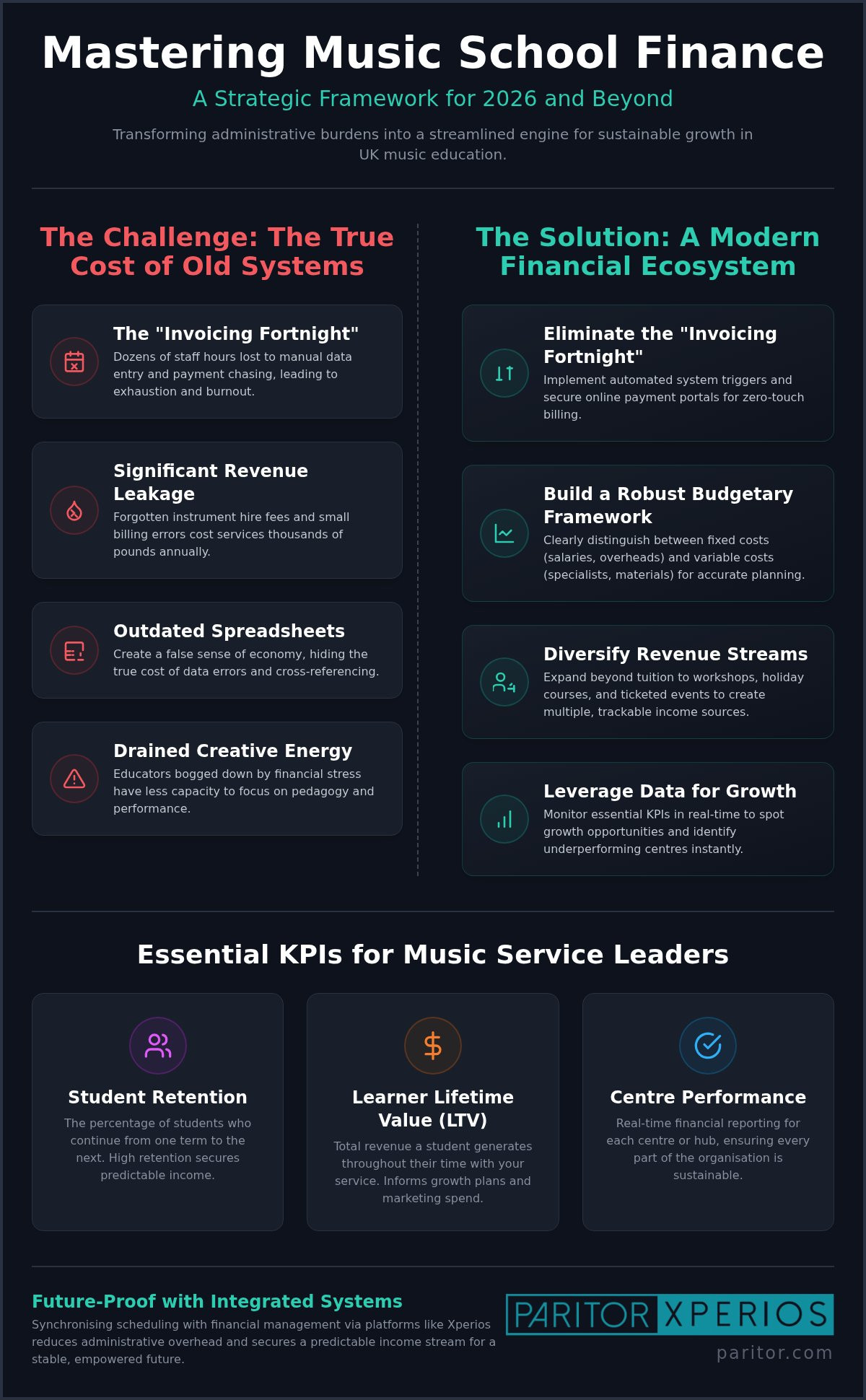
Staff often lose dozens of hours every month to manual data entry and payment chasing. This isn’t just a time sink; it’s a primary source of revenue leakage. Small errors in tuition billing or forgotten instrument hire renewals can cost a service thousands of pounds over a single academic year. Beyond the numbers, the psychological impact is heavy. When educators and leads are bogged down by financial stress, their creative energy is drained. They should be focusing on pedagogy and performance, not fighting with outdated spreadsheets that don’t talk to their scheduling software.
Navigating Funding Streams in 2026
Maximising Pupil Premium and local authority grants is essential for maintaining accessibility and equity. In 2026, the Hub and Spoke model centralises financial oversight, allowing for better resource sharing across regions. A Music Hub is a strategic partnership of organisations that works together to ensure every child has access to high-quality music education regardless of their background or location. Using modern music school budgeting tools allows leaders to track these diverse funding streams in real-time. This level of visibility ensures that every pound is accounted for, helping you prove your impact to stakeholders and secure future investment.
Building a Robust Budgetary Framework with Modern Tools
A robust framework requires more than just a list of expenses. It demands a structural approach to how money moves through your organisation. By using specialised music school budgeting tools, you can separate your core tuition income from secondary streams like instrument hire and ensemble fees. This clarity allows you to see exactly which areas are profitable and which require adjustment to ensure long-term sustainability.
Effective management involves distinguishing between fixed and variable costs. Fixed costs, such as permanent staff salaries and building overheads, remain constant regardless of student numbers. Variable costs, like the fees for visiting specialists or sheet music for a specific project, change based on activity levels. Distinguishing between these allows you to set realistic targets for student retention and calculate the Lifetime Value (LTV) of your learners, ensuring your growth plans are based on data rather than guesswork.
Diversifying Revenue Beyond Tuition
Don’t rely solely on weekly lessons to keep your service afloat. Weekend workshops, intensive holiday courses, and grade-specific masterclasses provide vital injections of cash whilst broadening your educational reach. You can also use events and ticketing as primary drivers for capital funding. Instead of just covering the cost of the hall, a well-managed concert can contribute towards a fund for new instruments. Implementing tiered pricing models for different levels of instruction or group sizes ensures your service remains accessible whilst maintaining healthy margins. Integrating Xperios Financial Management into your workflow helps you track these diverse streams automatically, giving you the time to focus on the music.
Long-term Financial Planning
The UK economy can be unpredictable, making a 3-5 year horizon essential for any music service leader. This long-term view helps you plan for major capital expenditures, such as replacing a fleet of woodwind instruments or upgrading your digital infrastructure. It’s also vital to establish a “Rainy Day” fund specifically for instrument repairs. These emergency costs shouldn’t derail your main budget. When you align these financial targets with your curricular excellence, you create a stable environment where both your students and your staff can thrive. Professional music school budgeting tools provide the forecasting capabilities needed to see these trends before they become challenges, allowing for proactive rather than reactive leadership.
Streamlining the Invoicing and Collection Cycle
The “Invoicing Fortnight” is a dreaded period for many UK music service administrators. It’s usually defined by frantic manual data entry, paper trails, and endless email chains. By 2026, this level of administrative friction should be a thing of the past. Transitioning away from cash and cheques toward secure, online payment portals isn’t just about modern convenience. It’s about data security and establishing professional institutional standards that parents expect. When you remove the manual barriers to payment, you naturally reduce the rate of late fees and arrears.
Automating the Billing Journey
Xperios transforms this process by synchronising attendance tracking directly with invoice generation. When a teacher marks a student present in the Teacher Portal, the system can automatically trigger the billing cycle. This eliminates the need for staff to spend weeks cross-referencing paper registers with accounting software. You can also configure automated reminders for overdue accounts. This ensures late payments are chased consistently without staff having to draft individual, often uncomfortable, emails. For a deeper look at managing your physical assets alongside your finances, see The Ultimate Guide to Instrument Inventory Management Software for Music Services (2026).
Implementing Direct Debit is the most effective strategy to secure a predictable monthly income stream. It flattens the cash flow curve and reduces the risk of missed payments. However, managing debt requires a delicate balance. You need to maintain professional standards whilst honouring the sensitive relationships you’ve built with parents. Using music school budgeting tools that provide real-time financial data allows you to have informed, empathetic conversations with families before debts become unmanageable.
Transforming Instrument Hire into Recurring Revenue
Instrument hire is frequently a neglected revenue stream because it’s notoriously difficult to track without specialised software. Xperios allows you to digitise hire agreements, automate monthly billing, and manage damage waivers in one centralised hub. By integrating repair costs directly into the hire financial model, you ensure that your fleet remains self-sustaining. This turns a complex logistical headache into a reliable source of recurring revenue. It allows your service to reinvest in higher-quality stock, ensuring students always have access to reliable instruments. Using music school budgeting tools in this way ensures that your assets are working for you, not against your balance sheet.
Leveraging Data for Strategic Financial Growth
Data shouldn’t be a source of stress. It should be your most reliable ally. Many music service leads feel overwhelmed by the sheer volume of information they handle daily. However, when you use modern music school budgeting tools, this data transforms into actionable insights. You can move beyond guessing which centres are thriving and start making decisions based on evidence. This level of transparency doesn’t just help your internal team; it provides the clear, professional reporting your board and local authority stakeholders require to maintain their trust in your leadership.
Financial Metrics That Matter
Monitoring the right Key Performance Indicators (KPIs) is vital for long-term sustainability. Calculating the cost per student hour across different centres allows you to see exactly where your resources are most effective. If a particular ensemble is consistently underperforming or becoming a financial drain, the data will highlight it early. Another critical metric is your Arrears Ratio. By tracking this in real-time, you can intervene before debt becomes unmanageable. Analysing the ROI on your instrument hire fleet also guides smarter purchasing decisions, ensuring you invest in the stock that provides the best return for your service.
Compliance and Secure Data Management
Handling parent and student financial information comes with significant legal and ethical responsibility. GDPR compliance isn’t optional; it’s a fundamental requirement of modern music service management. Cloud-based systems like Xperios, hosted on Microsoft Azure, offer superior security compared to local servers or vulnerable spreadsheets. This infrastructure ensures your data is redundant, encrypted, and accessible only to authorised staff. Detailed audit trails provide a clear, permanent record of every transaction, ensuring financial accountability and institutional safety at every level of your organisation.
Using data-driven insights also improves your student retention and recruitment efforts. When you can see patterns in attendance alongside payment behaviour, you can identify students at risk of dropping out before they leave. This allows for proactive support rather than reactive loss. To see how these reporting modules can support your organisation’s growth, explore Xperios Financial Management today. By letting the software handle the complex reporting and labor-intensive tracking, you can focus on the strategic decisions that move your music service forward into 2026.
Future-Proofing with Xperios Financial Management
Future-proofing your organisation means more than just surviving the next academic year. It’s about building a resilient system that scales alongside your ambitions. Xperios isn’t just a digital ledger; it’s a unified engine that integrates scheduling, attendance, and finance into one seamless workflow. By connecting these dots, you eliminate the data silos where revenue often goes missing. You don’t just see a list of payments. You see the entire lifecycle of a student’s journey from their first lesson to their final ensemble performance.
The Xperios Parent Portal plays a vital role in this evolution by reducing the constant stream of administrative enquiries. It empowers families to view their own schedules, track their billing history, and make payments in their own time. This shift significantly reduces the overhead on your office team, allowing them to move away from repetitive data entry. When you adopt these music school budgeting tools, you aren’t just buying software. You’re reclaiming your mission. You’re shifting the focus of your leadership team from exhausting paperwork back to pedagogy and creative excellence.
The Xperios Advantage for Music Hubs
Music hubs face the unique challenge of managing peripatetic staff and multiple school locations simultaneously. Xperios provides the infrastructure for centralised billing whilst supporting decentralised instruction. You can track the finances of hundreds of tutors across dozens of sites without losing oversight. This scalability ensures that whether you’re managing a small local service or a sprawling national hub, your financial management remains precise and professional. For a broader look at how technology is reshaping the sector, read The Complete Guide to Music Service Management Software in 2026.
Getting Started with Modern Financial Management
Moving away from legacy systems can feel daunting, but the onboarding process is designed to be a partnership. We specialise in migrating your existing data into Xperios securely, ensuring you don’t lose vital historical records during the transition. Our platform is built on a collaborative user-input model. We’ve spent decades listening to music service leads to ensure our music school budgeting tools solve real-world problems. You’ll have access to ongoing support and a system that continues to evolve based on the needs of the music education community. To see how we can transform your administrative labour into a streamlined, automated success story, organise a demonstration of Xperios Financial Management today.
Empowering Your Music Service for 2026
The journey toward financial stability in music education doesn’t have to be a solo performance. By adopting modern music school budgeting tools, you’re choosing to replace administrative friction with operational flow. We’ve explored how automated invoicing and real-time reporting modules transform your service from a reactive organisation into a proactive leader. Transitioning to a system that synchronises attendance with billing ensures your staff can finally step away from the spreadsheet and return to the classroom. It’s time to lead with confidence.
Paritor has been trusted by UK Music Hubs since 1993, offering a modular design specifically tailored for the performing arts. Our platform provides GDPR compliant hosting on Microsoft Azure, ensuring your data remains secure whilst providing the scalability you need to grow. Don’t let manual paperwork stifle your creative mission any longer. Book a consultation to see how Xperios can transform your school finances and secure a more predictable, sustainable future for your students. We’re here to help you build the stable foundation your musical community deserves.
Frequently Asked Questions
How can I reduce late payments in my music school without sounding aggressive?
The most effective way to reduce arrears is to remove the manual barriers to payment. By using the Xperios Parent Portal, you can send automated, professional reminders that feel like a helpful service rather than a confrontational chase. Offering modern payment methods like Direct Debit or secure online portals allows parents to settle accounts instantly. This shifts the focus from administrative friction to a supportive partnership, ensuring your cash flow remains steady whilst maintaining positive family relationships.
What are the benefits of using a cloud-based system for school finances?
Cloud-based systems provide real-time accessibility and superior data security compared to local spreadsheets or paper files. By hosting your financial data on platforms like Microsoft Azure, you benefit from high standards of encryption and automatic backups. This ensures your music school budgeting tools are always up to date and accessible from any location. It also facilitates seamless collaboration between peripatetic staff and central office administrators, ensuring everyone is working from a single, reliable source of truth.
Is it possible to automate invoicing for peripatetic teachers with varying schedules?
You can automate this complex process by synchronising attendance tracking directly with your billing engine. When peripatetic teachers mark their registers in a dedicated portal, the system calculates the correct fee based on the individual student’s rate and session duration. This removes the need for manual data entry at the end of each term. It ensures that even the most fluctuating schedules are billed accurately, reducing errors and saving your administrative team weeks of labour.
How does instrument inventory management affect a music service budget?
Effective inventory management turns a potential liability into a predictable revenue stream. By tracking the location, condition, and hire history of every asset, you can accurately forecast repair costs and replacement cycles. This prevents emergency expenditures from derailing your main budget. Integrating instrument hire fees into your broader music school budgeting tools allows you to see the true return on investment for your fleet, helping you make informed decisions about future capital investment and stock upgrades.
What financial reports should I be sharing with my board of governors?
You should provide high-level summaries that demonstrate both sustainability and educational impact. Key reports include your Arrears Ratio, cost per student hour, and a clear breakdown of revenue by stream, such as tuition versus instrument hire. Governors also value transparency regarding GDPR compliance and data security. Using modular reporting tools allows you to generate these insights instantly, proving that your organisation is managed with professional rigour and institutional accountability.
Can Xperios integrate with my existing accounting software?
Xperios is designed to work alongside your existing financial infrastructure. We offer bespoke integration services to ensure data flows smoothly between our platform and major third-party accounting software or local authority systems. This prevents the need for double entry and significantly reduces the risk of human error. By centralising your music-specific operations in Xperios, you can export clean, accurate data directly into your general ledger for final accounts and professional auditing.
How much time can a music hub realistically save by automating financial tasks?
Music hubs often report saving hundreds of hours per year by eliminating the “Invoicing Fortnight.” By automating repetitive tasks like payment chasing and register reconciliation, your staff can focus on strategic growth rather than paperwork. Whilst exact savings vary by organisation size, removing manual data entry typically allows administrative teams to reclaim up to 80% of the time previously spent on billing cycles. This efficiency enables your service to scale without increasing your administrative headcount.
Is our financial data secure when stored in a cloud management system?
Your financial data is significantly more secure in a cloud system like Xperios than on a local office computer. We host our platform on Microsoft Azure, which provides industry-leading security standards and full GDPR compliance. This infrastructure includes multi-layered encryption, regular security audits, and data redundancy to prevent loss. It ensures that sensitive student and parent financial information is protected by the same level of security used by global financial institutions and government bodies.