

What if the hours your team spends manually correcting scheduling clashes and chasing overdue invoices are actually the most expensive items on your balance sheet? You didn’t start a performing arts school to become a full-time debt collector or data entry clerk, yet the weight of administrative labour often pulls focus away from the stage and the studio. Understanding the ROI of performing arts school software is no longer just about choosing a tool; it’s about reclaiming your institutional capacity to grow whilst ensuring total financial and regulatory security.
We understand that the transition to digital systems can feel daunting, especially with the pressure of the UK’s Data (Use and Access) Act 2025 and evolving global privacy standards. This strategic guide provides a clear framework to help you calculate the tangible financial returns of automation. You’ll discover how to eliminate financial leakage, automate the workflows that currently drain your staff’s energy, and use modern portals to create a seamless experience for parents and students alike. By the end of this guide, you’ll have a roadmap to transform your back-office into a silent, efficient engine of growth.
Key Takeaways
- Uncover the “Time Leakage” phenomenon where manual data entry consumes up to 30% of your staff’s week, distracting them from their core educational mission.
- Measure the ROI of performing arts school software through tangible metrics like reduced Days Sales Outstanding and optimised room usage across your facilities.
- Explore how dedicated portals for parents and teachers foster institutional trust whilst significantly improving student re-enrolment rates.
- Follow a structured five-step audit framework to identify administrative bottlenecks and calculate potential savings before making a strategic investment.
- Understand why a person-centric architecture, built on decades of industry collaboration, ensures your software remains a long-term asset rather than a technical burden.
Beyond the Spreadsheet: Identifying the Hidden Costs of Manual Administration
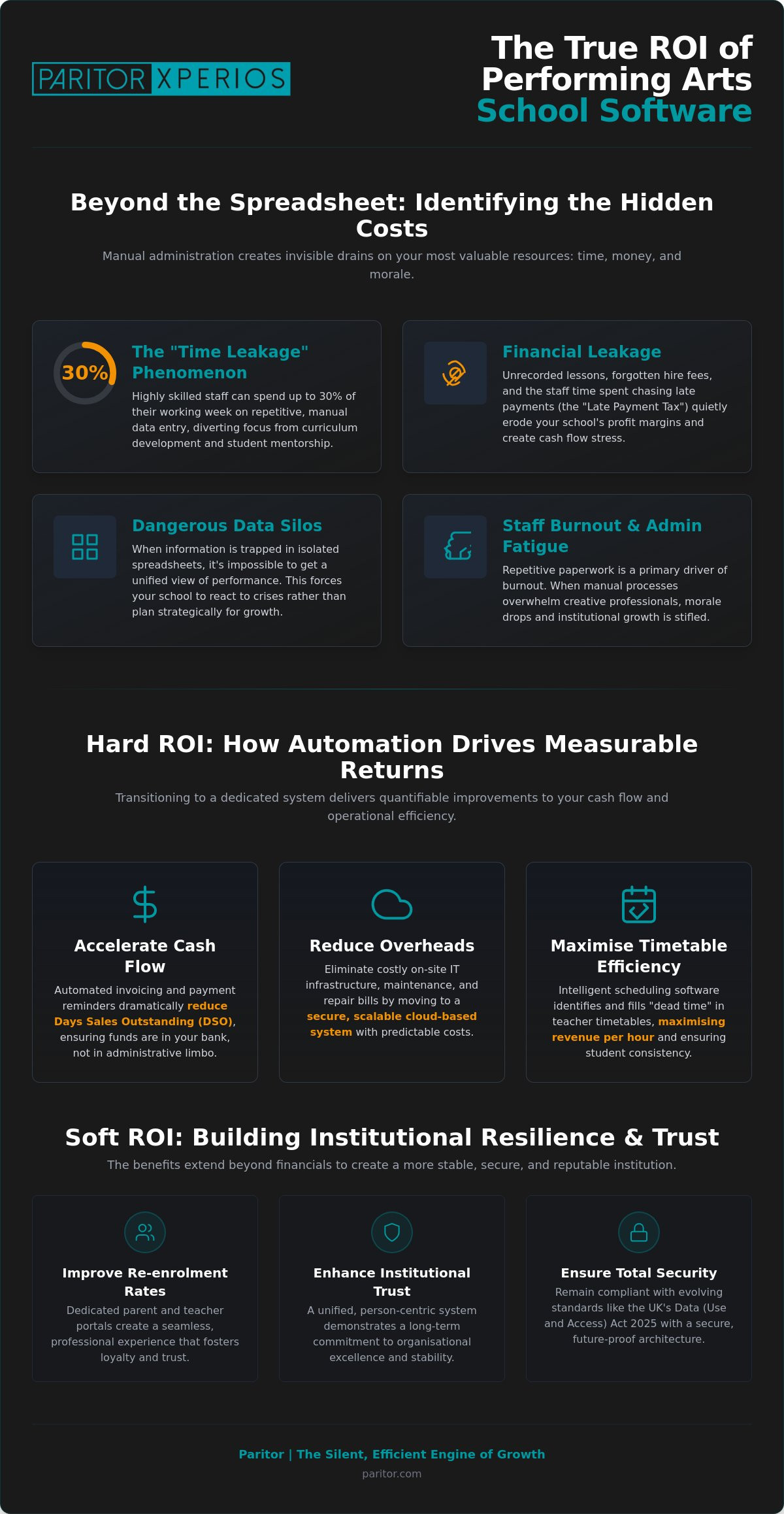
When we discuss the ROI of performing arts school software, we aren’t just looking at the price of a monthly subscription against a bank balance. True return on investment is the measurable balance between the cost of the technology and the volume of recovered resources. For many institutions, the most valuable resource is time. We see a recurring “Time Leakage” phenomenon where highly skilled senior staff spend up to 30% of their working week on repetitive, manual data entry. This is time stolen from curriculum development, student mentorship, and strategic growth. It’s a high price to pay for familiarity.
Relying on traditional spreadsheets often feels safe, but it creates dangerous data silos. When information is trapped in isolated files, it becomes impossible to gain a clear, institution-wide view of performance. In the field of arts administration, effective management requires a unified flow of data to inform strategic decisions. Without this, your school is operating in the dark, reacting to crises rather than planning for the next season. Your school deserves better.
The True Cost of Admin Labour
Consider the hourly cost of an administrator manually cross-referencing room bookings against teacher availability. When this process is automated, that salary is redirected toward high-value activities that actually generate revenue. Beyond the financial ledger, there’s a heavy morale cost. Repetitive paperwork is a primary driver of teacher and staff burnout, as creative professionals feel buried under administrative weight. Admin fatigue is the systemic exhaustion felt by staff when manual processes outpace their capacity to perform their actual roles, ultimately stifling institutional growth in 2026.
The Financial Leakage of Inefficient Billing
Financial leakage often occurs in the gaps between the studio and the office. Unrecorded extra lessons or forgotten instrument hire fees can quietly erode your margins. Then there’s the “Late Payment Tax”, which is the hidden cost of staff time spent manually chasing overdue fees. Manual tracking is prone to human error; a single missed billing cycle can cause significant cash flow stress.
By transitioning to a system like Xperios Financial Management, schools replace these fragile manual processes with automated, cloud-based workflows. This ensures every lesson is accounted for and every invoice is sent on time, turning financial leakage back into institutional profit. It’s about efficiency. Modern management means moving away from the “chasing” culture and moving toward a predictable, automated revenue stream that supports your long-term vision.
Hard ROI: How Automation Drives Revenue and Reduces Overheads
Hard ROI is where the numbers speak for themselves. Automated invoicing isn’t just a convenience; it’s a cash flow catalyst. By reducing Days Sales Outstanding (DSO), schools ensure that funds are in the bank rather than stuck in administrative limbo. This direct impact on liquidity is a cornerstone of the ROI of performing arts school software. When payments are automated, the friction of manual chasing disappears. Your finance team can then focus on high-level forecasting instead of hunting through bank statements.
We also see significant overhead reduction through cloud-based hosting. Traditional local IT infrastructure requires expensive hardware, maintenance, and physical space. Moving your operations to a secure cloud environment eliminates these hidden costs whilst providing superior data redundancy. It’s a shift that replaces unpredictable repair bills with a stable, scalable service standard. This reliability allows you to grow your student base without worrying if your server can handle the extra load.
Maximising Timetable Efficiency
Peripatetic teachers often suffer from fragmented schedules that leave gaps in the day. Specialist scheduling software identifies these pockets of “dead time” and helps you bridge them. By ensuring students receive consistent instruction, schools support the positive academic and social outcomes associated with arts education whilst maximising their own revenue per hour.
Ensemble optimisation takes this a step further. It ensures every group session is at peak capacity, turning underutilised rooms into profitable spaces. By using data to identify which programmes are thriving and which are underperforming, you can make informed decisions about where to invest your resources. If you want to see how this works in practice, exploring Xperios Ensemble Management can help you visualise your school’s untapped capacity.
Asset Protection and Instrument Management
Your instrument library represents a massive capital investment. Poor tracking doesn’t just lead to missing violins; it leads to financial leakage through uncollected hire fees and premature equipment failure. Digital loan agreements and automated repair tracking extend the life of these musical assets by ensuring accountability from the moment an instrument leaves the building.
Implementing a rigorous tracking system transforms a chaotic storeroom into a structured revenue stream. You can automate hire fee collections and receive alerts for scheduled maintenance, preventing small issues from becoming expensive replacements. For a deeper dive into protecting your physical stock, read The Ultimate Guide to Instrument Inventory Management Software for Music Services (2026). It’s about protecting your past investments to fund your future growth.
Soft ROI and Institutional Resilience: Retention and Regulation
Whilst hard metrics deal with immediate cash flow, soft ROI focuses on the long-term resilience of your organisation. It’s about student retention and the avoidance of catastrophic regulatory failures. Calculating the ROI of performing arts school software must include the value of institutional trust. If a parent feels their child’s data is secure and their progress is visible, they’re far more likely to remain enrolled for the next term. Real-time progress reports don’t just help students; they provide tangible proof of value to families, justifying tuition fees even in a competitive economic environment.
Trust is a delicate asset. In the performing arts, your reputation is built on the quality of instruction, but it can be dismantled by a single administrative lapse. Professional software ensures that every interaction—from the first registration to the final assessment—is handled with precision. This reliability creates a sense of stability that parents value deeply. They aren’t just paying for a lesson; they’re investing in a professional educational journey. When your back-office operations match the excellence of your teaching, you build a brand that families stay with for years.
The Parent Experience as a Retention Engine
A professional portal acts as your 24/7 digital concierge. By providing families with instant access to schedules, invoices, and teacher feedback, schools can significantly reduce the volume of inbound enquiries. Some administrators report that self-service options can lower administrative enquiries by up to 60%, freeing staff for more meaningful interactions. This frictionless communication builds long-term loyalty. When the process of managing a child’s education is simple, the administrative barrier to re-enrolment disappears. For a deeper look at this, see The Ultimate Parent Portal for Music Schools: A 2026 Strategy Guide.
Data Security and GDPR Compliance
The UK’s regulatory environment has become increasingly complex. The Data (Use and Access) Act 2025, which came into force on 5 February 2026, introduced rigorous new rules for data handling and automated decision-making. Non-compliance is expensive. Fines can reach up to £17.5 million or 4% of global turnover. A secure, Azure-hosted platform like Xperios mitigates this risk by design. Automated data retention policies handle the complex task of purging old records, saving your team hours of manual audit work. This level of security is a major competitive advantage. When bidding for local authority contracts or Music Hub partnerships, proving your data is handled by industry-standard software is often a prerequisite for success.
The ROI Calculation Framework: Measuring Success in Your School
Measuring the ROI of performing arts school software should not be a matter of guesswork. To make a compelling case for investment, you need a structured approach that translates administrative relief into financial facts. We’ve developed this five-step framework to help school leaders and Music Service directors quantify the value of modernisation before committing to a new system.
- Step 1: Audit Manual Hours. Document the time spent on repetitive tasks across your finance, teaching, and admin departments. Ask your team: how many hours each week are lost to scheduling, chasing signatures, or correcting data entry errors?
- Step 2: Identify Revenue Leakage. Review your records for missed billing opportunities. This includes unrecorded extra lessons, unreturned instruments, or hire fees that simply weren’t processed due to oversight.
- Step 3: Factor in the Growth Multiplier. Consider your current student capacity. If automation reduces your administrative burden by half, how many more students could your existing staff manage without increasing overheads?
- Step 4: Compare Costs and Savings. Weigh the total anticipated savings against the annual SaaS subscription and the one-time implementation fees. A true ROI calculation looks at the net gain over a three-to-five-year period.
- Step 5: Establish an Efficiency Baseline. Record your current performance metrics, such as your Days Sales Outstanding (DSO) and student retention rates, to serve as a benchmark for post-implementation success.
By following this process, you move beyond “feeling” more efficient and start proving it. This data-driven approach is essential for gaining the support of your board or local authority stakeholders. If you’re ready to start your audit, you can book a consultation with our team to see how these steps apply to your specific school structure.
Quantifying Time Savings
Converting staff hours into a British Pound value is a powerful way to visualise ROI. Use a simple formula: (Total Weekly Hours Saved x Average Hourly Rate) x 52 weeks. For example, saving just ten hours a week across a small team can recover thousands of pounds in lost productivity annually. The real value, however, lies in high-value reinvestment. Instead of filing paperwork, your staff can focus on curriculum innovation, community outreach, and improving the student experience. This shift from “maintenance” to “mission” is the hallmark of a successful digital transition.
Evaluating Long-Term Scalability
It’s tempting to choose the cheapest tool available, but “entry-level” software often delivers a negative ROI in the long term. As your organisation grows, a lack of scalability leads to “software outgrowing”, where you’re forced to migrate data and retrain staff all over again. A modular system is a more strategic choice. It allows you to pay only for what you need today whilst ensuring the architecture can handle a doubling or tripling of your student base tomorrow. When pitching this to governors, emphasise that you aren’t just buying software; you’re building a foundation for future expansion that won’t require a total system overhaul in two years’ time.
Future-Proofing with Xperios: Why Bespoke Architecture Delivers Superior Returns
The ROI of performing arts school software is ultimately realised through longevity and reliability. Choosing a system that understands the specific nuances of the UK arts sector ensures that your investment remains an asset rather than becoming a technical burden. Xperios has established itself as the standard for UK music services and performing arts schools because it was built on 30 years of direct industry collaboration. This person-centric design means the software mirrors the actual workflows of your staff, reducing the learning curve and accelerating your return on investment from day one.
Institutional reliability is non-negotiable in 2026. Our partnership with Microsoft Azure provides a foundation of professional trust, ensuring high uptime and robust data redundancy. When your system is stable, your school is stable. You avoid the hidden costs of downtime, data loss, or emergency IT support. Instead, you benefit from a system that scales effortlessly as your student numbers grow. This technical assurance, combined with our dedicated UK-based support and structured onboarding programmes, ensures that your team feels empowered rather than overwhelmed by new technology.
Modular Efficiency for Every Department
Generic management tools often fail because they lack the niche depth required for complex ensemble management or peripatetic scheduling. Xperios for Performing Arts specifically targets the unique workflows of drama and dance schools, whilst Xperios for Music Services provides the granular control needed by large-scale hubs. This modularity allows you to build a system that fits your current needs whilst leaving room for expansion.
The financial visibility provided by the Xperios Financial Management module is a critical driver of ROI. It connects your scheduling directly to your ledger, ensuring that no lesson goes unbilled and no instrument hire fee is overlooked. This level of integration is what separates a professional management system from a simple booking tool. For a broader look at how these systems support large-scale operations, explore The Complete Guide to Music Service Management Software in 2026.
The Partnership Model vs. The Vendor Model
Long-term ROI depends on a software provider that acts as a dedicated ally. Unlike generic vendors who offer a one-size-fits-all solution, we operate on a partnership model. This means our software updates are continuously shaped by collaborative user input, ensuring the platform evolves alongside the changing needs of the UK arts sector. You aren’t just buying a static product; you’re joining a community of educators and administrators who are collectively defining the future of arts management.
When you choose a partner that understands the specific frustrations of your role, the software stops being a chore and starts being an industrious engine that works behind the scenes. This allows you to excel in your primary mission: delivering world-class arts education. It’s time to move beyond manual burdens and embrace a system designed for your success. Discover how Xperios can transform your organisation’s ROI today and reclaim the time you need to grow.
Reclaiming Your Mission Through Modernisation
We’ve explored how identifying hidden administrative costs and automating billing cycles can transform your balance sheet. By applying a structured calculation framework, you can move away from fragile manual spreadsheets and embrace a scalable system that prioritises both financial growth and regulatory security. Maximising the ROI of performing arts school software is about more than just saving money; it’s about restoring focus to the students and teachers who define your institution.
Trusted by UK Music Services and Conservatoires for over 30 years, Xperios was built through direct collaboration with performing arts professionals. Our platform is hosted on Microsoft Azure, providing enterprise-grade security and 99.9% uptime to ensure your organisation remains resilient and future-proof. You don’t have to carry the burden of repetitive paperwork alone. Book a bespoke Xperios demo to see your potential ROI in action. We’re here to help you turn administrative relief into lasting institutional progress.
Frequently Asked Questions
How quickly can we expect to see a return on investment after implementing Xperios?
Most schools observe a tangible return on investment within their first full academic term. This immediate impact results from the elimination of manual invoicing errors and the recovery of previously unbilled fees. By automating these labour-intensive processes, your team reclaims significant capacity to focus on student development and strategic growth. Reclaiming just a few hours of senior staff time each week quickly offsets the initial subscription costs.
Does the software integrate with our existing accounting systems like Sage or Xero?
Yes, Xperios is designed to work alongside industry-standard accounting tools like Sage and Xero. Our Financial Management module exports precise transactional data directly to these systems, which eliminates the need for tedious double-entry. This integration ensures your financial records remain accurate and up to date whilst reducing the administrative burden on your finance team.
Can performing arts school software really help reduce student dropout rates?
Dedicated software helps reduce dropout rates by fostering a sense of partnership through professional parent and student portals. When families have real-time visibility of progress reports and easy access to schedules, they feel more invested in the educational journey. This increased engagement creates a “sticky” experience that makes families far more likely to re-enrol each term.
Is the cost of implementing new software worth it for a smaller music service?
Implementing modern systems is highly cost-effective for smaller services because it allows a lean team to manage a larger student body. For organisations with limited staff, the ROI of performing arts school software is found in the ability to scale without increasing headcount. Automation handles the repetitive tasks that would otherwise require a dedicated administrator, allowing you to focus on tuition.
How does automated instrument tracking contribute to the overall ROI?
Automated tracking contributes to ROI by preventing the loss of expensive instruments and ensuring every hire fee is collected. Without digital records, assets often sit idle in storage or go missing after a student leaves. By automating loan agreements and repair schedules, you protect your capital investment and turn your instrument library into a consistent revenue stream.
What is the “cost of inaction” when delaying a digital transformation for my school?
The cost of inaction is the cumulative loss of staff productivity and the missed revenue from inefficient billing cycles. Delaying your digital transition means your school continues to leak funds through manual errors whilst staff morale suffers under the weight of repetitive paperwork. In 2026, failing to offer modern digital portals also risks losing students to more technologically savvy competitors.
Does Xperios handle the complexities of peripatetic teacher payroll and scheduling?
Xperios is built to manage the intricate requirements of peripatetic scheduling and the resulting payroll data. The system automatically cross-references teacher hours with student attendance, ensuring that payroll records are accurate and ready for processing. This removes the monthly headache of manual timesheet reconciliation and protects your school from the financial risks of overpayment or scheduling clashes.
How does the software ensure our school remains GDPR compliant?
Xperios ensures your school remains compliant by utilising automated data retention policies and enterprise-grade security protocols. The system is built to align with the UK Data (Use and Access) Act 2025, handling complex tasks like data purging and consent management automatically. This proactive approach eliminates the risk of human error and protects your institution from the potential of heavy regulatory fines.