

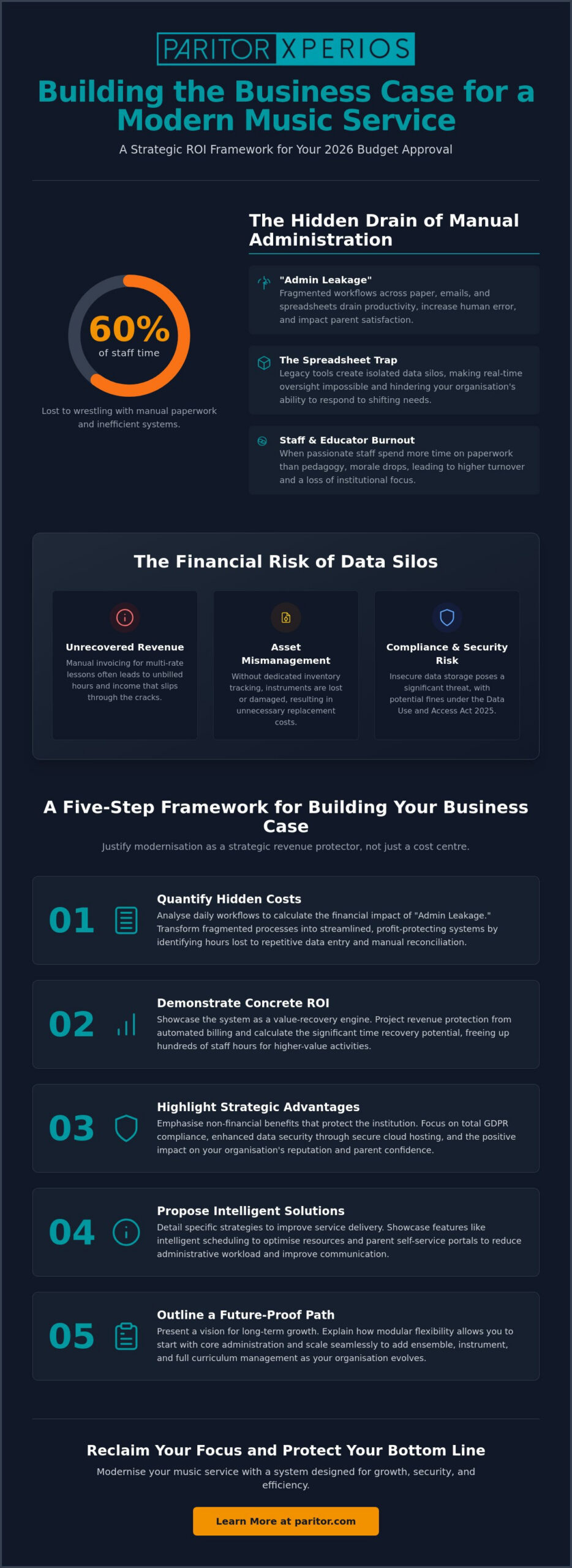
If your administrative staff are spending 60% of their working hours wrestling with manual paperwork, you aren’t just losing time; you’re actively draining your school’s growth potential. It is a frustrating reality for many leaders who find their creative mission sidelined by the weight of spreadsheets and scheduling conflicts. You likely already feel the strain of unbilled lessons or the quiet anxiety of keeping pace with the Data Use and Access Act 2025. Building a robust business case for music school management system adoption is no longer about simply “tidying up” the office. It is about reclaiming the professional focus your team deserves and protecting your bottom line.
We understand that justifying new technology to financial directors requires more than just a wish list. You need concrete evidence and a logical path forward. This 2026 ROI guide provides you with a structured framework to prove that modernisation is a strategic revenue protector rather than a mere cost centre. You will discover how to demonstrate evidence of significant time recovery and revenue protection. We will preview a future-proof path that allows your organisation to scale seamlessly whilst keeping student data secure and your reputation intact.
Key Takeaways
- Quantify the hidden costs of manual administration and learn how to transform fragmented workflows into streamlined, profit-protecting systems.
- Discover a structured five-step framework for building a compelling business case for music school management system adoption to secure 2026 budget approval.
- Identify specific strategies to recover hundreds of staff hours whilst improving service delivery through intelligent scheduling and parent self-service portals.
- Understand how to leverage real-time reporting and secure cloud hosting to ensure total GDPR compliance and institutional data security.
- Explore how modular flexibility allows you to start with core administration and scale to ensemble and instrument management as your organisation grows.
The Hidden Costs of Manual Administration in Music Services
Building a compelling business case for music school management system investment is no longer a luxury; it’s a necessity for the 2026 budget cycle. As we move into a period of increased regulatory scrutiny and rising operational costs, relying on legacy processes creates a vulnerability that music services simply cannot afford. A strategic justification isn’t just about software features. It’s about protecting the long-term viability of your educational mission by identifying where resources are being quietly wasted. In the current climate, every minute spent on manual data entry is a minute taken away from musical excellence.
Fragmented systems are the primary culprit. When your team has to jump between paper registers, personal emails, and disconnected spreadsheets, they aren’t just “busy.” They’re trapped in a cycle of “Admin Leakage” that drains productivity whilst exponentially increasing the risk of human error. The spreadsheet trap is particularly dangerous. These legacy tools were never designed to scale with a growing music service. They create isolated data silos where information is difficult to retrieve, making it impossible to get a clear, real-time view of your organisation’s health. This lack of transparency often results in missed opportunities for growth and a slow response to shifting student needs.
The emotional toll of these outdated systems shouldn’t be underestimated. Administrative burnout is a leading cause of teacher and staff turnover. When passionate educators spend more time on paperwork than on pedagogy, morale drops. A modern system restores focus to the creative mission, empowering your team to excel in their roles rather than being buried under repetitive burdens. By modernising, you aren’t just buying software; you’re investing in your people.
Quantifying “Admin Leakage” in Daily Workflows
Senior administrators often find themselves performing repetitive data entry tasks that should be automated. If a senior lead spends several hours each week manually reconciling registers, the annual cost of that single task is significant. This isn’t just a financial loss. Fragmented communication directly impacts parent satisfaction. When parents receive conflicting information about lesson times or billing, their confidence in the service wavers, which often leads to higher student drop-out rates. Admin leakage is the silent drain on music service profitability.
The Financial Risk of Data Silos
Data silos represent a significant financial liability. Manual invoicing often results in unrecovered revenue because unbilled lessons simply slip through the cracks. Beyond billing, asset mismanagement is a major concern. Without dedicated instrument inventory management software, tracking the location and condition of your fleet becomes a logistical nightmare, often resulting in lost equipment and unnecessary replacement costs. Crucially, in the broader music education software landscape, security is now a non-negotiable standard. With the phased implementation of the Data Use and Access Act 2025, the potential fines for insecure student data storage are a risk no music school should take.
Measuring the ROI of a Music School Management System
Establishing a business case for music school management system implementation requires a shift from viewing software as a cost to seeing it as a value-recovery engine. In 2026, the ROI of your administration isn’t just about what you spend; it’s about what you stop losing. By aligning your financial decisions with a proven System Strategy Return on Investment framework, you can demonstrate how every pound invested in automation protects your core mission. This strategic approach moves beyond surface-level savings, focusing instead on long-term institutional health and resource optimisation.
Revenue Growth through Automated Financial Management
Revenue leaks often occur at the intersection of attendance and invoicing. Manual systems struggle with multi-rate billing for private lessons, group sessions, and ensembles, which frequently leads to unbilled hours and unrecovered income. Automating these financial workflows ensures that every lesson taught is a lesson paid for, with zero manual intervention required. Online portals facilitate instant card payments, which dramatically reduces the payment cycle and improves cash flow for the organisation. Providing this level of financial transparency through a parent portal for music schools builds trust and reduces the time staff spend answering billing queries.
Time Recovery: Reallocating Staff to High-Value Tasks
Time is your most expensive resource. Moving from manual timetabling to automated ensemble management software eliminates the “scheduling tetris” that often plagues music services. The self-service revolution allows parents to update personal data and book sessions directly, shifting the administrative burden away from your central office. When your team is no longer tethered to repetitive data entry, they can focus on student mentoring and curriculum development. Ultimately, this recovered time translates into improved educational outcomes and a more vibrant learning environment.
Asset optimisation also plays a critical role in your return on investment. Digital tracking increases the yield of your instrument hire schemes by ensuring equipment is in the hands of students rather than sitting unrecorded in a store cupboard. Simultaneously, using CRM data to identify under-utilised classes allows you to target marketing efforts and expansion opportunities with surgical precision. Organisations looking to solidify their financial foundation often start by exploring Xperios Financial Management to eliminate invoicing errors and secure their revenue streams. By quantifying these gains, you can build an unshakeable business case for music school management system modernisation that resonates with every stakeholder.
Strategic Advantages: Reputation, Compliance, and Data
Whilst direct financial gains are essential, the business case for music school management system implementation extends far beyond the balance sheet. In 2026, the reputation of a music service is inextricably linked to its digital maturity and data integrity. Stakeholders, from local authority boards to parents, now expect a level of administrative transparency that manual systems simply cannot provide. Moving to a centralised platform transforms your data from a static record into a strategic asset. Real-time reporting allows you to justify funding and resource allocation with hard evidence, proving the impact of your programmes with a single click.
Scalability is perhaps the most overlooked strategic advantage. A modern system provides a robust foundation that supports organisational growth without requiring a proportional increase in administrative headcount. By decoupling expansion from office overhead, you create a sustainable model where resources stay focused on the classroom. This professionalisation of the “back office” elevates the perception of your brand, signalling to your community that you are a forward-thinking, reliable institution dedicated to excellence in every department.
GDPR Compliance as a Business Asset
Home-grown databases and fragmented spreadsheets are no longer just inefficient; they are a significant legal liability. In the current regulatory landscape, ensuring 100% GDPR adherence is a non-negotiable requirement for protecting your organisation’s reputation. Adopting an Xperios for Music Services solution provides the security of UK-based cloud hosting on Microsoft Azure. This infrastructure ensures that sensitive student information is stored according to the highest industry standards, providing a clean, transparent audit trail for any local authority or board inspections. Compliance shifts from being a source of anxiety to a badge of professional trust.
Enhanced Stakeholder Engagement
Professionalism is measured by the quality of the student journey. Providing real-time progress reports and dedicated digital portals creates a seamless experience that parents value and respect. This modern interface reduces the friction that often leads to student drop-out, fostering a deeper sense of connection to the music service. Teacher workflows also see a dramatic improvement. When instructors can record attendance or submit assessments through a streamlined interface, they feel empowered to focus on instructional quality rather than clerical tasks. Centralised, professional communication channels unify your team, building a stronger community whilst ensuring that your core educational mission remains the primary focus.
Building Your Business Case: A Five-Step Framework
Constructing a compelling business case for music school management system modernisation demands more than just a list of features. It requires a structured, evidence-based argument that resonates with every level of your organisation. Start by auditing your current workflows. You need to pinpoint the exact locations of “admin leakage” identified in earlier sections. Once you’ve mapped these pain points, define your strategic objectives. Are you looking to increase student numbers by 20% over five years, or is the priority reducing staff turnover by eliminating burnout? Aligning software capabilities with your long-term vision ensures the investment is seen as a growth engine rather than an overhead.
Successful mapping involves addressing the specific anxieties of finance, IT, and teaching staff. Finance directors require a clear Cost-Benefit Analysis that weighs the total cost of ownership (TCO) against projected savings from recovered time and protected revenue. IT teams need assurances regarding data migration and security protocols. Meanwhile, your teaching staff need to know how the system will simplify their daily lives. By presenting a unified front, you move the conversation from “can we afford this?” to “how can we afford to wait?” To help you navigate these discussions, you can request a tailored ROI assessment to see how these frameworks apply to your specific service.
Addressing Stakeholder Objections
Change management is the cornerstone of a smooth transition. Reassuring staff that the system is designed to support, not replace, their expertise is vital. Focus on long-term sustainability. Short-term savings from “free” or home-grown tools often lead to expensive failures later. Proving technical feasibility through robust integration and security strategies builds the professional trust necessary for board approval. This consultative approach ensures that the transition feels like a partnership rather than an imposition.
The Cost of Inaction (COI)
The risk of inaction is often higher than the risk of change. Legacy systems are prone to catastrophic data loss and lack the security updates required for 2026 compliance. Beyond safety, consider the missed opportunities. If your current administration is at capacity, you simply cannot launch new ensembles or outreach programmes. In the competitive landscape of UK music hubs, modernising is no longer an optional upgrade. It is a fundamental requirement for survival. Failing to adapt doesn’t just stall growth; it leaves your organisation vulnerable to more agile competitors and increasing regulatory demands.
Future-Proofing Your Music Service with Xperios
Choosing the right partner is the final, critical step in solidifying your business case for music school management system adoption. Xperios stands out as the strategic choice for UK music services, built on a foundation of 30 years of direct collaboration with the sector. This isn’t a generic administrative tool adapted for music; it’s a platform engineered from the ground up to handle the specific complexities of music tuition and ensemble coordination. By choosing a partner with a national footprint and deep domain expertise, you ensure that your modernisation efforts are supported by a team that speaks your language and understands your unique operational pressures.
Modular flexibility is at the heart of the Xperios philosophy. We recognise that every organisation is at a different stage of its digital journey. You can start by addressing your most urgent “admin leakage” areas with core administration and Financial Management, then scale your system as your requirements evolve. Whether you need to integrate Instrument Management to track your fleet or Ensemble Management to coordinate large-scale performances, the platform grows with you. This modular approach allows for a manageable transition that delivers immediate ROI whilst providing a clear roadmap for future expansion.
Reliability and trust are non-negotiable when handling sensitive student data and complex financial records. As a UK-based partner, we provide the stability and security that international, generic platforms often lack. The Paritor approach focuses on your long-term success through professional onboarding and structured data migration. We don’t just provide software; we facilitate a transformation. Our team works alongside you to ensure your legacy data is securely transitioned, allowing your staff to feel empowered and confident from day one.
Designed for the Nuances of Music Education
Music education involves logistical challenges that standard school management systems simply aren’t equipped to handle. Xperios excels at managing complex peripatetic timetables and multi-location logistics, ensuring that teachers and students are always in the right place at the right time. For organisations with a broader remit, we offer specialised modules for performing arts school administration. Our development roadmap is driven by continuous innovation and direct user feedback, ensuring the system remains at the forefront of educational technology.
Next Steps: Taking Action
The journey toward a more efficient, secure, and profitable music service begins with a single conversation. We recommend requesting a consultative demo to see exactly how Xperios can be mapped to your specific organisational structure. Our experts will help you develop a phased implementation timeline designed to minimise disruption to your teaching schedule. Don’t let administrative burdens continue to sideline your creative mission. You can organise a consultation with Paritor to begin your business case and take the first step towards a future-proof administration today.
Secure the Future of Your Music Service
Modernising your music service is about more than just operational efficiency; it’s about reclaiming the creative heart of your organisation. By quantifying “admin leakage” and identifying unrecovered revenue, you’ve already laid the groundwork for a robust business case for music school management system investment. You now have a structured framework to prove that moving away from legacy silos is a strategic necessity for 2026 and beyond. This transition isn’t just a technical upgrade. It’s a commitment to the long-term sustainability of your educational mission and a relief for your hard-working staff.
Xperios has been trusted by UK music services since 1993, providing a stable and secure platform hosted on Microsoft Azure. Our specialised modules for every aspect of arts administration ensure that you have the tools to scale with confidence whilst maintaining total data integrity. It’s time to eliminate the repetitive administrative burdens that drain your team’s energy and return your focus to the students and the music they create. We are ready to act as your industrious engine behind the scenes, allowing your expertise to take centre stage.
Start building your business case with an Xperios demo to see how our partnership can empower your organisation to excel.
Frequently Asked Questions
What is the most important factor in a music school management system business case?
The most critical factor in a business case for music school management system adoption is the clear quantification of “admin leakage” and its impact on your bottom line. By demonstrating how manual errors and fragmented workflows drain resources, you shift the narrative from a simple expense to a strategic investment. This focus allows you to present a compelling argument for revenue protection and long-term institutional stability to your financial directors.
How long does it typically take to see a return on investment (ROI)?
Whilst timelines vary based on organisational size, many services begin to see a measurable return on investment within the first full academic cycle. Initial gains are often found in recovered unbilled lessons and reduced staff overtime during peak scheduling periods. Over the longer term, the ROI compounds as increased student retention and streamlined instrument hire schemes contribute to a more sustainable financial foundation for the entire organisation.
Is cloud-based management software secure for sensitive student data?
Modern cloud-based platforms offer superior security compared to legacy local servers or home-grown databases that often lack consistent updates. Xperios utilises Microsoft Azure hosting to ensure that sensitive student information is protected by industry-leading encryption and redundancy protocols. This approach ensures total compliance with the Data Use and Access Act 2025, providing a secure, UK-based environment that safeguards your organisation’s reputation and student privacy at every level.
Can a management system integrate with existing local authority accounting tools?
Yes, a professional management system is designed to integrate seamlessly with standard local authority accounting and HR tools to ensure data consistency. Xperios Financial Management facilitates the export of clean, accurate data for reconciliation with broader institutional systems, reducing the need for manual dual-entry. This connectivity ensures that your music service remains a transparent and efficient department within the wider organisational structure, significantly simplifying audits and annual financial reporting.
How much time can administrative staff actually save with automation?
Automation can recover hundreds of staff hours annually by eliminating repetitive tasks like manual timetabling and attendance tracking. By shifting data entry and booking updates to a Parent Portal, your central office team can reduce their administrative load significantly. This recovered time allows staff to focus on high-value activities such as student recruitment and curriculum development, directly improving the educational quality and reach of your service.
What is the “cost of inaction” when delaying a software upgrade?
The “cost of inaction” includes the hidden expenses of unbilled revenue, the risk of regulatory fines for non-compliance, and the potential for catastrophic data loss in unmanaged legacy systems. Beyond financial risk, delaying an upgrade prevents your organisation from scaling to meet new demand. In a competitive landscape, failing to modernise means you are effectively paying a “legacy tax” in wasted productivity and missed growth opportunities.
Does the system support both private teachers and large music hubs?
The system is built with modular flexibility to support everyone from individual private teachers to large-scale music hubs and performing arts services. Whether you are managing a handful of pupils or a complex network of peripatetic staff and ensemble groups, the software scales to match your specific needs. This versatility ensures that as your organisation grows, your management infrastructure remains a stable and supportive foundation for your creative mission.
What happens to our legacy data during the transition to Xperios?
During the transition to Xperios, your legacy data undergoes a structured migration process managed by our professional onboarding team to ensure accuracy. We work closely with you to audit, clean, and securely transfer your existing records into the new system. This collaborative approach minimises disruption, allowing you to move from fragmented spreadsheets to a modern, centralised platform without losing your historical institutional knowledge or student records.