

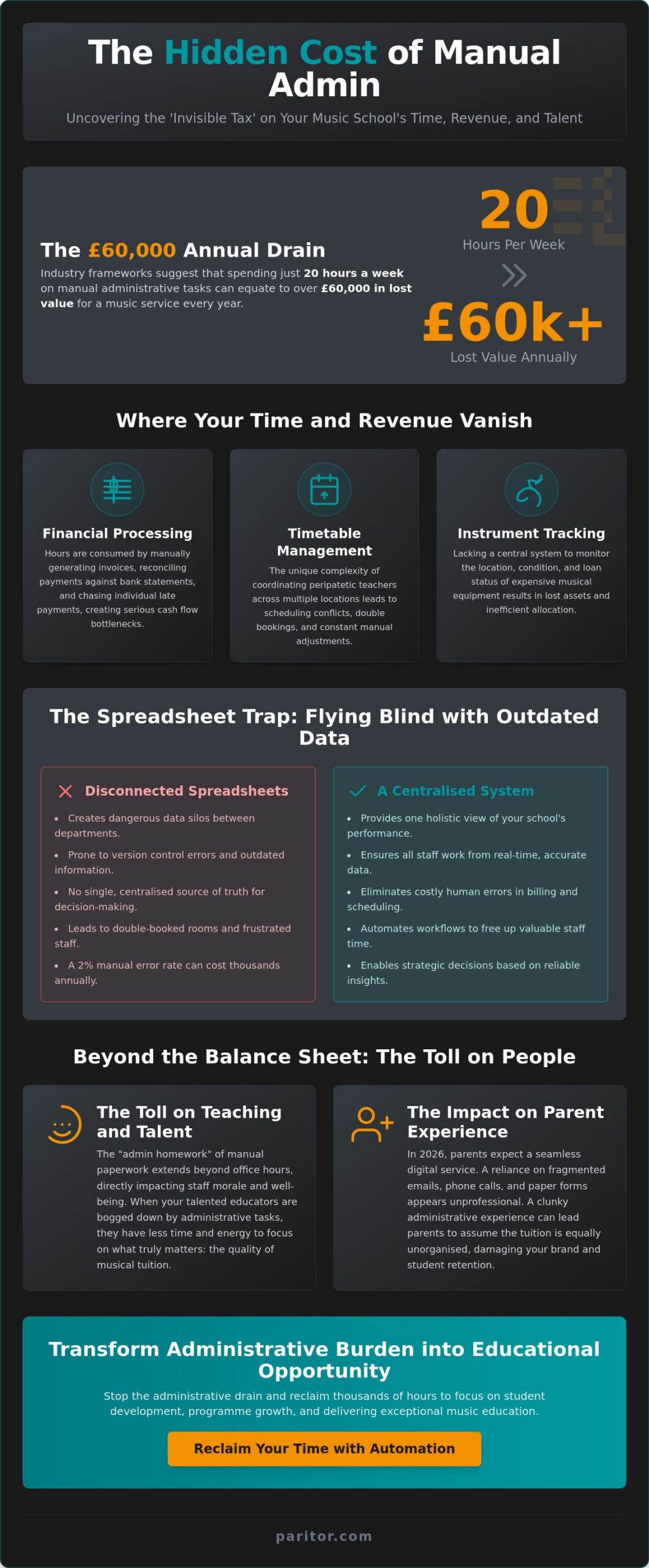
What if the most expensive asset in your music academy isn’t the concert grand piano, but the “invisible tax” of your daily paperwork? As we move through 2026, the true cost of manual admin in music schools has become impossible to ignore, especially when industry frameworks suggest that spending 20 hours a week on manual tasks can equate to over £60,000 in lost value every year. You likely feel this weight every time you’re forced to manually adjust a peripatetic teacher’s timetable or spend your evening chasing a late payment that should’ve been automated weeks ago. It’s a taxing cycle that pulls you away from the rehearsal room and into a maze of spreadsheets and invoicing errors.
We understand that you started your school to foster talent, not to become a full-time debt collector or instrument clerk. This analysis will help you discover the genuine financial and operational impact of manual paperwork whilst providing a roadmap to reclaim your time for music education. We’ll examine the tangible ROI of automation, the reality of reducing teacher burnout, and how a professionalised digital presence can transform your communication with parents. It is time to stop the administrative drain and return your focus to the music.
Key Takeaways
- Identify the specific bottlenecks created by disconnected spreadsheets and the complex scheduling requirements of peripatetic teachers.
- Calculate the true cost of manual admin in music schools by uncovering hidden expenses related to invoicing errors and manual payment reconciliation.
- Recognise the psychological toll of “admin homework” on your staff and how it directly impacts the quality of core musical tuition.
- Implement a practical step-by-step time audit framework to pinpoint exactly where your administrative team is losing valuable hours over a typical fortnight.
- Explore how automating your processes with Xperios for Music Services can enhance your professional image whilst reclaiming time for student development.
The Invisible Drain: Identifying Manual Admin Bottlenecks in 2026
Manual administration is more than just a stack of paper on a desk. It is a systemic reliance on disconnected spreadsheets, physical registers, and fragmented email chains that creates a constant friction in your daily operations. This administrative burden acts as an invisible tax on your resources. In 2026, the true cost of manual admin in music schools is measured in more than just lost hours; it is seen in the missed opportunities for growth and the slow erosion of staff morale. When your team is trapped in a cycle of data entry, they cannot focus on the high-value tasks that actually move your academy forward.
Music education providers are uniquely susceptible to these bottlenecks. Unlike traditional classroom settings, music schools must manage the complex, shifting schedules of peripatetic teachers who often move between multiple locations. This creates three primary “leak points” where your revenue and time simply vanish:
- Financial processing: Manually reconciling payments and generating hundreds of individual invoices.
- Timetable management: Coordinating lesson changes and teacher absences across different sites.
- Instrument tracking: Monitoring the location, condition, and loan status of expensive equipment.
The context has changed. By 2026, parents expect a seamless digital experience. They want real-time interaction and instant updates, not a tattered paper form tucked into a violin case. If your school still relies on manual processes, you aren’t just losing time; you’re falling behind the modern standard of service.
The Spreadsheet Trap: Why Excel Isn’t a Management System
Excel is a fantastic tool for basic calculations, but it was never designed to be a school management system. For multi-location music services, spreadsheets create dangerous data silos. One administrator might update a teacher’s availability on a local file, whilst another sends out a conflicting timetable based on an older version. These version control errors lead to double-booked rooms and frustrated staff. Without a single, centralised source of truth, it is impossible to gain a holistic view of your school’s performance or financial health. You are essentially flying blind, making strategic decisions based on fragmented and potentially outdated data.
Fragmented Communication and the Parent Experience
Chasing information through phone calls and manual email threads is an expensive way to run a business. The cumulative cost of manual admin in music schools becomes evident when you tally the hours spent answering basic questions about lesson times or payment status. Contrast this friction with the clarity of a parent portal for music schools. When parents can access their own schedules and billing history, your office phone stops ringing with avoidable queries. Professional, automated communication protects your brand reputation and directly improves student retention. If the administrative experience is clunky, parents may assume the tuition is equally unorganised, regardless of the quality of your teachers.
Quantifying the Financial Impact: Labour, Errors, and Lost Revenue
The cost of manual admin in music schools is often dismissed as a necessary part of doing business, yet the financial reality is far more damaging. When you move beyond the surface, you find a significant portion of your budget is being consumed by inefficient labour. Manual invoicing is a prime example. It isn’t just about generating a document; it’s the hours spent on payment reconciliation, cross-referencing bank statements, and updating student records. For a mid-sized school, this process can easily occupy a staff member for several days each month. This is time that could be spent on revenue-generating activities like student recruitment or programme development.
Human error introduces a secondary, more insidious cost. Manual data entry is prone to mistakes that lead to under-billing or, worse, missed lessons that are never invoiced at all. Even a conservative 2% error rate across a large student base can result in thousands of pounds in lost revenue annually. Furthermore, the friction of manual debt collection creates a cash flow bottleneck. Chasing late payments through individual emails and phone calls is uncomfortable for staff and creates a negative experience for parents. It’s a reactive cycle that keeps your school’s finances in a state of constant catch-up.
The opportunity cost is perhaps the most significant factor. When your senior administrators or department heads are bogged down in data entry, they’re unable to focus on high-level strategy. You’re essentially paying senior salaries for clerical tasks. Reclaiming this time allows your leadership team to focus on the educational mission and the long-term growth of the academy. To see how professional tools can bridge this gap, you might consider how Xperios Financial Management streamlines these exact processes.
Calculating Labour Hours in Manual Scheduling
Scheduling is the heartbeat of a music school, but it’s also a major labour drain. Staff often spend hours each week trying to manage peripatetic teacher timetables across various locations. When a teacher falls ill or a pupil requests a last-minute change, the manual effort required to notify all parties and reschedule the session is immense. Cloud-based automation replaces these frantic phone calls with instant, system-wide updates, ensuring that teachers and parents are always aligned without administrative intervention.
The Financial Leakage of Instrument Management
Instruments represent a massive capital investment, yet many schools lack a robust way to track them. Without instrument inventory management software, items frequently go missing or are left in a state of disrepair. Manual systems often miss scheduled maintenance cycles, leading to higher long-term costs when an instrument eventually requires a major overhaul or replacement. Real-time tracking ensures every asset is accounted for and maintained, protecting your school’s physical assets and its bottom line.
Beyond the Balance Sheet: The Toll on Teaching and Talent
While the financial figures discussed previously are stark, the human impact is often more difficult to recover from. The cost of manual admin in music schools extends directly into the teaching studio, where every minute spent fumbling with a paper register is a minute lost to musical instruction. Teachers are artists and educators first. When their primary interaction with management involves correcting errors in manual timesheets or deciphering handwritten attendance logs, their professional satisfaction plummets. This administrative friction creates a barrier between the teacher and the student, turning a passion-led vocation into a clerical chore.
In the 2026 recruitment market, talented educators have more choices than ever. They’re drawn to institutions that respect their time and provide the tools necessary to excel. A school that relies on manual paperwork projects an image of being stuck in the past, which can lead to a loss of respect from staff and parents alike. When the back-office is disorganised, it creates a chaotic environment that stifles creativity. Reclaiming this time through automation doesn’t just save money; it restores the educational heart of your organisation.
Teacher Burnout and the Administrative Burden
Peripatetic teachers often work across multiple sites, making the task of updating attendance a logistical nightmare if handled manually. Expecting staff to complete “admin homework” at the end of a long day of tuition is a recipe for resentment. Digital portals empower teachers by allowing them to record attendance and lesson notes instantly on any device, ensuring they leave their work at the school gates. Admin fatigue in music education is the silent erosion of professional enthusiasm caused by excessive, repetitive paperwork that ultimately drives talented staff toward more organised competitors. Providing a streamlined experience is a vital strategy for staff retention.
Student Progress and Real-Time Reporting
A disorganised back-office inevitably filters down to the student experience. Manual end-of-term reports are often retrospective and lack the immediacy required to sustain a young musician’s momentum. By contrast, real-time digital progress tracking provides instant feedback that keeps students engaged between lessons. When a system sends automated alerts for upcoming exams and assessments, it removes the stress of manual tracking for the teacher whilst providing clear milestones for the pupil. This data-driven approach allows for more personalised learning pathways, ensuring every student receives the specific support they need to excel. A school that manages its admin effectively creates a professional atmosphere where the focus remains entirely on the music.
The Path to Efficiency: Auditing Your Administrative Workflows
Before you can eliminate waste, you must see it clearly. A methodical audit is the only way to reveal the true cost of manual admin in music schools. We recommend that your administrative team performs a detailed time audit over a typical two-week period. During this fortnight, every staff member should record the time spent on repetitive tasks like manual invoicing, rescheduling, and data entry. You’ll likely be surprised by the cumulative hours lost to processes that could be handled in seconds by a centralised system. This audit isn’t about monitoring staff performance; it’s about identifying the institutional roadblocks that prevent your team from doing their best work.
Step 1: Mapping the Student Journey
Mapping the student journey is a vital part of this process. Trace every manual touchpoint from the moment a parent makes an initial enquiry to the student’s first lesson. It’s common to find “redundant data entry” where the same student information is typed into three or four different systems. This duplication doesn’t just waste time; it increases the risk of transcription errors that lead to billing disputes. Adopting a unified music service management software eliminates these silos, ensuring that data is entered once and updated everywhere instantly.
Step 2: Assessing Data Security and Compliance
Data security and compliance are no longer optional extras. In 2026, the potential fines and reputational damage of a GDPR breach are too significant to ignore. Paper-based student records and unencrypted spreadsheets are major liabilities. If a physical register is lost or a spreadsheet is accidentally shared, your school faces a serious regulatory crisis. Moving your operations to a secure platform hosted on Microsoft Azure is a strategic necessity. It provides the data redundancy and encryption levels required to keep sensitive student information safe whilst ensuring you remain fully compliant with modern standards. Protecting your data is just as important as protecting your instruments.
Ready to transform your operations? Learn how our management tools can modernise your academy.
Xperios: Transforming Administrative Burden into Educational Opportunity
Xperios stands as the industry standard for modern UK music and performing arts services. It isn’t just a software suite; it’s a dedicated ally built to eliminate the exhausting repetition of daily paperwork. By automating the “leak points” identified in our audit, Xperios directly counters the financial and emotional cost of manual admin in music schools. Whether you’re managing a small private studio or a large regional hub, our platform scales to your specific needs. It’s a modular system, allowing you to deploy Xperios Financial Management for billing or Xperios Instrument Management for your inventory as your organisation grows.
This isn’t technology built in a vacuum. Xperios is the result of 30 years of direct collaboration with music educators and administrators. We’ve listened to the frustrations of peripatetic teachers and the anxieties of school managers to build a tool that feels intuitive and supportive. It’s an industrious engine that works behind the scenes, ensuring that your data remains secure whilst providing the clarity you need to lead effectively. By choosing a system built on user insights rather than developer assumptions, you’re entering a partnership that values your mission as much as you do.
The Xperios Advantage for Music Hubs and Schools
Scalability is central to our philosophy. Our cloud-based platform supports organisations of all sizes, providing a stable foundation for growth and contemporary relevance. Secure portals are the primary drivers of efficiency here. With the Xperios Teacher Portal, staff can update registers in real-time, whilst the Xperios Parent Portal gives families instant access to schedules and billing history. These tools don’t just save time; they professionalise your image and improve student retention. For many providers, upgrading your music school system is the single most impactful strategic investment you can make in 2026.
Reclaiming the Mission: More Music, Less Admin
Our core promise remains simple: the software performs the labour-intensive tasks so you can return to the music. We want to help you shift your focus from spreadsheets to student achievement. By removing the administrative friction, we empower your teachers and inspire your pupils. The future of music service management in the UK is digital, secure, and person-centric. It is a future where your expertise is spent on pedagogy and performance, not on data entry.
Don’t let manual paperwork hold your academy back. Contact us today for a consultative demo or a full administrative site audit to see how much time your school could reclaim. Let’s work together to put music education back at the centre of your mission.
Modernise Your Academy for the Future
The evidence is clear: the cost of manual admin in music schools is a burden that no modern academy can afford to carry. We’ve explored how manual bottlenecks drain your finances, exhaust your teaching talent, and expose your organisation to unnecessary compliance risks. It’s time to move beyond the spreadsheet trap and embrace a system that scales with your ambition. By automating these labour-intensive tasks, you don’t just save money; you restore the creative energy that defines your school.
With over 30 years of experience supporting UK music services, Xperios is the trusted choice for leading conservatoires and national music hubs. Our platform is built on Microsoft Azure to provide enterprise-level security and total GDPR compliance for your sensitive data. We’re here to act as your industrious engine behind the scenes, ensuring your operations run with seamless precision. Book a discovery call to see how Xperios can reduce your administrative costs. Let’s work together to put the focus back where it belongs: on the music and the students who make it.
Frequently Asked Questions
How much time can a music school save by automating admin?
Most schools find they can reclaim up to 75% of their administrative hours by removing repetitive tasks. Automation handles instant timetable updates and recurring billing cycles that previously took days to process manually. By eliminating the need for constant data entry, your team can shift their focus toward student recruitment and enhancing the quality of your educational programmes.
Is music school management software worth the investment for a small studio?
Investing in software is vital for small studios because the cost of manual admin in music schools is often higher relative to their total revenue. Establishing a digital foundation early prevents the future pain of complex data migration as you grow. It also ensures you project a professional image from day one, helping you compete with larger academies whilst keeping your overheads manageable.
How does manual administration affect GDPR compliance in schools?
Manual systems like paper registers and unencrypted spreadsheets represent significant security risks that often lead to accidental data breaches. In 2026, regulatory standards require the robust encryption and data redundancy that only cloud-based platforms can provide. Moving your records to a secure system ensures that sensitive student and parent information is protected by enterprise-level protocols, significantly reducing your institutional liability.
Can software really help with peripatetic teacher scheduling?
Software is specifically engineered to manage the multi-site complexities of peripatetic teaching. It synchronises teacher availability, room bookings, and student absences into a single source of truth. When a change occurs, the system instantly notifies all relevant parties, which eliminates the need for frantic phone calls or fragmented email chains. This creates a more stable and professional working environment for your staff.
What are the most common errors in manual music school invoicing?
The most frequent mistakes include double-billing for sessions, failing to invoice for additional lessons, and simple transcription errors from handwritten notes. These errors lead to direct revenue loss and can quickly damage parent trust. Automation ensures that every lesson recorded on a digital register is accurately pulled through to the final invoice, guaranteeing that you’re paid correctly for every minute of tuition.
How do parents benefit from a digital music school portal?
Parents enjoy 24/7 access to lesson schedules, attendance history, and billing records through a dedicated portal. They don’t have to wait for office hours to check a lesson time or settle an invoice. This transparency reduces communication friction and makes it much easier for families to manage their child’s musical journey alongside their busy daily lives, improving overall student retention.
What is the “opportunity cost” of manual administration?
Opportunity cost is the valuable strategic work that remains ignored whilst your senior staff are bogged down with clerical data entry. Instead of developing new ensembles or securing vital grant funding, your leadership team is trapped in paperwork. Reclaiming this time allows you to focus on high-level growth activities that increase the long-term value and educational impact of your music school.
How difficult is it to migrate from spreadsheets to Xperios?
Migration is a structured, consultative process designed to be as seamless as possible. Our team works closely with you to map your existing spreadsheet data directly into the Xperios system. Because the software is built on collaborative user input, the interface feels familiar to music industry professionals. We provide the technical support and training necessary to ensure your transition is a moment of relief.