

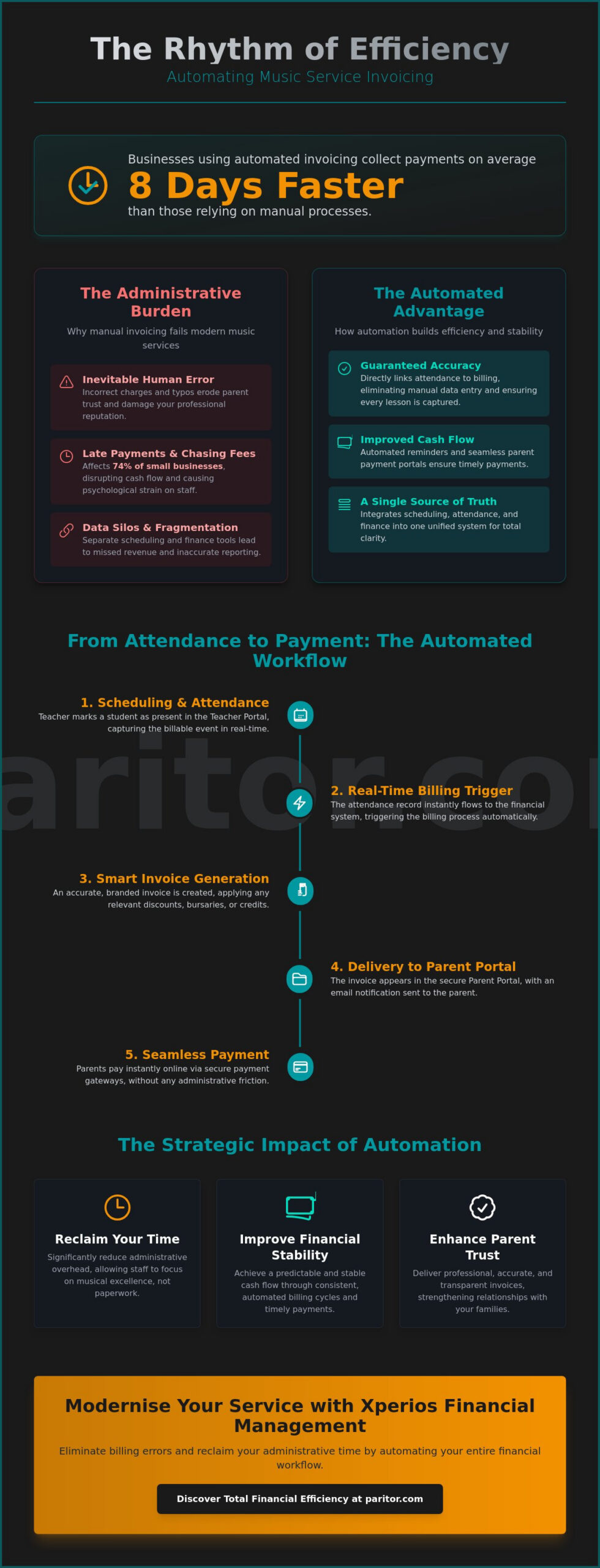
Did you know that small businesses using automated invoicing collect payments an average of eight days faster than those relying on manual processes? For music services, where the gap between a lesson taught and a payment received often feels like a chasm, this efficiency is transformative. You likely spent your week managing complex ensemble schedules and student attendance, only to face a weekend of manual data entry and chasing late fees from parents. It’s a taxing cycle that pulls you away from your primary mission. Adopting music service invoicing automation isn’t just about modernising your office; it’s about reclaiming the hours you lose to repetitive administrative labour.
We know how exhausting it is to chase payments whilst trying to maintain positive relationships with parents and teachers. This guide will show you exactly how to eliminate manual billing errors and reclaim your administrative time by automating your entire financial workflow. We will explore the integration of attendance tracking, the power of automated reminders, and the specific software modules that ensure your music service operates with total financial efficiency in 2026.
Key Takeaways
- Learn how to synchronise teacher timetables with real-time billing triggers to ensure every lesson is accurately captured and billed.
- Discover how to manage complex fee structures, including sibling discounts and bursaries, through customisable templates that reflect your organisation’s branding.
- Understand how music service invoicing automation eliminates the fragmentation between scheduling and finance to significantly reduce administrative overhead.
- Identify the strategic impact of automated reminders and seamless payment portals on your service’s overall cash flow and financial stability.
- Explore why a modular, cloud-based approach to financial management is essential for modernising your service whilst maintaining data security.
The Administrative Burden: Why Manual Invoicing Fails Modern Music Services
Manual billing is an invisible anchor. For many large-scale music services, the sheer volume of data entry required to sustain operations is staggering. Every individual lesson, instrument hire, and ensemble session must be recorded with total precision. When this process relies on manual input, errors are inevitable. These mistakes aren’t just minor administrative hiccups; they directly erode parent trust. If a parent receives an incorrect invoice for a lesson their child missed or is overcharged due to a typo, it creates immediate friction and damages your professional reputation.
Spreadsheets often create a “fragmentation problem” amongst teaching staff. Whilst a single spreadsheet might work for a solo tutor, it fails the complexity of a multi-site music hub. This decentralised approach makes it impossible to maintain a single source of truth. As your service scales, the time required for traditional invoice processing balloons. You often find yourself needing more administrative staff just to keep up with the paperwork, rather than investing in musical excellence. This is where music service invoicing automation becomes a necessity rather than a luxury.
The High Cost of Late Payments and Chasing Fees
Late payments are a persistent thorn in the side of educational providers. Research indicates that late payments affect 74% of small businesses, often leaving significant sums in outstanding receivables. Chasing these fees carries a heavy psychological toll on administrative teams. It’s draining to spend hours on the phone or drafting emails to parents who have simply forgotten a deadline. These inconsistent billing cycles disrupt your organisational cash flow, making it difficult to plan for future growth or instrument procurement. Automation replaces these awkward conversations with polite, scheduled reminders that work silently in the background.
Data Silos: The Enemy of Financial Clarity
When scheduling and invoicing tools live in separate silos, revenue simply disappears. A lesson marked as “attended” on a teacher’s register might never make it to the final bill if the data has to be manually transferred. These gaps in communication lead to missed revenue that could have been reinvested into your students. Generating accurate financial reports across multiple sites becomes a Herculean task when data is scattered across different platforms. Music service invoicing automation bridges this gap. It ensures that every minute of tuition is accounted for and billed correctly, maintaining total consistency in tuition fees across your entire teaching faculty.
How Music Service Invoicing Automation Works: From Attendance to Payment
The journey from a single violin lesson to a cleared payment shouldn’t be a manual marathon. It begins with the schedule. By synchronising teacher timetables with real-time billing triggers, the system removes the administrative guesswork. When a teacher marks a student as present, that data flows instantly into the financial system. It’s the essence of music service invoicing automation. It transforms attendance records into financial assets without requiring a single keystroke from your office team.
Digital invoices are delivered straight to the Xperios Parent Portal. They don’t get lost in school bags or buried in email spam. Instead, they sit in a professional, branded environment where parents can settle fees immediately via secure payment gateways. Once a payment is made, the system closes the loop. It issues an automated receipt, updates the student’s balance, and reconciles the transaction. Your ledger remains accurate. Your team is freed from the burden of manual reconciliation.
The Trifecta: Scheduling, Attendance, and Billing
Success lies in the connection. Xperios links the Xperios Teacher Portal directly to Xperios Financial Management. This link ensures that every change on the ground is reflected in the books. If a student is absent, the system handles make-up lessons or credits based on your specific rules. It’s vital for eliminating the traditional “end-of-term rush” by supporting rolling billing cycles. This approach spreads the administrative workload across the year. It provides a more stable and predictable cash flow for your organisation.
Secure Cloud Infrastructure and GDPR Compliance
Security is the foundation of professional trust. Hosting financial data on Microsoft Azure provides the robust infrastructure and data redundancy required by UK educational bodies. This setup ensures that your service meets the most stringent data protection standards and remains fully GDPR compliant. Every transaction and student record is protected by professional-grade encryption. It’s protected from unauthorised access, ensuring that sensitive information is never compromised. You can learn more about how this integrates with wider music service management software to protect your data whilst improving efficiency.
Essential Features of an Automated Financial Management System
Choosing a financial system requires looking beyond simple digital receipts. Large-scale organisations like Music Hubs and Local Authorities face complexities that basic studio software simply can’t handle. High-quality music service invoicing automation must accommodate the intricate reality of public-sector and multi-site music education. This includes everything from customisable billing templates that carry your official branding to sophisticated logic for sibling discounts and bursaries. When your system automatically calculates a 10% discount for a second child or applies a low-income subsidy, it removes hours of manual verification and potential for human error.
Integration is the cornerstone of true efficiency. For many services, instrument hire is a major revenue stream and a significant administrative challenge. By using integrated instrument inventory management software, you can link hire fees directly to a student’s account. This ensures that whilst a student has a cello on loan, the monthly hire fee is automatically added to their invoice. There’s no need for separate spreadsheets or manual cross-referencing between the store cupboard and the finance office. It’s a seamless link that protects your assets and your income.
Managing Complex Ensemble and Group Fees
Music Hubs thrive on ensembles, but billing for them is often a headache. Your system should automate termly charges for choirs, orchestras, and bands with ease. It needs to handle tiered pricing structures, where a student might pay a different rate for a second ensemble, and manage one-off fees for events or exam registrations. Automating these triggers means your finance team can focus on long-term strategy rather than chasing individual exam fees. Supporting automated Direct Debit and recurring payment options further stabilises your income, ensuring that payments arrive on schedule without manual intervention.
Parent Self-Service via Secure Portals
Transparency reduces the volume of administrative enquiries. Providing a dedicated parent portal for music schools allows families to take control of their own financial data. Parents can view their full payment history, download past invoices, and update their payment methods in real-time. This self-service model provides immediate clarity, which is essential for maintaining trust. By providing a secure, central hub for all financial interactions, you empower parents whilst simultaneously reducing the workload on your office staff. It’s a professional step forward that modernises the entire service experience and reinforces your role as an expert facilitator.
The Strategic Impact: Reclaiming Time and Improving Cash Flow
The transition to music service invoicing automation is more than a technical upgrade. It’s a strategic pivot that shifts your team’s focus from paperwork to progress. By removing the manual bottlenecks that typically clog the finance office, your organisation can scale student numbers without a corresponding increase in administrative headcount. This efficiency is vital for hubs looking to expand their reach whilst keeping overheads lean. When the system handles the heavy lifting, your staff are finally free to prioritise educational excellence and student engagement.
Financial stability follows when processes are streamlined. Research indicates that small businesses using automated invoicing collect payments an average of eight days faster than those stuck with manual workflows. For a music service, this acceleration isn’t just a statistic. It represents a significant improvement in liquidity, allowing for more agile decisions regarding instrument repairs, staff training, or new ensemble initiatives. Professional, timely communication also improves the “parent experience.” Parents appreciate the clarity of a predictable billing cycle, which reduces the friction often associated with fee collection.
Enhanced Financial Reporting and Forecasting
Predictability is the bedrock of a stable service. Real-time data allows you to forecast termly revenue with surgical precision. Instead of waiting until the end of a term to see where you stand, you can identify trends in late payments amongst specific groups and take proactive measures before they impact your bottom line. When it’s time for an annual review, you can generate audit-ready reports for local authorities or boards at the click of a button. This level of transparency builds institutional trust and ensures your financial data is always reliable and redundant.
Modernising the Perception of Your Service
Professionalism builds confidence amongst all stakeholders. When a parent receives a clear, well-branded invoice on time, every time, it reinforces the high quality of the musical tuition you provide. It positions your hub as a forward-thinking, efficient organisation that respects their time and investment. Aligning your administrative standards with your musical excellence ensures that stakeholders see a unified, professional front. This modern approach doesn’t just save time; it elevates the reputation of your entire service within the community. You can begin this transformation by exploring how to optimise your financial workflows with dedicated software.
Modernising Your Service with Xperios Financial Management
Xperios Financial Management is the established cloud management standard for UK music services. It’s not just a tool; it’s a dedicated ally built to handle the heavy lifting of administrative labour. By adopting a modular approach to music service management software, your organisation can select the specific components it needs without being weighed down by unnecessary complexity. This philosophy of simplicity ensures that your team stays focused on their primary creative and educational mission whilst the software serves as the industrious engine behind the scenes.
Our platform was developed through direct collaboration with industry professionals who understand the specific frustrations of multi-site management. This user-centric approach means that every feature, from attendance tracking to automated billing, is grounded in real-world insights rather than developer assumptions. Transitioning from legacy financial systems or fragmented spreadsheets shouldn’t be a daunting prospect. We prioritise seamless onboarding and data migration, ensuring that your move to music service invoicing automation is smooth and secure. You aren’t just buying software; you’re entering a partnership with a team that values your professional journey.
Tailored Solutions for Every Scale
Scalability is at the heart of our design. We provide tailored solutions that grow with you, whether you’re using Xperios for Private Teachers or managing a national conservatoire. You can customise workflows to match your specific organisational needs, from unique fee structures to complex bursary applications. Our reliable UK-based support team is always on hand to assist, and we provide continuous software updates to ensure you stay ahead of regulatory changes and technological shifts. This stability provides a foundation of professional trust that allows your service to excel.
Ready to Transform Your Administration?
The journey from manual chaos to automated clarity is a fundamental step in modernising your organisation. We’ve seen how removing the burden of manual data entry empowers staff and improves the overall parent experience. By synchronising your financial workflow, you reclaim the time needed to focus on what truly matters: the students. Adopting this platform is a necessary step forward for any forward-thinking music service. It’s time to replace the repetitive strain of paperwork with the efficiency of a system built specifically for you. Book a discovery call to see Xperios in action and discover how music service invoicing automation can secure your financial future.
Securing the Future of Your Music Service
The administrative landscape is shifting towards total integration. By bridging the gap between teacher registers and the finance office, you eliminate the data silos that lead to missed revenue and manual errors. We’ve explored how music service invoicing automation transforms your workflow, allowing you to scale your organisation whilst protecting your team’s time. This shift doesn’t just improve your bottom line; it elevates your professional reputation amongst parents and stakeholders. It’s about restoring focus to your primary mission of musical excellence.
Since 1993, we’ve partnered with UK Music Hubs to build tools that solve real-world administrative burdens. Our platform is designed in collaboration with music educators and securely hosted on Microsoft Azure, providing the reliability and institutional safety your service requires. It’s time to transition away from the repetitive strain of spreadsheets and embrace a future of financial clarity and operational ease. We pride ourselves on being the engine behind the scenes that allows your educators to truly shine.
Empower your music service with Xperios automation and reclaim the focus you need to deliver exceptional musical tuition. We’re here to facilitate your progress and support your professional journey every step of the way.
Frequently Asked Questions
How does music service invoicing automation handle sibling discounts?
The system applies pre-set logic to identify students linked to the same primary contact or address. Once these links are established, the software automatically calculates the correct percentage or fixed-rate reduction for second or third siblings. This removes the need for manual verification and ensures every family receives the correct discount on their termly invoice.
Can I integrate automated invoicing with my existing accounting software?
Yes, Xperios Financial Management is designed to export data in formats that are compatible with major institutional accounting platforms. This ensures your specialised music billing data flows seamlessly into your wider organisational accounts. It maintains a single source of truth whilst allowing you to utilise the specific financial tools required for music education.
Is it possible to automate billing for instrument hire and repairs?
Absolutely, as recurring hire fees can be linked directly to a student’s profile via the instrument management module. When an instrument is assigned to a pupil, the recurring charge is automatically triggered in the next billing cycle. One-off repair costs can also be added easily, ensuring all financial interactions are captured in a single, professional document.
How secure is the parent financial data stored within the system?
Security is a foundation of the platform, with all data hosted on Microsoft Azure’s robust cloud infrastructure. This setup provides professional-grade encryption and data redundancy, ensuring your organisation meets the strict GDPR standards required for UK schools. Parent payment details are handled through secure gateways, so sensitive information is never stored directly on local servers.
Can the software handle different billing cycles for different ensembles?
Yes, you can set bespoke billing triggers for individual choirs, orchestras, or bands. This flexibility allows you to manage termly fees for some groups whilst using monthly or rolling cycles for others. It ensures that music service invoicing automation adapts to your specific organisational structure rather than forcing you into a rigid, one-size-fits-all process.
Will automating our invoicing reduce the number of late payments?
Evidence shows that businesses using automation collect payments an average of eight days faster. By providing automated reminders and a convenient parent portal, you remove the friction that often leads to delays. Parents find it much easier to pay when they receive clear, timely invoices with direct links to secure payment methods, which significantly stabilises your cash flow.
Does the system support Direct Debit for recurring tuition fees?
Yes, the platform supports automated Direct Debit and recurring card payment options. This is a vital feature of music service invoicing automation that ensures regular income without requiring manual action from parents each month. It provides a more predictable financial outlook for your service and reduces the administrative burden of chasing individual payments.
How much time can our administrative team expect to save?
Whilst savings vary based on the scale of your operation, automation can reclaim the vast majority of the hours traditionally lost to manual data entry. Some industry professionals report that administrative tasks can take up 20% of their week when handled manually. By eliminating repetitive tasks and manual reconciliation, your team can redirect their energy toward student recruitment and educational excellence.