

It’s 8:30 AM on a Monday morning, and a last-minute school assembly has just cancelled three instrumental lessons, forcing you into a frantic game of “spreadsheet Tetris” to avoid a total scheduling collapse. If you’re like most music service leads, you’ve spent far too many hours manually shifting lesson slots to accommodate rotations or fielding calls from frustrated parents clutching outdated paper schedules. You likely agree that managing peripatetic teacher timetables shouldn’t feel like a constant battle against the clock. It’s a repetitive, taxing burden that pulls you away from your primary mission of delivering high-quality music education.
This guide promises to change that by showing you how to eliminate scheduling conflicts and reclaim your administrative time through a modern, cloud-based approach. You’ll discover how to implement a fully automated system that handles complex rotations whilst providing real-time portal access for parents and staff. We will explore how to transition from manual spreadsheets to a strategic ecosystem that prioritises safeguarding under the latest KCSIE 2026 guidance and boosts operational efficiency, allowing your service to scale with confidence.
Key Takeaways
- Understand the logistical mechanics of the ‘Rotation Problem’ and how to maintain academic fairness across multiple school sites.
- Learn a five-step strategic framework for managing peripatetic teacher timetables that centralises data and respects complex school constraints.
- Identify the ‘Hidden Admin Tax’ of manual scheduling and discover how automated systems can drastically reduce your weekly administrative overhead.
- Strengthen your safeguarding procedures for 2026 by utilising real-time portals to track student and teacher locations instantly.
- Discover how a modular, cloud-based ecosystem like Xperios integrates scheduling, financial management, and instrument tracking into one seamless operation.
The Complexity of Managing Peripatetic Teacher Timetables in 2026
Managing peripatetic teacher timetables isn’t merely an administrative task; it’s a high-stakes logistical challenge that requires balancing the needs of schools, parents, and students across dozens of locations. A Peripatetic Teacher often visits multiple sites in a single day. This means your schedule must account for travel time, site-specific room constraints, and the varying term dates of different academies. The “Rotation Problem” adds another layer of difficulty. To ensure students don’t miss the same core academic lesson every week, music services must shift lesson times constantly. Whilst this is essential for academic fairness, it creates a massive manual workload that is prone to human error.
The friction usually happens in the communication gap between the central music service, the school office, and the parent. When a schedule exists only on a static document, a change made at 9:00 AM might not reach the school office until it’s too late. This leads to genuine safeguarding risks where pupils aren’t where they’re expected to be. It also results in missed billing opportunities when lessons are forgotten and eventually leads to total administrative burnout for your coordinator team.
Why Traditional Spreadsheets Are Failing Music Services
Excel files are inherently static. Once you email a spreadsheet, you lose all version control. Teachers might be working from “Version 2” whilst the school office is looking at “Version 4.” When managing peripatetic teacher timetables via spreadsheets, you also struggle to account for the physical reality of a teacher’s day. Static grids don’t calculate the drive time between Primary A and Secondary B, often leading to late arrivals. Most importantly, manual sheets don’t link to your finance system. If a teacher marks an absence on a paper sheet, that information rarely triggers an automatic billing adjustment, causing significant revenue leakage.
The Shift Towards Cloud-Based Management
Modern services are moving towards a single “source of truth” for all scheduling data. A cloud-based system ensures that when a coordinator moves a lesson, the change is instantly visible on the teacher’s phone and the parent’s portal. This accessibility is vital for staff who are constantly on the move between different school sites. By providing real-time updates, you drastically reduce the volume of administrative enquiries and “where is my teacher” phone calls. This shift allows your service to prioritise its educational mission over repetitive paperwork, ensuring that your experts focus on teaching rather than data entry.
A 5-Step Guide to Organising a Dynamic Peripatetic Schedule
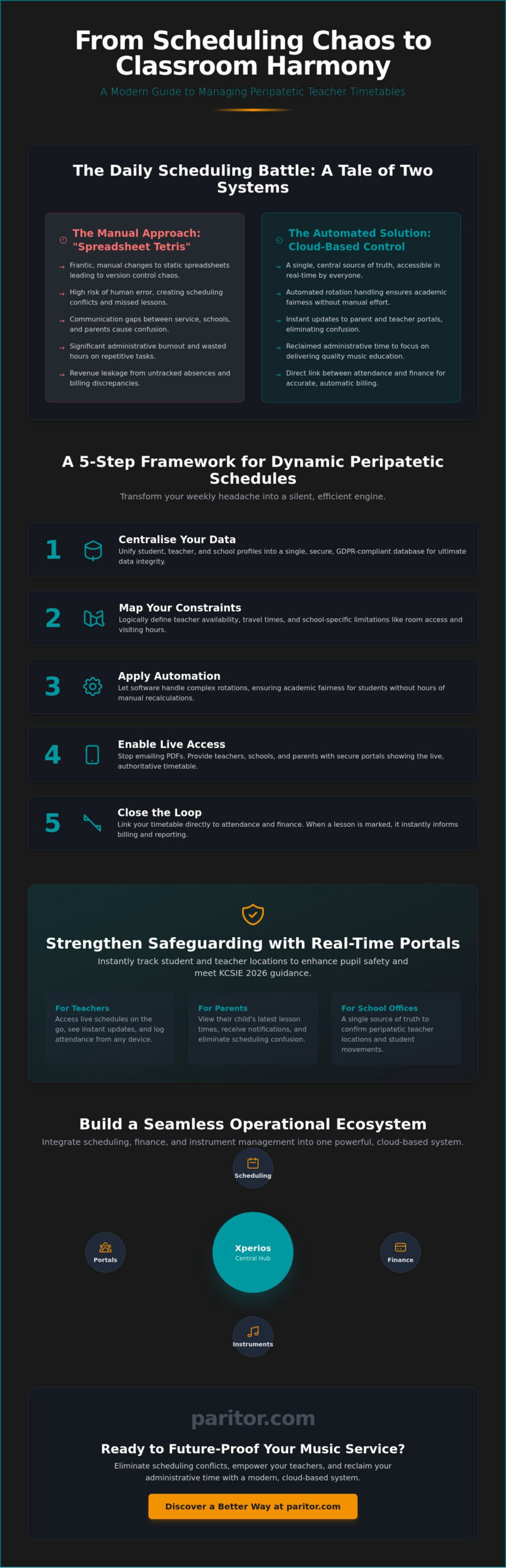
Moving from a chaotic spreadsheet to a streamlined, professional operation requires a structured approach. You can’t simply digitise a broken process; you must refine the workflow to ensure it serves your teachers, schools, and students equally. By following these five steps, you’ll transform the way you approach managing peripatetic teacher timetables, turning a weekly headache into a silent, efficient engine.
- Step 1: Centralise your data. Move away from disparate lists. Every student, teacher, and school profile must live in a secure, GDPR-compliant database to ensure data integrity and institutional safety.
- Step 2: Map your constraints. Identify teacher availability alongside school-specific limitations. This includes physical room availability and the specific hours each school allows for visiting tutors.
- Step 3: Apply automation. Use software to handle the heavy lifting of rotations. This ensures students don’t miss the same academic subjects repeatedly without requiring you to manually recalculate every slot.
- Step 4: Enable live access. Stop emailing PDFs. Provide teachers and parents with secure, real-time portals where the most current version of the timetable is always available.
- Step 5: Close the loop. Link your timetable directly to attendance tracking. When a teacher marks a student as present, that data should feed your reporting and financial systems instantly.
Designing the Perfect Rotation Logic
Rotation logic is a method to balance musical tuition with the core school curriculum. Most services use a mix of fixed schedules for older students and rotating slots for younger pupils. However, the most effective systems allow for bespoke adjustments, such as “protected” lessons. If a pupil has a critical mock exam or a specific intervention group, your system should allow you to lock their lesson time whilst the rest of the group continues to rotate. This level of granularity ensures academic fairness without creating extra admin work. If you’re looking for a way to simplify this process, exploring a dedicated Teacher Portal can help your staff manage these nuances on the fly.
Integrating Multi-Site Logistics
For large music hubs, the challenge isn’t just the lessons; it’s the space between them. You must calculate realistic travel windows to ensure teachers aren’t expected to be in two places at once. This is particularly vital for staff who split their day between primary and secondary settings, where lunch breaks and bell times rarely align. Using specialised managing multiple school locations software allows you to visualise these travel gaps clearly. This foresight prevents teacher burnout and ensures that your service remains a reliable partner for every school in your network.
Manual vs. Automated Timetabling: Calculating the True Cost
Many music services continue to use spreadsheets because they appear “free” on the surface. There is no monthly software subscription, and most staff already know how to use basic cells and formulas. However, this perspective ignores the “Hidden Admin Tax” that erodes your budget and exhausts your team. When managing peripatetic teacher timetables manually, you aren’t just paying for the teacher’s time; you’re paying for the hours your coordinators spend fixing broken links, re-sending emailed PDFs, and correcting human-entry errors. A single typo in a spreadsheet cell can result in a teacher arriving at a school to find no available room, or worse, no students.
The financial implications of these errors are significant. If a lesson is missed due to a scheduling clash and isn’t recorded correctly, it often goes unbilled. Over a full academic year, these small “revenue leaks” can add up to thousands of pounds in lost income. Beyond the finances, chaotic scheduling is a primary driver of poor teacher retention. Professional tutors want to focus on pedagogy, not on deciphering a messy calendar or arguing with the school office about room bookings. An automated system provides the stability that makes your service a desirable place to work. For independent practitioners facing similar challenges, dedicated software for private music teachers can automate payments and centralise student management to eliminate these same revenue leaks.
The ‘Admin Tax’ of Spreadsheet Management
Estimates from across the sector suggest that coordinators can spend up to five hours per week per twenty teachers just on manual timetable adjustments. Over a twelve-week term, that’s sixty hours of high-level staff time spent on basic data entry. Contrast this with the “one-click” updates provided by modern ensemble management software. Automation allows your team to shift their focus from moving boxes on a screen to improving educational outcomes and supporting teacher development. It replaces the frantic Monday morning scramble with a calm, predictable workflow.
MIS Integration: SIMS, iSAMS, and Beyond
A common concern for IT leads is how new software will talk to existing school systems. Modern platforms solve this by syncing directly with Management Information Systems (MIS) like SIMS or iSAMS. This integration is a game-changer for safeguarding because it ensures that student data is always current. When a pupil leaves the school or moves tutor groups, the change reflects in your timetable automatically. This eliminates data duplication and ensures that your teachers are always working with the most accurate, up-to-date information, significantly reducing the risk of administrative errors that could compromise student safety.
Safeguarding and Communication: The Benefits of Real-Time Portals
Safeguarding in 2026 requires more than a signed policy; it demands real-time visibility. When you’re managing peripatetic teacher timetables across multiple sites, the ability to know exactly where a pupil is at 10:15 AM is non-negotiable. Modern music services have moved past the era of “hopeful” scheduling, where a teacher might arrive at a school and spend fifteen minutes hunting for a student who is actually in a maths intervention. By using real-time portals, the school office, the teacher, and the central service are all looking at the same live data. This transparency doesn’t just save time; it ensures that every student is accounted for, fulfilling your statutory obligations with zero guesswork.
Professional boundaries are often the first casualty of poor systems. Teachers sometimes resort to texting parents from personal mobiles to confirm lesson times, which is a significant GDPR risk and a breach of professional conduct. A centralised portal removes this necessity. You can automate lesson reminders to be sent directly to parents’ phones or email inboxes, which drastically reduces “no-shows” and ensures your teachers’ time is spent instructing rather than waiting. This professional distance protects your staff whilst keeping parents informed and engaged.
GDPR Compliance in Peripatetic Education
Storing student medical details or emergency contacts in a physical diary or a personal phone is a liability your service doesn’t need. Cloud-hosted solutions, built on high-security infrastructure like Microsoft Azure, ensure that sensitive data remains encrypted and accessible only to authorised personnel. A centralised portal is the most secure way of managing peripatetic teacher timetables whilst maintaining strict data privacy.
Checklist for secure data handling:
- Implement multi-factor authentication for all portal logins.
- Ensure sensitive student data is encrypted at rest and in transit.
- Set automated data retention periods to remove old records.
- Prevent teachers from exporting full student lists to personal devices.
Empowering Parents through Self-Service
Transparency is the foundation of trust for fee-paying parents. When they can log in to a single dashboard to view lesson times, read progress reports, and settle invoices, their perception of your service shifts from “informal” to “expert.” This self-service model also reduces the administrative burden on your office team, as parents no longer need to call to ask when the next lesson is. You can learn more about this by exploring the ultimate parent portal for music schools. Providing this level of service empowers parents to take an active role in their child’s musical journey. If you’re ready to modernise your communication and safeguarding, you can book a demo of the Xperios Parent Portal today.
Future-Proofing Your Music Service with Xperios
Adopting a new system isn’t just about changing software; it’s about shifting your organisational culture from a state of constant reaction to one of strategic growth. Xperios has established itself as the industry standard for music service management software because it understands the unique pressures of the UK education sector. Unlike generic scheduling tools, this platform was built through direct collaboration with music hubs and services. It acts as an industrious engine behind the scenes, allowing your team to move from simply surviving the week to thriving as a modern, efficient organisation. By managing peripatetic teacher timetables within a unified ecosystem, you eliminate the friction that slows down your service and frustrates your staff.
The platform’s modular design ensures that every facet of your operation is connected. Whether you’re utilising Xperios Ensemble Management to coordinate weekend rehearsals or Xperios Instrument Management to track thousands of violins across the county, the data remains consistent. This integrated approach provides a reassuring, stable presence for your administrators, who no longer have to jump between different programmes to find a single piece of information. It’s a partnership that restores focus to your primary mission: providing exceptional musical opportunities for every child.
Streamlining the Entire Student Journey
The student journey often begins with a single lesson, but it shouldn’t end there. Xperios allows for a seamless transition as students progress from individual tuition into larger groups and graded evaluations. The timetable integrates directly with music exam administration, ensuring that teachers can track assessment readiness without extra paperwork. Xperios automates the link between a lesson occurring and an invoice being generated, ensuring your service maintains a healthy cash flow without the need for manual data reconciliation. This connectivity ensures that every student’s musical path is supported by a robust administrative foundation.
Next Steps: Modernising Your Timetabling Strategy
Transitioning from legacy systems or fragmented spreadsheets might feel daunting, but it’s a necessary step forward in your professional journey. The value of professional onboarding and data migration services cannot be overstated, as they ensure your historical records are preserved whilst you adopt more efficient workflows. When you choose to modernise your approach to managing peripatetic teacher timetables, you aren’t just buying software; you’re gaining a dedicated ally committed to your success. You don’t have to tackle this transition alone. Discover how Xperios can transform your peripatetic scheduling and help you reclaim the time you need to lead your service into the future.
Empowering Your Service for the Next Decade of Music Education
The transition from manual “spreadsheet Tetris” to a strategic, automated ecosystem is the most effective way to protect your coordinator team from administrative burnout. By centralising your data and utilising real-time portals, you ensure that every student is safe and every lesson is accurately recorded for billing. Managing peripatetic teacher timetables shouldn’t be a source of weekly stress; it should be a silent, reliable process that supports your organisational growth and educational mission.
Xperios is built on 30 years of music service expertise and is already trusted by leading UK Music Hubs to deliver consistent results. Our platform provides institutional peace of mind through GDPR-compliant cloud hosting on Microsoft Azure, ensuring your sensitive student data remains secure and accessible. It’s time to move beyond the limitations of legacy systems and reclaim the hours you need to focus on delivering high-quality musical tuition.
Book a Discovery Call to modernise your peripatetic scheduling and take the first step towards a more efficient, professional future. You’ve built a service that inspires students; now, give your team the industrious engine they deserve to help it flourish.
Frequently Asked Questions
What is a rotating peripatetic timetable and why is it used?
A rotating peripatetic timetable is a schedule where lesson times shift each week to ensure academic fairness. It’s used so that students don’t miss the same core subject, such as Maths or English, at the same time every Tuesday. This system balances musical tuition with the core curriculum, ensuring that instrumental progress doesn’t come at the expense of a student’s broader education.
How can I manage peripatetic timetables across multiple school sites?
The most effective method is to centralise all student and teacher data in a single, cloud-based platform. This allows you to map teacher availability against the specific constraints of each school site, such as room availability and varying term dates. A unified system gives your coordinators a clear overview of the entire hub, making it easier to spot clashes before they happen.
Does peripatetic scheduling software integrate with school MIS like SIMS or iSAMS?
Yes, modern management systems are designed to sync directly with school Management Information Systems (MIS). This integration ensures that your pupil records are always current and accurate. When a student moves tutor groups or leaves the school, the change reflects in your timetable automatically, which drastically reduces manual data entry and improves your overall safeguarding accuracy.
How do I ensure GDPR compliance when sharing timetables with peripatetic teachers?
You should move away from emailing spreadsheets and instead use secure, encrypted portals. When managing peripatetic teacher timetables, hosting data on a secure infrastructure like Microsoft Azure ensures that sensitive information is protected by multi-factor authentication. This prevents student medical details or contact information from being stored on personal devices or in physical diaries, which is vital for data protection.
Can parents see their child’s music lesson schedule online?
Yes, parents can access the latest schedule through a dedicated Parent Portal. This self-service model allows families to view lesson times, track attendance, and settle invoices from any device. Providing this level of transparency builds trust with fee-paying parents and significantly reduces the volume of “where is the lesson” phone calls to your administrative office.
What happens if a peripatetic teacher is absent or a lesson needs rescheduling?
Automated systems allow you to handle absences with one-click notifications. If a teacher is unwell, the system can instantly alert all affected parents and school offices via the portal or email. This replaces the frantic manual phone-tree and ensures that everyone is updated in real-time, preventing wasted journeys and ensuring that rescheduling is handled logically within the existing rotation.
How do I create a music school timetable that accounts for teacher travel time?
You must map your school locations and build realistic travel windows into the daily schedule. When managing peripatetic teacher timetables, it’s essential to include buffer periods that account for the transit between different primary and secondary sites. Dedicated software automates these calculations, ensuring that your teachers have enough time to travel safely without arriving late for their next student.
Is it possible to link peripatetic attendance directly to parent invoicing?
Yes, integrating your timetable with a financial management module allows for seamless billing. When a teacher marks a student as present on their portal, the system can automatically trigger the relevant invoice or update the student’s account balance. This “closed-loop” process ensures that every lesson is accounted for, eliminating the risk of unbilled hours and reducing the time spent on manual financial reconciliation.