

What if the hours you spend untangling calendar clashes and chasing late fees could be reinvested into the music itself? Managing a modern music service often feels like conducting an orchestra where half the players are missing their sheet music and the other half haven’t paid their tuition. It’s a relentless cycle of manual data entry that pulls you away from your primary creative mission. Adopting a dedicated ensemble management software isn’t just about digitising your records. It is about building a robust administrative engine that handles the heavy lifting for you.
We know that the pressure to maintain GDPR compliance whilst organising hundreds of instrument loans can feel overwhelming. You shouldn’t have to choose between administrative accuracy and musical excellence. This article explores how to unify your scheduling, financial management, and student communication into one seamless, cloud-based system. We will look at how automated invoicing and secure portals can transform your workflow, giving you the clarity and time needed to scale your service with confidence.
Key Takeaways
- Move beyond fragmented spreadsheets by adopting a secure, cloud-based ensemble management software that ensures data integrity across your whole team.
- Reduce administrative enquiries significantly by implementing self-service portals that allow parents and students to access schedules and updates independently.
- Protect your organisation from the security risks and hidden costs of manual data entry by centralising your records within a unified digital ecosystem.
- Streamline your financial workflows with automated invoicing and integrated instrument tracking to reclaim hours of labour-intensive administrative work.
- Conduct a focused audit of your current bottlenecks to identify the specific modular tools required to scale your music service effectively.
What is Ensemble Management Software in 2026?
By 2026, the definition of ensemble management software has evolved into a comprehensive cloud platform that serves as the central nervous system for music organisations. It’s no longer just a digital calendar for booking rehearsals. Whilst a standard list of music software might focus on creative notation or recording tools, administrative leaders require a platform that synchronises staff logistics, complex financial streams, and safeguarding requirements. This shift represents a move away from fragile local spreadsheets toward secure, multi-user environments hosted on resilient infrastructure like Microsoft Azure.
The modern requirement is total accessibility. Teachers, parents, and students now expect real-time data access whilst on the move. Whether it’s a tutor checking an attendance register on a tablet or a parent verifying a rehearsal time via a mobile portal, the data must be instant and accurate. Unlike simple rehearsal-only apps that focus on score reading or tuning, a professional ensemble management software manages the entire organisational lifecycle from the first student enquiry to the final concert invoice.
The Evolution of Music Service Administration
The role of the ensemble manager has undergone a radical transformation. It’s no longer about manual paper-shuffling or spending hours cross-referencing email chains. Instead, the role has moved toward strategic oversight. For UK music hubs and services operating across multiple locations, digital transformation is now a necessity rather than an optional upgrade. These organisations require ‘one version of the truth’ to prevent double-booked rooms or missing instruments. A centralised system ensures that every department, from finance to faculty, looks at the same live data, eliminating the costly errors inherent in fragmented systems.
Core Components of a Modern System
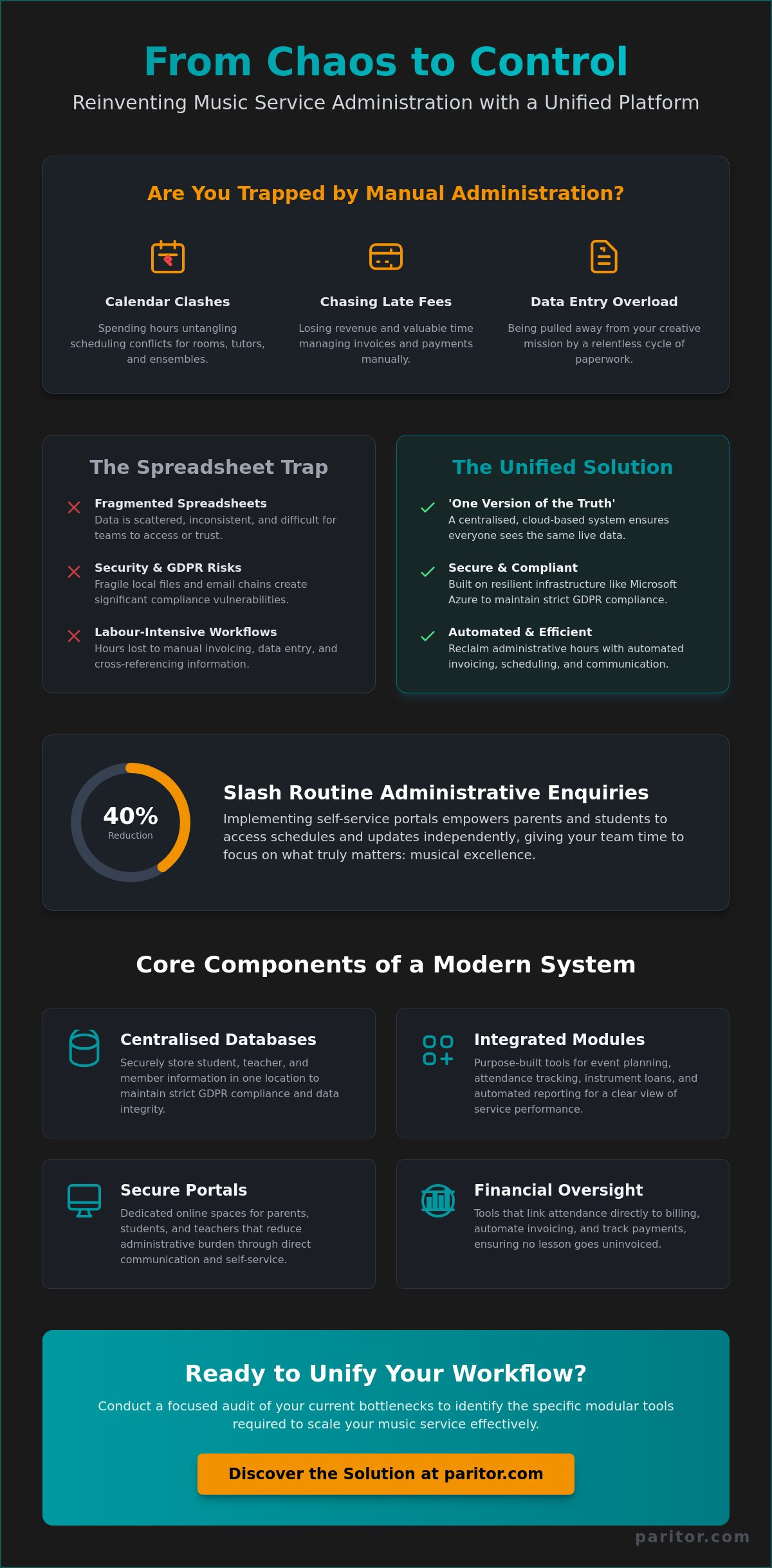
A truly effective system isn’t a collection of separate tools; it’s a unified structure built on user insights. It provides a stable foundation that allows you to focus on musical excellence rather than paperwork. Key elements include:
- Centralised Databases: Securely store student, teacher, and member information in one location to maintain strict GDPR compliance.
- Integrated Modules: Purpose-built tools for event planning, attendance tracking, and automated reporting that provide a clear view of service performance.
- Secure Portals: Dedicated spaces for parents and teachers that reduce the administrative burden by facilitating direct communication and self-service updates.
- Financial Oversight: Tools that link attendance directly to billing, ensuring no lesson or rehearsal goes uninvoiced.
This modular approach allows organisations to start with their most pressing needs and scale as they grow. It’s about empowering your team with technology that acts as a dedicated ally, performing the repetitive tasks that used to consume your week. Independent tutors looking to solve similar challenges may also benefit from reviewing the best software for private music teachers in 2026, which covers how to automate payments and centralise student communications for solo practices.
Centralising the Ensemble: Scheduling and Portals
The heart of any music service is its schedule. Yet, trying to manually create a music school timetable that accounts for room availability, tutor sessions, and ensemble rehearsals is often a recipe for burnout. Modern ensemble management software removes this burden by automating the logistics. It allows you to build complex rotations that respect the constraints of your staff and facilities. When a change occurs, the system doesn’t just update a spreadsheet. It pushes notifications to everyone involved. This ensures that a last-minute room change or rehearsal cancellation never leaves a student standing in a hallway alone.
Communication is often where administrative time is lost. Some industry studies suggest that implementing self-service portals can reduce routine administrative enquiries by as much as 40%. This efficiency is backed by broader Performing Arts Administration research, which emphasises the need for professional tools to handle the growing complexity of arts organisations. By shifting the responsibility for data accuracy to the users themselves, you ensure that contact details and medical information are always current. Real-time attendance tracking also moves your service beyond the paper register, providing an immediate digital audit trail that enhances safeguarding across every rehearsal.
Intelligent Scheduling for Complex Timetables
Managing peripatetic teachers requires a level of flexibility that standard calendars cannot provide. You need to track tutors as they move between multiple school locations whilst ensuring their travel time is accounted for. Professional ensemble management software uses intelligent clash detection to prevent double-bookings across different sites. It creates a unified view of your entire operation. This transparency allows managers to spot gaps in the timetable and optimise staff usage without the risk of data duplication or conflicting commitments. For a deeper look at how to eliminate scheduling conflicts and automate complex rotations, our guide to managing peripatetic teacher timetables offers a practical, step-by-step approach for music services in 2026.
Empowering Members through Secure Portals
The communication triangle between parents, teachers, and students is vital for musical progress. Providing dedicated access points transforms the administrative experience from a series of hurdles into a smooth, supportive journey.
- Xperios Parent Portal: Families can settle invoices instantly, view lesson attendance, and update essential safeguarding information without calling the office.
- Xperios Teacher Portal: Staff can take digital registers on any mobile device, access repertoire lists, and record student progress notes in real-time.
- Xperios Student Portal: Students have a dedicated space for practice materials and event details, fostering a sense of ownership over their musical journey.
By centralising these interactions, you eliminate the need for constant email chains and fragmented messages. If you want to see how these tools can reclaim your team’s time, you might explore the modular features of Xperios to see which portals best fit your current needs.
Overcoming the Spreadsheet Trap: Why Integration Matters
It’s tempting to stick with what you know. For many music services, that means a collection of colour-coded spreadsheets and shared drives. You might feel these systems work just fine, but they often hide significant administrative costs. Manual data entry is prone to human error. It consumes hours of your team’s week. Most importantly, it creates data silos where information is trapped. Research into the challenges in ensemble management confirms that logistical and resource allocation issues are exacerbated when systems don’t talk to each other. Adopting a unified ensemble management software transforms these scattered records into a single, reliable source of truth.
Integration isn’t just about convenience; it’s about financial health. When your scheduling module is separate from your billing, financial leakage is almost inevitable. A missed attendance mark in one file doesn’t trigger an invoice in another. By using modular software, you can start by fixing your scheduling and then expand into financial management as your confidence grows. This connected approach provides the Big Data insights you need for annual reporting and successful funding bids. You can see exactly which ensembles are growing and which resources are underutilised with just a few clicks.
The Risk of Fragmented Data
Fragmented data is a security risk. Maintaining strict GDPR compliance is nearly impossible when student medical details or contact info are scattered across personal devices or various local files. There’s also the issue of continuity. When a key administrator leaves, they often take the logic of their spreadsheets with them. A centralised system ensures that your organisation’s intelligence stays within the organisation. It provides a stable foundation for whoever steps into the role next, ensuring that your service doesn’t grind to a halt during staff transitions.
Scalability for Growing Services
Whether you are a private teacher or a national conservatoire, your tools should grow with you. Xperios is designed to support this journey. You can add new ensembles, instrument types, or locations without needing to rebuild your entire database from scratch. Modern cloud hosting ensures your data is always available, providing 99.9% uptime for busy organisations that can’t afford technical downtime. This reliability allows you to focus on the future, knowing your administrative engine is built to scale alongside your musical ambitions. If you operate as an independent tutor rather than within a larger organisation, our dedicated guide to software for private music teachers explores how solo practitioners can apply the same principles of automation and compliance to their own studios.
Financial Automation and Asset Management
Whilst many platforms focus on the creative side of performance, such as score reading or stem sharing, they often leave administrators stranded when it comes to the books. A professional ensemble management software fills this gap by acting as a robust financial engine. Generating thousands of termly invoices shouldn’t take your team days of manual effort. It should take minutes. By automating the invoicing cycle, you eliminate the repetitive labour that leads to burnout and human error. This transition allows your staff to move from reactive chasing to proactive financial oversight.
Cash flow stability is the backbone of any growing music service. Integrating secure payment gateways like Stripe or GoCardless directly into your workflow offers parents a frictionless way to settle accounts. It’s a professional approach that significantly reduces late payments. You gain real-time visibility of outstanding balances and cash flow through integrated reporting tools. This means you don’t have to wait until the end of the month to understand your financial position. You can see it instantly, allowing for more confident decision-making regarding future investments or programming.
Revolutionising the Invoicing Cycle
The most effective way to prevent financial leakage is to link your attendance data directly to your billing. When a teacher marks a register in the portal, the system automatically accounts for that session in the next invoice. It’s a seamless connection that ensures every lesson and rehearsal is paid for. You can also set up recurring payment plans for ensemble memberships or instrument hire, providing a steady income stream for the organisation. Automating ‘chase’ emails for overdue accounts ensures that professional relationships remain intact, as the software performs the difficult task of reminding parents about payments.
Managing Musical Assets and Inventory
Your instrument collection is a significant capital asset that requires careful oversight. Tracking loans, repairs, and valuations shouldn’t happen in a separate, disconnected file. Within the same system, you can manage the entire lifecycle of an instrument. Instrument inventory management software tells you exactly who has which asset and when it’s due back, reducing the risk of lost inventory. This level of organisation extends to music exam administration, where you can track candidate details and associated fees in one place.
Maintaining high-value assets also requires a clear history of maintenance. You can record repair histories and schedule maintenance for your ensemble’s instruments to ensure they stay in peak condition. This comprehensive approach to asset management protects your investment and ensures your musicians always have the tools they need to succeed. If you’re ready to reclaim your time and secure your service’s finances, explore how Xperios Financial Management can automate your most demanding administrative tasks.
Choosing the Right Ensemble Management Solution
Selecting the right ensemble management software is a strategic decision that shapes the future efficiency of your organisation. It isn’t just about picking a set of features; it’s about finding a partner that understands the unique pressures of the UK music sector. To ensure you make an informed choice, follow a structured approach that moves from internal reflection to external evaluation. This process ensures the tool you choose acts as a dedicated ally rather than a detached service provider.
- Step 1: Audit your administrative bottlenecks. Identify where your team loses the most time. Is it manually reconciling invoices or untangling scheduling conflicts? A clear audit ensures you solve real problems.
- Step 2: Identify your ‘Must-Have’ modules. Focus on the core pillars that will have the biggest impact. Whether you need Scheduling, Financial Management, or Instrument Inventory, prioritise the tools that address your primary pains first.
- Step 3: Evaluate security and support. For UK music services, data residency and support location are critical. Ensure your data is hosted within secure UK environments to simplify GDPR compliance and check that the support team is available during your operational hours.
- Step 4: Request a tailored demonstration. A generic walkthrough won’t suffice. Ask to see how the software handles your specific organisational workflows, such as managing peripatetic teacher timetables across multiple sites or complex termly billing cycles.
- Step 5: Plan a phased implementation. Success depends on staff buy-in. Introduce the system in stages to allow your team to adapt without feeling overwhelmed by sudden change.
The Importance of UK-Based Support and Security
British organisations often have specific regulatory requirements that international platforms struggle to meet. UK-hosted data provides essential peace of mind regarding GDPR and institutional safety. Beyond security, having a support team that understands the specific landscape of UK music hubs is invaluable. This local expertise ensures the software can integrate smoothly with local authority accounting systems, preventing the technical friction that often stalls digital transformation projects. It provides a stable, reassuring presence that allows you to focus on your educational mission.
The Xperios Advantage: Built by the Industry
We don’t build software based on assumptions. Paritor has spent 30 years collaborating directly with music services and performing arts organisations. This partnership ensures that every module is refined through direct user feedback and real-world testing. We pride ourselves on being the industrious engine behind the scenes, performing the labour-intensive tasks so you can excel in your own role. Adopting our platform is a necessary step forward for any organisation looking to modernise and scale with confidence.
Discover how Xperios can transform your ensemble management today.
Reclaiming Time for Musical Excellence
Transitioning from fragmented spreadsheets to a unified digital ecosystem is more than an administrative upgrade; it is a commitment to the future of your music service. By centralising your scheduling, financial workflows, and student safeguarding into one ensemble management software, you eliminate the repetitive manual labour that often leads to burnout. You’ve seen how automated invoicing and secure portals can reduce routine enquiries and ensure that every lesson is accounted for, allowing your team to focus on strategic growth rather than paperwork.
With 30+ years of industry expertise and the backing of Microsoft Azure Cloud Security, Xperios provides the stable, professional foundation that leading UK music hubs rely on every day. We pride ourselves on being the industrious engine behind the scenes that empowers you to excel in your creative mission. Taking the next step in your professional journey is simple. Book a Personalised Xperios Demo to Modernise Your Service and discover how a dedicated ally can transform your daily operations. It’s time to restore your focus to the music and leave the administrative burden behind.
Frequently Asked Questions
What exactly is ensemble management software?
Ensemble management software is a centralised cloud platform designed to coordinate the administrative, financial, and logistical needs of music organisations. It moves beyond simple rehearsal tools by integrating scheduling, student data, and financial reporting into one secure environment. This allows administrators to manage the entire lifecycle of an ensemble, from initial registration to final performance billing, without relying on fragmented spreadsheets or manual data entry.
Can this software handle both professional orchestras and school music hubs?
Yes, the system is designed to scale across diverse organisational structures, from professional ensembles to large-scale educational music hubs. It provides modular features that adapt to your specific needs, whether you are managing professional musician rosters or coordinating hundreds of peripatetic lessons across multiple school sites. The flexible architecture ensures that the software grows alongside your organisation’s complexity whilst maintaining a stable, professional presence.
Is our student data secure and GDPR compliant?
Data security is built into the core of the platform, utilising Microsoft Azure’s resilient cloud infrastructure to ensure institutional safety. We prioritise strict GDPR compliance by centralising sensitive student information in a secure, encrypted environment. This eliminates the risks associated with storing data on personal devices or local files, providing a clear digital audit trail for safeguarding and ensuring your organisation meets all regulatory requirements.
How does the software handle instrument hire and inventory?
The Xperios Instrument Management module provides a dedicated digital ledger for tracking every asset in your collection. You can record loan histories, repair schedules, and current valuations, ensuring you know exactly who has which instrument and when it’s due back. This integrated approach prevents asset loss and allows for proactive maintenance of high-value instruments within the same system used for your daily rehearsals and events.
Can we automate invoicing and collect payments online?
You can automate the entire financial cycle by linking attendance data directly to the Xperios Financial Management module. This allows you to generate thousands of termly invoices in minutes and collect payments through secure online gateways like Stripe or GoCardless. By automating these labour-intensive tasks, you significantly reduce late payments and gain real-time visibility of your organisation’s cash flow without the need for constant manual chasing.
Does it support peripatetic teacher scheduling across multiple locations?
The software is specifically built to manage the complex logistics of peripatetic staff working across multiple school locations. It features intelligent clash detection to prevent double-bookings and accounts for travel time between sites. This ensures that your teachers always have accurate, live schedules accessible on any device, reducing the administrative burden on your central office team and ensuring lessons always run as planned.
How long does it take to migrate from our current spreadsheet system?
Migration timelines vary based on the size of your organisation, but we focus on a structured, phased implementation to ensure minimal disruption. We assist with data imports from your existing spreadsheets and provide tailored onboarding sessions to help your staff adapt to the new workflow. This consultative process ensures that you can begin reclaiming your time and modernising your service as quickly and smoothly as possible.
Is there a portal for parents to track their child’s progress and pay fees?
The Xperios Parent Portal provides a dedicated self-service space where families can manage their entire relationship with your music service. Parents can settle invoices, update contact details, and view attendance records or progress reports independently. This transparency improves parent engagement whilst significantly reducing the volume of routine administrative enquiries handled by your office staff, allowing them to focus on more strategic tasks.