
What if the hours your staff spend untangling timetable clashes and chasing late payments could be reclaimed for the studio instead? Managing a performing arts institution in 2026 requires a level of administrative precision that legacy spreadsheets simply cannot match. You likely feel the weight of GDPR anxiety and the frustration of inaccurate instrument tracking every single day; it’s a taxing cycle that pulls focus away from your primary mission. Adopting modern conservatoire management software is no longer just an upgrade, it’s a necessary step toward institutional stability and peace of mind.
We agree that administrative labour shouldn’t overshadow artistic growth. This guide reveals how to transition to a unified digital ecosystem that acts as your single source of truth, bringing scheduling, inventory, and financial management into one secure cloud platform. You’ll learn how automated invoicing and self-service portals can significantly reduce admin hours whilst preparing your organisation for the new National Centre for Arts and Music Education standards launching this September. We’ll preview the essential features, built through direct user collaboration, that empower staff and improve parent engagement through a more connected, professional experience.
Key Takeaways
- Understand why general school management systems struggle with the unique complexities of music services and why a specialist solution is essential for operational success.
- Learn how automated scheduling and modular workflows eliminate the risk of double-bookings, returning valuable hours to your administrative and teaching staff.
- Discover the strategic benefits of migrating from fragmented spreadsheets to a secure cloud-based conservatoire management software that protects sensitive student data.
- Explore a clear implementation framework for digital transformation that ensures your new platform is built on direct user insights and proven industry expertise.
- Find out how to unify your instrument inventory and financial management into a single source of truth to reduce administrative burdens and improve parent engagement.
Understanding the Complexity of Modern Conservatoire Management
A conservatoire isn’t just a school; it’s a high-tempo network of creative energy and intricate logistical hurdles. Specialist conservatoire management software acts as a dedicated Management Information System (MIS) tailored for these unique environments. It moves beyond basic record-keeping to address the three essential pillars of arts administration: dynamic scheduling, precise instrument inventory, and complex financial management. Success in Understanding the Complexity of Modern Conservatoire Management requires a system that respects these rhythms rather than trying to force them into a generic box.
The administrative landscape is shifting rapidly. With the new National Centre for Arts and Music Education set to launch in September 2026, the demand for higher data standards and more robust reporting is no longer optional. Music Hubs and performing arts organisations across the UK are now aligning with regional requirements that demand a “single source of truth”. This evolution reflects a broader move toward professionalisation, where having a unified digital ecosystem is the only way to meet modern compliance and enrichment framework standards.
Why General Education Software Falls Short
Generic school management systems are typically built for fixed classrooms and static 30-student blocks. They often fail when faced with the nuances of peripatetic tutor scheduling, where teachers move between multiple venues and one-to-one sessions shift weekly. Managing ensembles adds another layer of difficulty; groups fluctuate, and multi-venue logistics require a level of flexibility that standard timetables can’t provide. Furthermore, generic tools lack specialised capabilities for instrument hire. They won’t tell you if a specific violin is out for repair or if a parent’s hire agreement is overdue. You’re left with fragmented spreadsheets that drain your time and increase the risk of errors.
The Move Towards Cloud-Based Administration
The era of “on-premise” legacy databases is ending. Storing sensitive student data on local servers creates significant security risks and tethers your staff to a physical office. Modern conservatoire management software utilises secure cloud infrastructure to ensure data is accessible in real-time. This accessibility is vital for travelling tutors and remote administrators who need to update attendance or check student assessments on the go. By transitioning to a cloud platform, you replace disconnected silos with a seamless workflow. It’s a strategic shift that empowers your team, improves data reliability, and ensures your institution is prepared for the regulatory challenges of 2026 and beyond.
Core Functional Requirements for Arts Administration Excellence
To move beyond the administrative friction discussed in our previous section, your institution needs a robust digital foundation. A high-performing system isn’t just a database; it’s a modular ecosystem designed to handle the specific pressures of the performing arts. Identifying the Core Functional Requirements for Arts Administration is the first step toward reclaiming your team’s time. At its heart, effective conservatoire management software must integrate scheduling, inventory, and finance into a single, seamless workflow. This integration is why music service management software has become a foundational pillar for modern organisations looking to future-proof their operations.
Intelligent Scheduling and Timetabling
Manual timetabling for peripatetic tutors is a notorious drain on resources. Intelligent scheduling modules, such as those found in Xperios for Performing Arts, eliminate the risk of double-booking tutors or rooms by cross-referencing availability in real-time. When a change occurs, the system sends automated notifications to teachers, students, and parents. This immediate synchronisation reduces “no-shows” and ensures everyone is looking at the same, accurate calendar. It’s about creating a predictable rhythm that allows your tutors to focus on instruction rather than logistics.
Instrument Inventory and Asset Tracking
Managing a large-scale instrument hire scheme requires more than just a list of serial numbers. Effective conservatoire management software provides digital tracking for every asset, from initial loan to final return. Xperios Instrument Management allows you to log maintenance schedules, repair histories, and insurance data in one place. You can even automate the “hire-to-buy” workflow, ensuring that billing for equipment loans is handled accurately without manual intervention. This level of detail protects your investment and ensures students always have the tools they need to excel.
Financial Automation and Reporting
Chasing late payments and managing thousands of individual invoices can overwhelm any finance department. Integrated financial management modules streamline this process by generating bulk invoices and providing secure payment links via the Xperios Parent Portal. These systems often integrate directly with accounting software like Sage or Xero, ensuring your records are always up to date. Beyond simple billing, the ability to pull explicit reports allows you to demonstrate service performance to stakeholders with clarity and confidence. If you’re ready to see how these tools can transform your institution, explore our modular solutions to find the right fit for your needs.
Legacy Systems vs. Unified Cloud Platforms: The Strategic Shift
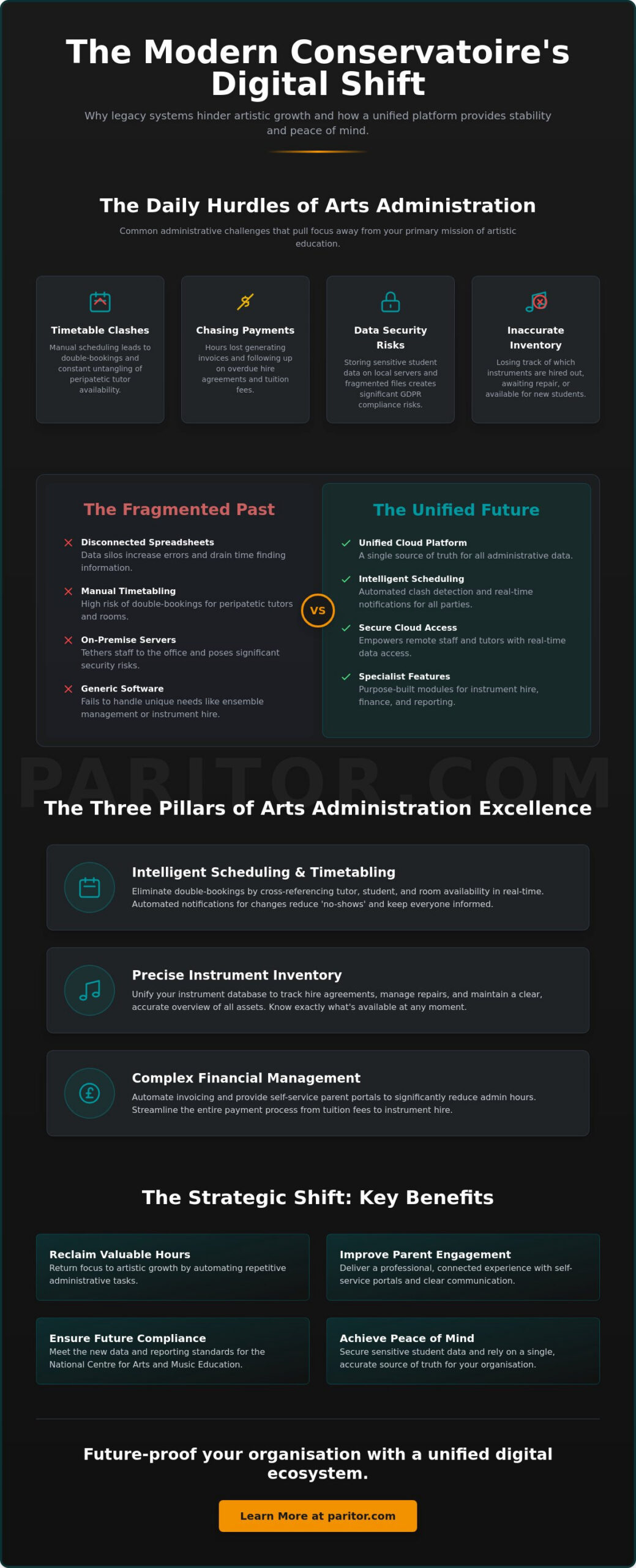
The transition from fragmented “home-grown” databases to a unified digital ecosystem isn’t just a technical upgrade; it’s a strategic necessity. Many organisations still rely on a patchwork of spreadsheets and local files, unaware of the hidden costs accumulating in lost hours and constant data duplication. These legacy setups demand manual intervention for even the simplest tasks, which diverts your team from their primary creative mission. By adopting a modern conservatoire management software, you replace these fragile systems with a single source of truth that ensures data integrity and operational agility.
This shift reflects a broader trend of digital transformation in the arts, where institutions move away from isolated silos toward integrated, collaborative platforms. Moving to the cloud allows your institution to scale without the physical constraints of local hardware, providing a stable foundation for long-term growth.
Security, GDPR, and Data Integrity
Storing sensitive student data on local office servers or unencrypted spreadsheets carries significant security risks. A unified cloud platform, hosted on secure environments like Microsoft Azure, provides a level of protection that local hardware simply can’t match. This approach supports a “secure working environment anywhere” philosophy, allowing staff to access vital information whilst maintaining strict GDPR compliance. Automated data updates further protect your organisation by reducing the risk of human error and potential data breaches. When information is centralised, safeguarding becomes more manageable, as every staff member works from the same verified records, ensuring no student is lost amongst the paperwork.
Improving the Stakeholder Experience
Legacy administration often relies on “endless calling” and manual email chains to update parent details or confirm lesson times. Modern conservatoire management software transforms this experience through dedicated portals. The Xperios Parent Portal empowers families to manage their own contact details and view lesson schedules at their convenience, significantly reducing the burden on your front-of-house team. This self-service model doesn’t just improve efficiency; it enhances the professional image of your institution.
The benefits also extend to your teaching staff. Reducing “admin homework”, those repetitive tasks that tutors often perform outside of teaching hours, is a powerful tool for teacher retention. When tutors can log attendance and track student progress through the Xperios Teacher Portal, they feel supported rather than burdened. This digital shift ensures that everyone, from the finance director to the peripatetic tutor, can focus on what they do best: fostering excellence in the performing arts.
A Framework for Evaluating and Implementing Your New System
Moving from a collection of legacy spreadsheets to a unified digital ecosystem is a significant milestone for any institution. It requires more than just a software purchase; it’s a strategic transition that demands a clear, structured approach. When evaluating conservatoire management software, look for a platform that is built on user insights. A system designed by industry veterans who understand the specific rhythms of arts administration will always outperform generic code. This partnership ensures the tool solves real-world frustrations rather than adding new technical burdens to your team’s workload.
Modularity is your greatest asset during this transition. You don’t need to adopt every feature at once. By choosing only the specific modules your institution requires, such as Xperios Ensemble Management or Xperios Financial Management, you can scale at a pace that suits your staff and budget. This targeted approach reduces the initial learning curve and allows your team to see immediate relief from their most taxing administrative tasks.
Step-by-Step Implementation Strategy
A successful rollout follows a logical progression to ensure data integrity and staff confidence. We recommend a four-phase approach to modernise your operations:
- Phase 1: Audit. Document your existing data structures and identify the specific administrative bottlenecks that drain the most time.
- Phase 2: Selection. Choose a modular system that offers the scalability needed to grow alongside your organisation.
- Phase 3: Migration. Execute a structured data migration. This is a critical step to ensure no pupil records or historical assessment data are lost during the move.
- Phase 4: Launch. Roll out staff training in stages, followed by the activation of self-service tools like the Xperios Parent Portal.
Managing the cultural shift amongst your staff is just as important as the technical setup. Emphasise how the new system eliminates repetitive “admin homework”, allowing tutors to focus on their creative mission. When staff see that the software is an ally designed to reclaim their time, adoption becomes a shared goal rather than a top-down mandate.
Key Questions for Potential Software Partners
Before committing to a provider, verify their deep domain knowledge. Ask about their specific experience within the UK performing arts sector and how they’ve handled regional requirements for other music services. Inquire about their “professional onboarding” services; a seasoned partner should offer more than just a login. They should provide a consultative process that helps you organise your data for long-term success. Finally, verify their roadmap. Your conservatoire management software should be a living tool with a commitment to future regulatory updates and feature growth. To begin your journey toward a more efficient future, book a consultation with our implementation experts today.
Future-Proofing Your Institution with Xperios
Choosing the right conservatoire management software is about more than just solving today’s scheduling headaches; it’s about securing the future of your institution. Paritor’s Xperios stands as the industry standard, providing a stable and forward-thinking foundation for performing arts organisations. With a 30-year heritage as a seasoned industry veteran, we’ve transitioned alongside the sector, evolving our technology to meet every new regulatory challenge. Our platform serves as the definitive performing arts school administration system, ensuring your organisation remains compliant and efficient whilst you focus on creative excellence.
The Xperios suite is inherently modular, allowing you to build a system that matches your specific operational needs. From Xperios Financial Management to the specialised Xperios Exams and Assessments Module, every component is designed to work in harmony. This unified approach eliminates the friction of fragmented data and ensures that your staff always have a single source of truth. Our core promise is simple: we perform the labour-intensive tasks so your team can reclaim their time for what truly matters.
Built Through Direct User Collaboration
We believe that the best software isn’t built in a vacuum. Xperios is developed through direct collaboration with the registrars, teachers, and administrators who use it every day. This person-centric approach ensures the interface is intuitive for non-technical staff, removing the anxiety often associated with digital transformation. By listening to user insights, we’ve created a platform that feels like a dedicated ally rather than a detached service. Having managed over a million lessons, our reliability is a matter of record. This milestone represents a million instances where we’ve helped staff move away from repetitive paperwork and back toward their educational mission.
Scalable Solutions for Every Size of Organisation
Whether you’re an independent tutor using Xperios for Private Teachers or a national conservatoire managing thousands of pupils, our solutions scale with you. We understand that music services are growth-oriented, and our platform is built to support that journey. As you expand your ensembles or integrate new regional hubs, Xperios adapts without requiring a complete system overhaul. This scalability ensures that your investment remains relevant for years to come, providing the technical assurances and data redundancy required for institutional safety.
It’s time to modernise your administrative processes and empower your staff with tools built specifically for their needs. Don’t let repetitive burdens stifle your organisation’s growth. We invite you to book a consultative demo today and discover how Xperios can act as the industrious engine behind your institution’s success.
Empowering Your Creative Mission through Digital Transformation
Modernising your institution is more than a technical upgrade; it’s a commitment to your staff’s wellbeing and your students’ success. By moving away from fragmented legacy systems, you establish a single source of truth that simplifies scheduling, inventory, and finance. This transition ensures your organisation is ready for the 2026 enrichment framework changes whilst protecting sensitive data on the secure Microsoft Azure cloud platform.
Selecting the right conservatoire management software is a necessary step forward in your professional journey. With over 30 years of industry experience, Paritor is a trusted partner for major UK music hubs and conservatoires. We understand the specific administrative burdens you face and have built a modular system through direct user collaboration to eliminate those repetitive tasks.
Discover how Xperios can transform your conservatoire administration and reclaim the hours your team needs to focus on excellence. It’s time to let technology handle the labour-intensive paperwork so you can return to the studio with confidence.
Frequently Asked Questions
What is conservatoire management software and how does it differ from a standard MIS?
Specialist conservatoire management software is a dedicated Management Information System designed for the specific logistical needs of performing arts organisations. Whilst standard school MIS platforms focus on static classroom blocks, this specialist tool manages the fluid dynamics of one-to-one tuition, ensemble rotations, and instrument hire schemes. It provides a level of flexibility that generic systems simply can’t match, ensuring your administrative workflows respect the unique rhythms of arts education.
How can software help manage complex peripatetic teacher timetables?
The software utilises intelligent scheduling modules to cross-reference tutor availability with room bookings and student rotations in real-time. This automation eliminates the risk of double-bookings and manual errors that often plague paper-based systems. When a session changes, the system sends immediate notifications to all stakeholders, reducing no-shows and ensuring your tutors can focus entirely on instruction rather than untangling their diaries.
Is our student data secure and GDPR compliant on a cloud-based platform?
Cloud-based platforms provide a significantly more secure environment than local office servers or unencrypted spreadsheets. By hosting data on enterprise-grade infrastructure like Microsoft Azure, conservatoire management software ensures high levels of data redundancy and encryption. This approach prioritises regulatory compliance and provides a secure working environment that protects sensitive student information from potential breaches whilst maintaining strict GDPR standards.
Can the software handle instrument hire schemes and inventory tracking?
Specialised modules like Xperios Instrument Management are designed to track every asset from initial loan to final return. The system logs maintenance schedules, repair histories, and insurance details, providing a comprehensive overview of your inventory. It even automates the billing for equipment loans and hire-to-buy workflows, ensuring your physical assets are managed as efficiently as your student records.
Will we be able to automate invoicing and reduce late payments from parents?
Integrated financial modules allow your team to generate bulk invoices for thousands of pupils simultaneously, saving hundreds of admin hours. By providing secure payment links through dedicated portals, the system makes it easier for parents to settle accounts promptly. This automation reduces the need for manual chasing and provides clear, real-time reporting on your institution’s financial health.
How long does the implementation and data migration process typically take?
The timeline for digital transformation depends on your organisation’s size and the complexity of your existing records. A structured, consultative approach ensures that data migration is executed carefully to protect pupil history and assessment data. Professional onboarding services help manage this transition in stages, allowing your staff to adapt to the new system without disrupting daily operations.
Can the system integrate with our existing accounting or learning management tools?
Modern management platforms are built to integrate seamlessly with third-party accounting software like Sage or Xero. This connectivity ensures your financial records are always synchronised and reduces the need for repetitive data entry. The system acts as a central hub, connecting with various tools to create a unified digital ecosystem that supports every aspect of your institution’s mission.
Does the software provide portals for teachers, parents, and students?
The Xperios suite includes dedicated self-service portals for teachers, parents, and students to improve engagement and transparency. These portals empower parents to update contact details and view schedules, whilst tutors can log attendance and track progress on the go. Providing these digital touchpoints enhances the stakeholder experience and significantly reduces the administrative burden on your front-of-house team.