
What if the hours your team spends wrestling with spreadsheets and chasing late payments were redirected into the music itself? Upgrading your music school system is often viewed as a daunting technical chore, but in 2026, it’s actually the most strategic move you can make to reclaim your administrative sanity. You’ve likely felt the frustration of manual data entry errors and the constant headache of tracking instrument loans across multiple sites. It’s exhausting to feel like an administrator first and an educator second, especially when legacy systems fail to keep pace with your growth.
We’ve built this guide to help you transition to a modern cloud-based environment that automates your billing and secures your cash flow. You’ll discover how a centralised system for all departments can eliminate repetitive labour and improve student outcomes. We will explore how dedicated portals for parents and teachers create a seamless communication loop, ensuring your focus remains on musical excellence rather than paperwork. It’s time to let your software handle the heavy lifting so you can get back to what you do best.
Key Takeaways
- Learn to identify the “spreadsheet ceiling” where manual data entry begins to hinder your growth and increases the risk of administrative errors.
- Discover why upgrading music school system infrastructure to a cloud-based model creates a reliable, single source of truth for your entire organisation.
- Explore how automated scheduling and integrated financial modules can secure your cash flow and reclaim hours of lost administrative time.
- Master the roadmap for a smooth transition, starting with a thorough audit of your current data and a plan to protect your existing processes.
- Understand how choosing a platform built on collaborative user insights ensures your technology evolves alongside the specific needs of your teachers and students.
Recognising the Signs: When to Upgrade Your Music School System
Many music school leaders reach a point where their administrative tools actually hinder their growth. This is the spreadsheet ceiling. It’s the moment when manual tracking, once a simple solution, transforms into a significant liability. Upgrading your music school system is no longer just a technical choice; it’s a necessary step to ensure your organisation remains viable and secure. By 2026, data security expectations have evolved. Relying on unencrypted files or paper records creates a vulnerability that parents and regulatory bodies simply won’t overlook. When you commit to upgrading your music school system, you’re choosing to protect your data and your reputation simultaneously.
The Hidden Costs of Legacy Administration
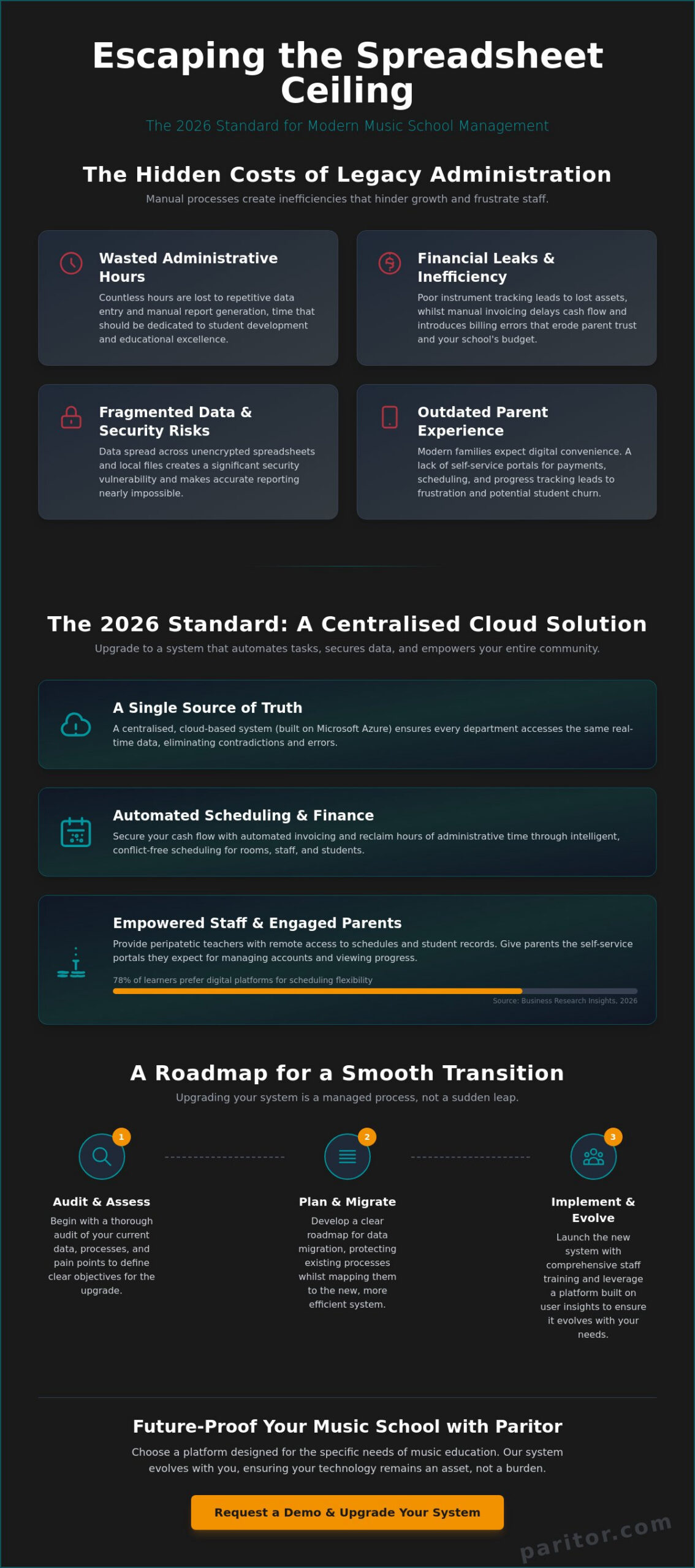
Every hour your staff spends on repetitive data entry is an hour stolen from student development. Fragmented data often leads to chaos during instrument hire audits, where misplaced records result in lost assets and wasted budget. If you can’t instantly see who has which violin or when a cello is due for maintenance, your capital is effectively leaking away. Administrative errors aren’t just inconvenient; they carry a tangible financial cost. A single missed lesson on an invoice or a double-booked practice room can erode parent trust and lead to student churn. Whilst manual invoicing delays your school’s cash flow, an automated system accelerates it by ensuring bills are sent and tracked without human intervention. When billing is handled via separate spreadsheets, errors are inevitable. These delays directly impact your school’s ability to plan for future expansions or invest in new music technology. A modern system replaces this friction with automated workflows that protect your bottom line.
Meeting Modern Parent and Student Expectations
Families now expect the same level of digital convenience in music education that they receive in every other area of their lives. Self-service portals are the standard across the educational sector. Parents want to manage their own accounts, view real-time schedules, and settle invoices without needing to call the office during working hours. Recent studies show that 78% of learners prefer digital platforms because of the flexibility they offer in scheduling (Business Research Insights, 2026). If your current system doesn’t offer this, you’re likely seeing a dip in student retention. The shift towards digital-first communication is a global trend; parents no longer have the patience for misplaced paper notes or waiting for email replies that get lost in a cluttered inbox. Real-time access to schedules is no longer a luxury; it’s a baseline requirement for busy families managing multiple extracurricular activities. Digital progress reports and instant communication via portals don’t just provide information. They foster a sense of partnership that keeps families engaged for the long term. When parents feel connected to their child’s musical journey through a professional interface, they’re far more likely to remain loyal to your school.
Defining the 2026 Standard: Cloud-Based Management
By 2026, the benchmark for a high-performing music service is a robust cloud-based architecture. This isn’t merely about digital storage; it’s about establishing a centralised “single source of truth” where every department, from finance to faculty, accesses the same real-time data. When you commit to upgrading your music school system, you move away from the inherent risks of local hardware failure and towards the institutional stability of professional hosting. We utilise Microsoft Azure to provide this foundation, ensuring your data is redundant, secure, and always available. This modern approach replaces the headache of manual software patches with automated updates. These seamless transitions ensure your team always works on the latest version without the frustration of system downtime or compatibility errors.
The impact on your teaching staff is immediate. Peripatetic teachers, who often work across various sites, benefit immensely from remote access. They no longer need to wait until they return to a central office to update registers or check student notes. Instead, they can manage their schedules and student records from any location via a mobile device. This level of connectivity is a cornerstone of future-proofing with emerging technology, allowing your school to adapt as pedagogical tools and administrative needs continue to evolve. It’s about empowering your team with the tools they need to succeed in a mobile, digital world.
Security and GDPR Compliance in the UK
UK music services handle sensitive pupil data, making strict British data protection standards a non-negotiable requirement. A cloud-based system simplifies this by centralising security protocols rather than leaving them scattered across individual machines. Role-based access ensures that staff only see the information necessary for their specific duties, protecting student privacy at every level. By moving to the cloud, you also reduce the physical security burden on your school buildings. Your sensitive data no longer lives on a vulnerable local server that could be damaged or stolen. It resides in a fortified digital environment designed to withstand modern threats.
Scalability for Growing Music Services
Growth shouldn’t lead to a proportional increase in administrative headcount. Modular systems allow you to add features as your service expands, whether you’re introducing new ensembles or opening additional sites. This flexibility supports multiple locations without cluttering your daily workflow. We have seen a significant shift from “one-size-fits-all” software to bespoke workflow configuration, where the system bends to your specific needs. If you are ready to see how this looks in practice, you can explore our cloud-based solutions designed specifically for the performing arts. This modular approach ensures that your infrastructure remains an asset to your growth, not a bottleneck that holds you back.
Core Features to Prioritise During an Upgrade
When you’re upgrading your music school system, it’s easy to get distracted by aesthetic interfaces. However, the real value lies in the functional infrastructure that handles your heaviest administrative loads. You need a system that doesn’t just store data but actively manages it. This means prioritising intelligent scheduling and Xperios Ensemble Management to coordinate complex group rehearsals without the manual clash-checking that plagues older methods. By 2026, the standard for excellence includes secure, dedicated portals. Features like the Xperios Parent Portal and Teacher Portal provide the self-service access that families and staff now demand, ensuring everyone stays informed without constant back-and-forth emails.
Transforming Financial Management
Financial stability is the heartbeat of any music service. Xperios Financial Management moves your office away from the exhausting cycle of manual debt chasing. By integrating billing directly with attendance records, you ensure that every lesson is automatically accounted for and invoiced correctly. This automation eliminates the “human error” gap where lessons are taught but never billed. Some industry professionals report that schools moving to automated billing often see a marked reduction in late payments, as the system handles reminders and reporting with clinical consistency. It’s about creating a professional payment experience that respects both your staff’s time and the parents’ need for clarity.
Modernising Instrument Hire and Assets
Managing a fleet of instruments is a logistical challenge that often leads to lost assets and wasted budget. Xperios Instrument Management allows you to digitally track the entire lifecycle of an instrument from its initial purchase through to every repair and hire period. You can organise hire schemes with automated contract generation and digital signatures, removing the need for physical paperwork that easily gets lost. To streamline the physical audit process amongst your staff, consider these modern tracking methods:
- Digital Asset Mapping: Instantly see the location and status of every instrument in your inventory.
- Automated Hire Contracts: Generate legal agreements that parents can sign on their mobile devices.
- Maintenance Scheduling: Set automated alerts for routine servicing to extend the life of your equipment.
- Streamlined Audits: Utilise barcodes or RFID technology to quickly scan and verify stock during termly checks.
By focusing on these core functional modules, you ensure your system upgrade provides a genuine return on investment. It’s no longer about simply digitising your records; it’s about deploying an industrious engine that handles the labour-intensive tasks for you.
Managing the Transition: A Roadmap for System Upgrades
Transitioning to a new platform requires more than just a software switch; it demands a clear, strategic roadmap. Upgrading your music school system is a journey that begins with a thorough audit of your current administrative processes. You must identify exactly where data flows and where it gets stuck. Selecting a partner who understands the unique nuances of music services is the next critical step. You don’t need a generic tool; you need a solution built by industry veterans who recognise the difference between a standard invoice and a complex ensemble hire agreement. To keep your school running smoothly, execute a phased migration rather than a “big bang” launch. This approach minimises disruption to the teaching term and allows your team to adjust in manageable stages.
The Data Migration Process
Success depends on the quality of your information. Before moving a single record, take the time to clean and organise your data. Delete duplicate student profiles and update old contact details to ensure a fresh start. This preparation ensures continuity for existing student and teacher records, preventing the frustration of lost history. Once the new system is live, validate your data integrity by cross-referencing a sample of records. It’s about building a foundation of trust in your new centralised database.
Staff Training and Change Management
Internal resistance is natural when changing long-standing habits. To overcome this, communicate the benefits clearly, focusing on how the upgrade reclaims their time. The Xperios Teacher Portal is an excellent tool for simplifying this transition for peripatetic staff, as it offers a familiar, intuitive interface for their daily registers. Implement a structured onboarding programme for all administrative staff and establish a feedback loop during the first term. This allows you to address small issues before they become ingrained habits. If you’re ready to begin your journey, book a personalised demonstration to see how we manage the transition process for you.
Future-Proofing with Xperios by Paritor
Xperios has established itself as the industry standard for music and performing arts schools by focusing on the people behind the instruments. It isn’t just a suite of tools; it’s the result of a collaborative development process built on real user insights. When you commit to upgrading your music school system, you’re adopting a platform that has been refined in the field, not just in a developer’s office. Every module, from Xperios Ensemble Management to the Xperios Exams and Assessments Module, is designed to solve the specific logistical hurdles you face every day. This person-centric approach ensures that the technology feels like a natural extension of your school rather than an external burden.
Strategic alignment is more important than ever as we move through 2026. The National Plan for Music Education demands a high level of transparency and accessibility, and Xperios provides the infrastructure to deliver on these promises. We utilise the Microsoft Azure platform to host our services, providing institutional-grade security and reliability. This technical foundation means your data is redundant and protected by world-class standards, allowing you to focus on student outcomes whilst we handle the digital heavy lifting. It’s about providing a stable, scalable environment that can grow alongside your ambitions.
A Partnership for Long-Term Growth
Paritor acts as a dedicated ally rather than a detached software provider. We recognise that software is only as effective as the support behind it, which is why we prioritise ongoing customisation to suit your specific workflows. We don’t believe in a “one-size-fits-all” approach; we believe in building a system that bends to your needs. Staff feel a profound sense of relief and empowerment when they reclaim their time from repetitive paperwork and redirect it towards their primary creative mission. This shift allows your team to excel in their roles, supported by an industrious engine that works quietly in the background.
Taking the Next Step in Your Digital Journey
The journey from administrative burden to organisational freedom begins with a clear vision of what’s possible. To explore the wider landscape of modern tools, you can read our complete guide to music service management software in 2026. This resource offers a deep dive into the features that are currently shaping the most successful music services in the UK. If you’re ready to see how Xperios can be tailored to your school, we invite you to book a personalised demonstration. We’ll walk you through the portals and modules that matter most to your team, showing you exactly how to future-proof your organisation for the years ahead.
Modernising Your Path to Musical Excellence
The transition from legacy administration to a streamlined, digital environment is more than a technical necessity. It’s a commitment to your staff’s wellbeing and your students’ success. By moving beyond the spreadsheet ceiling and embracing automated billing and secure portals, you replace repetitive labour with strategic focus. You’ve seen how a phased roadmap can mitigate disruption, ensuring that upgrading music school system infrastructure becomes a catalyst for growth rather than a source of stress.
Built on 30 years of industry experience, Xperios is trusted by leading UK music services and hubs to handle their most complex logistical challenges. Our platform is hosted on secure Microsoft Azure infrastructure, providing the stability and peace of mind your institution requires. It’s time to let your software perform the heavy lifting so you can return to the heart of your mission. Discover how Xperios can transform your music school administration and lead your organisation into a more efficient, empowered future. Your journey toward organisational freedom starts today.
Frequently Asked Questions
How long does it typically take to upgrade a music school system?
Upgrading a music school system usually takes between four to twelve weeks, depending on the volume of data and the complexity of your current processes. We recommend a phased migration over a single term to ensure your staff have time to adapt without feeling overwhelmed. This timeline allows for thorough data cleaning, staff training, and system configuration before your full launch.
Is our data secure when moving to a cloud-based management platform?
Your data is highly secure when hosted on a professional cloud platform like Microsoft Azure. This infrastructure provides advanced encryption and redundant backups that most local servers simply can’t match. We implement role-based access controls; this means your staff only see the specific student or financial information required for their daily roles, protecting sensitive pupil records from unauthorised access.
Can we migrate data from our existing spreadsheets into a new system?
You can certainly migrate data from spreadsheets when you’re upgrading your music school system. The process involves auditing your current files to remove duplicates and errors before importing them into the new centralised database. This transition ensures that your historical records for students and teachers remain intact whilst moving into a more reliable and organised environment.
Will a new system help us comply with GDPR for our music service?
A modern system is a powerful tool for maintaining GDPR compliance within your music service. By centralising your data, you eliminate the risk of sensitive information being scattered across unencrypted personal devices or paper files. Features like secure portals and automated data retention policies help you meet British data protection standards with significantly less manual effort from your administrative team.
How does an upgraded system improve communication with parents?
Communication improves through the use of dedicated portals that offer parents real-time access to information. Instead of waiting for email replies, families can check lesson schedules, track student progress, and settle invoices directly through the Xperios Parent Portal. This transparency builds trust and reduces the administrative burden of handling routine enquiries over the phone or via email.
Can we manage instrument hire and repairs within the same software?
You can manage the entire lifecycle of your equipment using Xperios Instrument Management. This module allows you to track everything from the initial purchase and hire agreements to routine maintenance and repair histories. By keeping all asset data in one place, you can streamline your termly audits and ensure that your school’s physical resources are always accounted for.
Is the system suitable for both small private teachers and large music hubs?
The modular nature of our software makes it suitable for everyone from individual private teachers to large-scale music hubs. You can select the specific modules you need, such as Xperios for Private Teachers or Xperios for Music Services, ensuring the system fits your current size. As your organisation grows, you can easily add new features like Ensemble Management or Financial Management without starting from scratch.
Do we need to install any hardware to use a modern cloud system?
You don’t need to install any specialised hardware to use a cloud-based system. All you require is a standard internet connection and a modern web browser on your computer, tablet, or smartphone. This approach eliminates the cost and hassle of maintaining local servers, allowing your team to access the system securely from any location, whether they’re in the office or teaching on-site.