

What if the hours your team spends manually reconciling invoices and tracking down lost cellos could be reinvested directly into the classroom? It’s a common struggle for music hubs and conservatoires across the UK, where fragmented communication and tedious manual billing often lead to late payments and administrative burnout. You deserve a system that understands the unique rhythm of music education, rather than one that adds to the noise.
Implementing the right music service management software is no longer just about digital storage; it’s about creating a partnership that protects your data and your staff’s time. This guide will show you how to transform your administration into a streamlined, GDPR-compliant operation that provides a single source of truth for every student and teacher. We’ll explore how to handle data access requests within the mandatory 30-day window effortlessly and demonstrate how automated billing and real-time parent portals can evolve your service into a modern, efficient institution. Discover how to build a system that does the hard work, so you don’t have to.
Key Takeaways
- Learn how to replace fragmented spreadsheets with a single source of truth that centralises all student, teacher, and ensemble data in one secure location.
- Discover how modern music service management software automates tedious financial reporting and instrument tracking to restore your focus to the art of teaching.
- Master the essentials of GDPR compliance by hosting sensitive data on accredited cloud platforms, ensuring you can action data requests effortlessly within the 30-day limit.
- Improve engagement across your community through real-time portals that simplify communication between the office, parents, and tutors.
- Understand the importance of choosing a management partner that evolves alongside you, using feedback-driven modules designed specifically for the UK music sector.
What is Music Service Management Software?
Music service management software is a specialised, cloud-based platform designed to handle the complex administrative needs of music hubs, schools, and conservatoires. Unlike generic tools that focus on live event booking or venue settlements, these systems are built specifically for the educational journey. They provide a digital infrastructure that manages everything from student registration and teacher scheduling to instrument inventory and financial reporting. It’s a move away from the “reactive” admin of the past. Instead of simply fixing problems as they arise, you gain the power to proactively manage your entire organisation from a single, secure location.
At its heart, this technology creates a “single source of truth.” In many organisations, student data is scattered across various departments; the office has the address, the teacher has the progress notes, and the finance team has the billing history. By centralising this information, you eliminate the fragmentation that leads to errors and missed opportunities. When looking through a list of music software, it’s clear that whilst creative tools help students play, management software helps the organisation breathe. It’s the engine that does the hard work, so you can focus on the music.
The Core Pillars of a Music Management System
A modern system is built on modularity, allowing you to scale as your service grows. The primary focus is often on three critical areas:
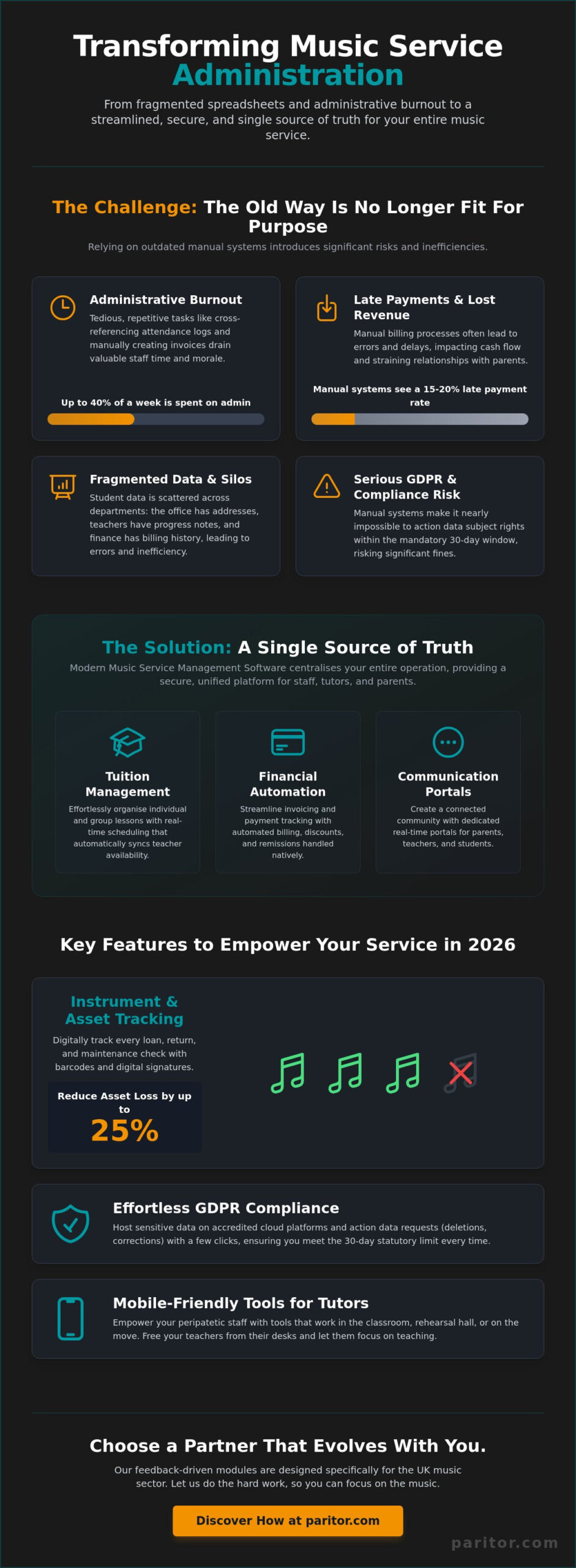
- Tuition management: This involves organising individual and group lessons effortlessly. Modules like “Tuition” and “Groups” allow for real-time scheduling that updates automatically if a teacher’s availability changes.
- Financial automation: Streamlining invoicing and payment tracking is essential. Automated billing ensures that parents receive accurate invoices on time, reducing the 15% to 20% late payment rate often seen in manual systems.
- Communication portals: Dedicated portals for parents, teachers, and students create a connected community. These tools allow for instant updates on lesson times, exam results, and ensemble rehearsals.
Why Spreadsheets are No Longer Fit for Purpose
Relying on spreadsheets in 2026 is a significant risk. Data silos and manual entry errors don’t just cause headaches; they threaten your compliance. With GDPR regulations becoming stricter, evidenced by the €1.2 billion in fines issued across the EU in 2025, the cost of a data breach is too high to ignore. Manual systems make it incredibly difficult to action data subject rights, such as deletions or corrections, within the mandatory 30-day window.
Tedious tasks like cross-referencing attendance logs with invoices drain valuable resources. Staff often spend up to 40% of their week on these repetitive administrative burdens. Real-time reporting is now a necessity for local authority requirements and stakeholder transparency. A dedicated management partner provides the peace of mind that your data is secure whilst giving you the insights needed to evolve and grow your service.
Key Features to Look for in 2026
The landscape of music education is shifting. In 2026, the best music service management software prioritises the person over the process. Teachers shouldn’t be tethered to a desk. Peripatetic tutors need mobile-friendly tools that work in the classroom, the rehearsal hall, or on the train. When your software does the hard work, your staff can rediscover the joy of teaching. Efficiency isn’t just a buzzword; it’s the difference between a thriving music hub and one buried under paperwork.
Integrated financial modules are a game-changer for office productivity. Whilst many systems offer links to third-party accounting software, these often fail to capture the nuance of music tuition. An integrated system handles complex billing cycles, sibling discounts, and remissions natively. This ensures your financial reporting is accurate without the need for manual data exports or the risk of synchronisation errors. It creates a seamless experience from the first lesson booking to the final payment. If you’re looking to understand how to run a music service efficiently, adopting integrated financial automation is one of the most impactful steps you can take.
Instrument Inventory and Asset Tracking
Managing a fleet of thousands of instruments is a logistical mountain. Modern systems use barcodes and digital signatures to track every loan, return, and maintenance check. This level of accountability reduces asset loss by up to 25% in large organisations. By linking the Xperios Instrument Management module directly to student records, you ensure that every violin or trumpet is accounted for at all times, with maintenance schedules triggered automatically to keep your inventory in top condition.
Teacher, Parent, and Student Portals
Portals are the frontline of community engagement. They slash the “where is my lesson” enquiries that often clog up office phonelines. Teachers use these tools to track attendance and record progress reports on the move. Parents get a secure, private space to view payment history and student updates. It’s a transparent system that builds trust and keeps everyone in the loop without the need for endless email chains or physical letters.
Ensemble and Event Management
Organising a music hub tour or a local concert involves a dizzying array of permissions and rehearsal schedules. A unified platform tracks attendance for ensembles and manages the specific “Exams” workflow for tutors. You can oversee assessments and assessment results in real time. It simplifies the movement from individual tuition to large-scale events, ensuring no student is left behind in the administrative shuffle and every event is fully staffed and compliant.
Ensuring Data Security and GDPR Compliance
A common question amongst administrators is whether student data is truly safe in the cloud. It’s a valid concern when you’re responsible for the personal details of thousands of children. Moving to a professional music service management software platform actually enhances security compared to local spreadsheets or physical servers. By hosting data on accredited platforms like Microsoft Azure, you benefit from enterprise-level security that individual schools or hubs simply can’t replicate. It’s a transition from a vulnerable, fragmented system to a robust, protected environment.
Reliability is built into the architecture through mirrored servers. This setup ensures 99.9% uptime; if one server encounters an issue, another takes over instantly without your staff even noticing. Your office stays open and your teachers stay connected. Automated backups are performed constantly to prevent catastrophic data loss. In the event of a local hardware failure in your building, your data remains untouched and ready to access. This provides a stable, reassuring presence for your entire organisation.
GDPR and the Music Education Sector
Managing data for minors requires the highest level of scrutiny. In 2025, regulators issued over €1.2 billion in fines for data breaches, proving that compliance is a critical institutional requirement. Centralised software simplifies the process of handling Subject Access Requests (SARs). Under current regulations, you must action these requests within 30 days from the original request. Finding every mention of a student across twenty different spreadsheets is a nightmare; finding it in a single database takes seconds. You can meet your legal obligations effortlessly whilst maintaining professional trust.
Role-based access control is another vital layer of safety. It ensures that a peripatetic teacher only sees the schedules for their own students, whilst the finance team only accesses billing information. This “need-to-know” structure is a core requirement for modern institutional safety. It prevents internal data leaks and ensures that sensitive information is only available to those who truly need it to perform their roles.
Peace of Mind with Accredited Systems
When reviewing a Service Level Agreement (SLA), look for clear guarantees on data sovereignty and uptime. Working with a partner that understands UK educational standards ensures your system is built around the specific needs of music hubs and conservatoires. Cloud-based systems are often more secure than local servers because they’re monitored 24/7 by dedicated security teams. You don’t have to worry about a physical server in a dusty cupboard being stolen or damaged by a leak. It’s a modern approach that does the hard work of protection, so you don’t have to.
Choosing the Right Management Partner
Selecting the right partner for your music service management software requires looking beyond the immediate feature list. You need a partner that understands the specific pedagogical needs of the UK music sector. Generic CRM systems might seem appealing initially, but they often require expensive, bespoke customisation to handle simple tasks like sibling discounts or instrument maintenance cycles. Choosing a sector-specific partner eliminates these hidden costs. A system built on “valuable feedback” from actual music service managers ensures the platform evolves alongside your organisation, rather than forcing you to adapt to a rigid, corporate framework. The same principles apply when evaluating a performing arts school administration system, where sector-specific functionality is equally critical to long-term success.
The long-term ROI of a dedicated system is found in the reduction of administrative overhead. When your office staff no longer spend 15 hours a week manually reconciling payments, they can focus on student recruitment and ensemble development. It is an investment in your staff’s mental well-being and your service’s professional reputation. You are not just buying a tool; you are entering a partnership with an expert facilitator that has a 30-year heritage in supporting UK music education. To see how this partnership can transform your office efficiency, book a personalised demonstration of Xperios today.
Onboarding and Implementation
Implementation shouldn’t be a source of stress. A professional data migration process involves cleaning your existing spreadsheets and mapping them to a new, structured database. This prevents the “migration headache” that often plagues digital transitions. Structured training for both administrative staff and peripatetic tutors is vital. Your team should feel empowered, not overwhelmed. A dedicated implementation partner ensures that your transition is smooth and that your team hits the ground running from day one, with full support during the critical first term.
Scalability for Growing Hubs
Growth is the goal. Your software must be able to scale effortlessly as your student numbers increase or your ensemble lists expand. Look for a modular approach where you can add specific capabilities, such as “Exams” or “Events,” only when you need them. Tiered licensing is a fair way to manage costs. For instance, music school plans typically start at £32 per user/monthly, whilst larger music hubs benefit from bespoke pricing models that include premium support and third-party payment integrations. This ensures you only pay for what you use whilst keeping the door open for future expansion as your hub evolves.
Evolve with Paritor Xperios
Paritor Xperios represents the culmination of 30 years of dedicated service to the UK music education sector. Since its founding in 1994, the company has evolved from a simple database tool into a sophisticated, cloud-based engine that powers the country’s most successful music hubs and conservatoires. This isn’t just another piece of music service management software; it’s a platform built “by you” through decades of collaborative feedback. We act as an Expert Facilitator, providing the technological backbone that allows your teachers to shine whilst we handle the administrative heavy lifting.
Our philosophy is simple. We believe in providing software that does the hard work, so you don’t have to. This commitment to partnership has made Xperios the definitive choice for organisations that value stability, innovation, and deep industry knowledge. By choosing Paritor, you’re not just adopting a new tool; you’re joining a community of professionals dedicated to the art of teaching. It’s a reassuring, stable presence in an ever-changing educational environment.
Why Xperios is the Favourite of Music Hubs
The strength of the platform lies in its modularity. You can tailor the system to your specific needs using short, punchy modules like Tuition, Groups, and Instrument Management. This allows for a steady, logical flow of data across your entire organisation. The Rapport module is specifically designed to enhance communication and engagement, ensuring that parents and students feel connected to their musical journey in real time. It’s about building a community, not just a database.
Our proven track record includes long-standing partnerships with UK conservatoires and local authorities. These institutions rely on Xperios to manage complex ensembles, assessments, and financial reporting with absolute precision. Whether you’re managing a small private practice or a large-scale music hub, the software provides the same level of institutional safety and professional trust. We understand the specific headaches of an orchestra manager or a music tutor because we’ve been solving them for over three decades.
Taking the Next Step
Your digital transformation journey doesn’t have to be a daunting task. We’ve refined our onboarding process to ensure it’s as smooth as possible. By centralising your student and teacher data, you can move away from tedious manual tasks and focus on what truly matters: providing world-class music education. Growth is the goal. We’re here to help you achieve it.
Seeing the software in action is the best way to understand how it can solve your specific administrative headaches. We invite you to book a bespoke demonstration where our team will walk you through the modules that matter most to your organisation. Leave the spreadsheets behind and move forward with a partner who understands your world.
Evolve your music service with a free Xperios demo today.
Evolve Your Music Service for 2026 and Beyond
Moving from fragmented spreadsheets to a unified digital ecosystem is the most significant step your organisation can take this year. By centralising student data and automating billing cycles, you remove the administrative friction that prevents tutors from focusing on their students. You gain the peace of mind that comes from hosting sensitive information on Microsoft Azure, ensuring your hub remains fully GDPR compliant whilst maintaining 99.9% uptime. It’s a modern solution for a modern service.
Choosing the right music service management software is about finding a partner that understands the unique rhythm of UK music education. With over 30 years of industry experience, Paritor has built Xperios on the valuable feedback of the people who use it every day. It’s a system trusted by leading UK music hubs and conservatoires because it’s an expert facilitator for your team. Let your software do the hard work, so you don’t have to. The future of your service starts with a single, smart choice.
Book a free demo of Xperios for Music Services and discover how to empower your staff today.
Frequently Asked Questions
What exactly is music service management software?
Music service management software is a specialised digital infrastructure designed to centralise the administrative tasks of music hubs and conservatoires. It replaces disconnected spreadsheets with a single, secure database for managing student registrations, teacher timetables, and billing. This allows your team to move away from reactive paperwork and focus on delivering high-quality music education, ensuring all information is accurate and accessible across your entire organisation in real time.
Is my music service data secure in a cloud platform?
Your data is more secure in a cloud environment than on local physical servers. Professional systems use enterprise-grade hosting like Microsoft Azure, which provides robust encryption and constant security monitoring. Mirrored servers ensure 99.9% uptime; if one server fails, another takes over instantly. This level of technical protection is often impossible for individual schools to maintain, offering a stable and reassuring presence for your sensitive information.
Can I manage instrument loans and inventory with this software?
You can track every instrument in your inventory using specialised asset management tools. By utilising barcodes and digital signatures, you log loans and returns with total precision, which helps reduce the asset loss often associated with manual tracking. Linking these records directly to student profiles ensures that every violin or cello is accounted for, allowing you to manage maintenance schedules and stock levels effortlessly across multiple locations.
How does automated billing work for music tuition?
Automated billing works by synchronising your tuition schedules directly with an integrated financial module. This modern approach to music service management software handles complex calculations like sibling discounts and remissions automatically. By providing parents with secure portals to view and pay invoices, you can reduce late payments significantly. It eliminates the need for manual reconciliation, allowing your finance team to process thousands of transactions smoothly and accurately.
Is Xperios compliant with UK GDPR regulations?
Xperios is designed to meet all UK GDPR requirements, providing specific tools for managing the sensitive data of minors. The system simplifies the process of handling Subject Access Requests, enabling you to extract and provide data within the legal 30-day timeframe. Role-based access control ensures that staff only see the information they need, protecting student privacy whilst maintaining the professional trust of parents and local authorities.
Can peripatetic teachers access their schedules on mobile devices?
Peripatetic tutors can access their full schedules and student progress notes on any mobile device through dedicated portals. This mobile-first design allows teachers to record attendance and provide feedback whilst in the classroom or travelling between schools. There’s no need for paper registers, as all updates synchronise instantly with the central office. It ensures that everyone remains connected, regardless of where the teaching takes place.
How long does it take to migrate data from spreadsheets to Xperios?
A typical migration from spreadsheets to a professional system is completed within a single academic term. Our expert facilitators manage the structured data migration process, ensuring your existing information is cleaned and mapped correctly. This transition includes thorough training for your administrative staff and teachers, so the whole team feels empowered to use the new tools effectively from the very first day of the new term.
Does the software support ensemble and concert planning?
The software provides comprehensive support for planning ensembles, concerts, and tours through dedicated modules. You can manage rehearsal schedules, track student attendance for large-scale events, and handle parent permissions all in one place. This centralisation ensures that every event is fully staffed and compliant with safety regulations, allowing you to focus on the performance rather than the logistics of event administration.