

What if the most significant obstacle to your students’ musical growth isn’t their dedication to practice, but the weight of your office paperwork? Many music school leaders find themselves trapped in a cycle of manual invoicing and chasing late payments, whilst juggling complex peripatetic timetables on fragile spreadsheets. Implementing robust music school workflow automation is no longer a luxury for the tech-savvy; it’s a vital step for any institution that wants to remain relevant in a global market projected to exceed £4 billion by 2032.
You likely started your school to foster talent, not to spend your evenings reconciling instrument hire lists or untangling scheduling conflicts. We understand that the transition from legacy systems can feel daunting, yet the relief of a centralised source of truth is transformative. This guide will show you how to reclaim hundreds of hours by modernising your administrative processes, ensuring your staff can finally shift their focus back to musical excellence. We’ll explore how automated financial reporting and secure portals can create a seamless experience for teachers, parents, and students alike.
Key Takeaways
- Quantify the true cost of administrative friction and learn how manual data entry creates a bottleneck for musical growth.
- Explore the core pillars of music school workflow automation to synchronise complex timetables with error-free financial reporting.
- Evaluate the strategic advantages of modular systems over rigid platforms to ensure you only pay for the features your organisation actually needs.
- Master a strategic roadmap for digital transformation that ensures safe data migration from legacy spreadsheets to secure cloud environments.
- Discover how modernising your workflows can reclaim hundreds of administrative hours whilst improving the experience for teachers, students, and parents.
The High Cost of Manual Admin in Music Education
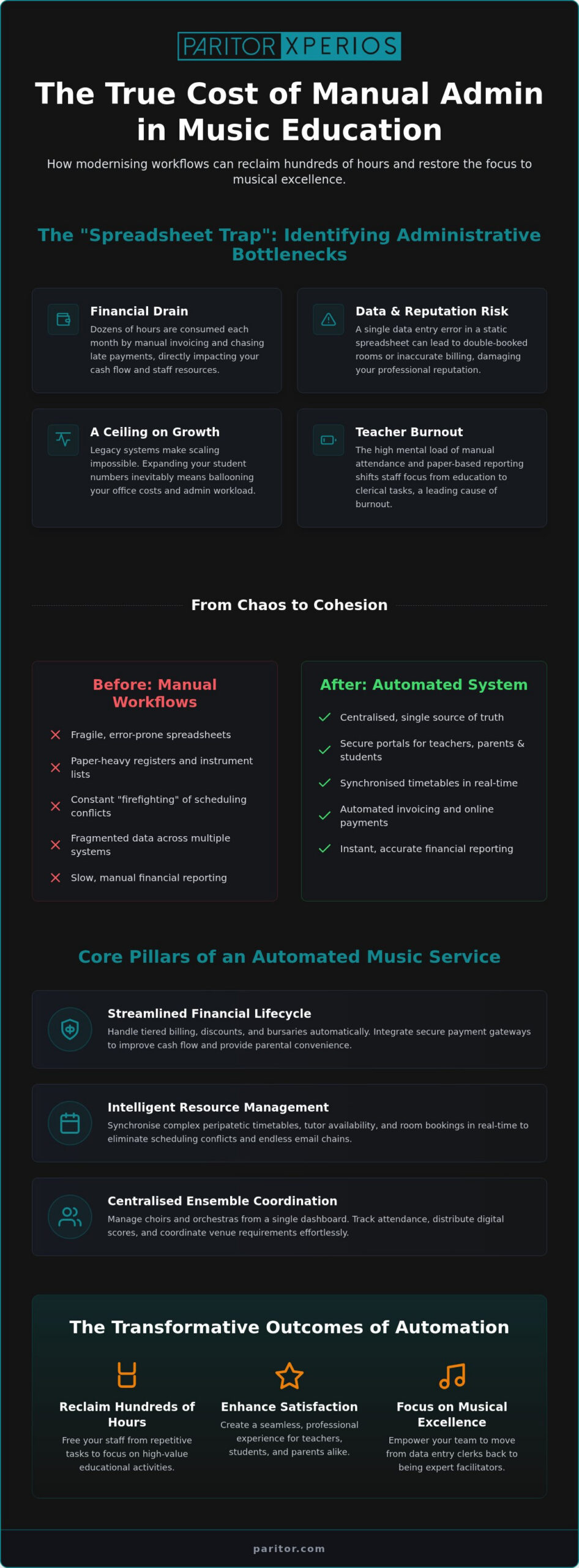
Relying on manual processes is like trying to conduct an orchestra where every musician is reading from a different score. For many UK music services, the “spreadsheet trap” is a daily reality. Whilst spreadsheets feel familiar, they’re static tools ill-suited for the dynamic nature of instrument tracking and lesson scheduling. A single data entry error can ripple through your entire organisation, leading to double-booked rehearsal spaces or inaccurate billing that damages your professional reputation.
Administrative friction isn’t just a nuisance; it’s a financial drain. Manual invoicing and chasing late payments can consume dozens of hours every month. When your team spends their time cross-referencing bank statements against paper registers, they aren’t supporting your educational mission. Adopting Business process automation allows you to replace these repetitive tasks with reliable, digital workflows. Without this shift, legacy systems often act as a ceiling on your growth, making it impossible to scale your student numbers without also ballooning your office costs.
Identifying Administrative Bottlenecks
Recognising the signs of an overwhelmed admin department is the first step toward recovery. If your staff are constantly “firefighting” scheduling conflicts or if your financial reporting takes days to compile, you have a bottleneck. Paper-heavy functions are particularly costly in a digital-first world. Fragmented data stored across different computers prevents music leads from making informed decisions about resource allocation or instrument procurement. Effective music school workflow automation eliminates these silos, providing a single source of truth that keeps everyone on the same page.
The Human Element: Admin vs. Education
The true cost of manual admin is often measured in human terms. High levels of administrative burden are a leading cause of teacher burnout. Peripatetic teachers already manage complex travel schedules; adding the mental load of manual attendance tracking and paper-based reporting is often the breaking point. By modernising these workflows, you restore the balance between clerical tasks and educational focus. Automation empowers your staff to move away from being data entry clerks and back to being expert facilitators. This shift doesn’t just improve efficiency; it directly enhances student satisfaction. When teachers have more time to focus on personalised support rather than paperwork, the quality of the musical experience improves for everyone involved.
Core Pillars of Automating Music School Workflows
A successful music service relies on more than just talented tutors. It requires a robust infrastructure where every administrative task supports the educational goal. Achieving true music school workflow automation means connecting your financial, scheduling, and inventory data into a single, cohesive ecosystem. This removes the friction of manual data transfer and ensures that information flows seamlessly from the first booking to the final exam. When these systems work in harmony, you create a stable foundation that allows your school to scale without increasing the administrative burden on your staff.
Streamlining the Financial Lifecycle
Managing varied tuition fees and activity costs shouldn’t be a headache for your accounts team. Modern systems like Xperios Financial Management handle tiered billing for different student groups effortlessly, applying discounts or bursaries automatically. By integrating secure online payment gateways, you provide parents with a familiar and convenient checkout experience. This significantly reduces the time spent chasing outstanding balances and improves your school’s cash flow. Automated financial reporting then allows you to present accurate, real-time data to stakeholders or local authorities, ensuring full transparency without the need for manual spreadsheet tallying.
Intelligent Resource and Ensemble Management
Coordinating peripatetic timetables across multiple sites is one of the most taxing roles in music admin. Smart scheduling tools help you manage these complexities by synchronising tutor availability with room bookings in real-time. For larger organisations, using specialised ensemble management software is essential for coordinating choirs and orchestras. This allows you to track attendance, distribute digital scores, and manage venue requirements from a single dashboard. It ensures your ensembles run smoothly without the need for endless email chains or paper registers.
Unlike generic tools, a dedicated music management platform integrates asset control directly into your daily operations. Xperios Instrument Management allows you to track loans, maintenance history, and repair schedules alongside student records. This ensures no asset is lost and every instrument is accounted for throughout its lifecycle. Secure portals further empower parents and students to update their own contact details and view lesson schedules. This shift reduces the volume of routine enquiries hitting the main office, allowing your team to focus on higher-value tasks. Discover how Xperios for Music Services can transform your daily operations and restore your focus to musical excellence.
Modular vs All-in-One: Selecting the Right System
Choosing the right platform is a strategic decision that shapes your school’s future. Many leaders fall into the all-in-one trap, where they pay for a bloated suite of features they’ll never use. This unnecessary complexity often leads to staff frustration rather than the intended efficiency. A modular approach ensures you only invest in the capabilities you need today, whether that’s Instrument Management or the Exams and Assessments Module. This philosophy of simplicity allows your team to master the tools they actually use without being overwhelmed by a cluttered interface.
Scalability is crucial as your student numbers grow amongst your expanding community. Your software must be an industrious engine behind the scenes, not a bottleneck that hinders your progress. Effective music school workflow automation allows you to add specific modules as your organisation evolves, ensuring your system is always the right size for your current needs. Integration is another vital factor; your admin system must talk to your accounting software to ensure error-free financial reporting. This creates a seamless flow of data that saves time and reduces the risk of manual errors during data transfer.
Evaluating System Flexibility
Modularity allows for bespoke workflows that reflect the unique needs of different departments. A conservatoire requires vastly different tools than a private tutor, and tiered licensing reflects this reality. A one-size-fits-all approach often fails music organisations because it ignores the specific nuances of peripatetic teaching and ensemble coordination. By choosing a system built on collaborative user input, you ensure the tools actually solve your specific management frustrations. This person-centric approach creates a trustworthy atmosphere where the software feels like a dedicated ally in your educational mission.
Cloud-Based vs On-Premise Solutions
By 2026, cloud management has become the definitive industry standard for music services. Hosting your data on secure platforms like Microsoft Azure provides maximum reliability and top-tier security, ensuring GDPR compliance is handled automatically. This shift allows you to manage your music service from any device, anywhere, which is essential for staff working across multiple sites or schools. Moving to a SaaS subscription model also reduces IT overheads, as you no longer need to maintain expensive on-site servers or handle manual updates. It’s a cost-effective way to ensure your institution remains technologically savvy whilst prioritising your core mission over technical maintenance.
A Strategic Roadmap for Digital Transformation
Successful digital transformation requires a structured approach rather than a frantic rush. You should begin by auditing your current manual processes to identify which administrative tasks cause the most friction. Often, the most impactful starting point for music school workflow automation is the replacement of fragmented spreadsheets with a centralised database. Once your priorities are clear, the focus shifts to data migration. Safely moving your student records from legacy systems to a secure cloud environment is a critical milestone. Training is vital. Comprehensive staff onboarding ensures your team feels empowered by the new tools rather than overwhelmed by them. Remember that automation is a continuous evolution. Regularly use feedback from your tutors and office staff to refine your workflows and maintain peak efficiency.
Ensuring Data Security and Compliance
Maintaining high standards of GDPR compliance is a primary concern for any UK music service managing sensitive student data. Legacy systems often lack the robust encryption required to meet modern regulatory standards. By hosting your data on Microsoft Azure, you benefit from institutional-grade safety and redundancy that on-premise servers simply cannot match. This secure foundation allows you to manage student and parent permissions with confidence. A dedicated parent portal for music schools provides a transparent way for families to access their own data whilst ensuring your organisation remains fully compliant. It’s about building trust through professional-grade security.
Measuring the ROI of Automation
The value of modernising your admin is best seen through clear metrics. You should track the time savings across key tasks such as invoicing and timetable coordination to quantify the impact on your bottom line. Many organisations report a significant reduction in administrative errors and financial discrepancies within the first few months of implementation. These data insights don’t just prove the system’s worth; they allow you to plan for future service expansion with precision. When you aren’t bogged down by clerical mistakes, you have the clarity to focus on growth. Adopting a strategic approach to music school workflow automation ensures your service remains resilient and competitive. If you’re ready to start your journey, explore how Xperios can support your digital transformation today.
Xperios: The Intelligent Engine for Modern Music Services
Xperios isn’t just a collection of administrative tools; it’s the industrious engine that allows your organisation to excel. After auditing your processes and securing your data on the cloud, you need a platform that scales alongside your ambitions. By centralising your operations, Xperios delivers a complete guide to music service management software that transforms how you interact with your community. It’s a partnership designed to remove the friction of repetitive labor, allowing you to reclaim hundreds of hours for what matters most: the music.
Building meaningful connections with your students is the heart of any successful music school. The Rapport module provides the power to nurture these relationships through better communication and progress tracking. This specific focus on student engagement ensures that music school workflow automation doesn’t feel cold or detached. Instead, it creates a supportive environment where teachers can offer personalised guidance whilst the system handles the clerical heavy lifting. We also recognise that every institution has its own rhythm. Our bespoke development services mean we can tailor Xperios to your unique organisational needs, ensuring the software fits your workflow perfectly.
A Partner-Centric Approach to Software
We’ve spent decades listening to the frustrations of music leads and peripatetic teachers. This collaborative input is the foundation of Xperios. Our philosophy of simplicity is visible in our naming conventions; we use short, one-word titles for our modules to ensure clear functionality. Whether you’re using Ensemble, Finance, or Instrument, the interface remains intuitive and focused. You’re never alone on this journey. We provide dedicated UK-based support and structured onboarding programmes to ensure your transition is seamless. You’re joining a growing community of UK music services that have chosen to evolve with Paritor, moving away from legacy burdens toward a more empowered future.
Getting Started with Xperios
The first step toward modernising your school is seeing the technology in action. We invite you to arrange a bespoke demo where you can witness how automation solves your specific scheduling and billing challenges. This consultative process allows you to evaluate which modules are right for your organisation size, ensuring you only pay for the capabilities you actually use. Whether you manage a large conservatoire or a small private practice, our modular system scales to fit your student numbers. It’s time to stop drowning in spreadsheets and start focusing on excellence. Taking this step is a necessary move forward in your professional journey, ensuring your school remains a technologically savvy leader in music education.
Empowering Your Future Through Digital Transformation
The journey toward operational excellence begins with a single, decisive step away from the spreadsheet trap. We’ve explored how transitioning from fragmented legacy systems to integrated music school workflow automation removes the repetitive burdens that stifle growth. By adopting a modular approach, you ensure your organisation only pays for the capabilities it needs, whilst institutional-grade security on Microsoft Azure provides absolute peace of mind.
With over 30 years of industry experience, Paritor is more than a software provider; we’re a dedicated ally in your educational mission. Our UK-based support team is ready to guide you through a structured onboarding process that respects the unique rhythm of your service. It’s time to restore your focus to musical excellence and leave the clerical heavy lifting to an industrious engine built specifically for your needs.
Arrange a demo of Xperios to see how automation can transform your music service and start reclaiming the time your students deserve. Your more efficient, music-focused future is well within reach.
Frequently Asked Questions
What are the primary benefits of music school workflow automation?
The primary benefits include reclaiming hundreds of administrative hours and improving accuracy across all departments. By centralising your data, you eliminate the need for repetitive manual entry and reduce the risk of human error. This allows staff to focus on musical excellence rather than paperwork. Additionally, music school workflow automation improves student and teacher satisfaction by providing real-time access to schedules and financial records through secure, dedicated portals.
How does automation help with music instrument inventory tracking?
Automation streamlines instrument tracking by integrating inventory control directly into your daily operations. You can monitor the entire lifecycle of an asset, from the initial loan to maintenance history and repairs. The system automatically alerts you when instruments are due for return or service, preventing lost assets and ensuring equipment remains in top condition. This centralised approach replaces fragmented spreadsheets with a reliable, digital audit trail for every piece of equipment.
Is cloud-based music school software secure and GDPR compliant?
Our cloud-based platform is highly secure and fully GDPR compliant. We host all data on Microsoft Azure, which provides institutional-grade safety and redundancy. This ensures your sensitive student and parent information is protected by industry-leading encryption and security protocols. By moving away from local servers and paper files, you benefit from a system designed specifically to meet the rigorous data protection standards required by UK local authorities and educational bodies.
Can I automate invoicing for different types of music lessons?
You can certainly automate invoicing for varied lesson types, including individual tuition, group classes, and ensemble rehearsals. Xperios Financial Management handles tiered billing structures effortlessly, automatically applying specific rates, bursaries, or discounts based on student profiles. This removes the mental load of manual calculations and ensures that invoices are generated accurately and sent out on time. It also integrates with online payment gateways to reduce late payments and improve cash flow.
Will automating admin tasks make my music school feel less personal?
Automating admin tasks actually makes your school feel more personal by freeing up staff to engage directly with students and parents. When you aren’t bogged down by clerical duties, you have more time for meaningful support and communication. Tools like the Rapport module help you nurture relationships through better progress tracking and personalised updates. Automation removes the friction of paperwork, allowing the human element of music education to remain the primary focus.
How long does it typically take to implement an automated management system?
The implementation timeline varies depending on the size of your organisation and the complexity of your data migration. Typically, a structured onboarding programme ensures that your team is proficient within a few weeks. We provide dedicated UK-based support to guide you through initial configuration and account setup. This facilitator approach ensures a smooth transition from legacy systems, allowing you to begin seeing the efficiency benefits of automation as quickly as possible.
Can I customise the software to fit my school’s unique workflows?
The platform is designed with a modular philosophy that allows you to tailor the system to your specific organisational needs. You only pay for the capabilities you use, whether that’s Ensemble Management or the Exams and Assessments Module. For more unique requirements, we offer bespoke development services to ensure the software fits your existing workflows perfectly. This collaborative approach ensures that the technology adapts to your school, rather than forcing you to change how you teach.
Does automating admin help with peripatetic teacher scheduling?
Automation is exceptionally effective for managing complex peripatetic teacher schedules across multiple sites. The system synchronises tutor availability with room bookings and student timetables in real-time. This eliminates double-bookings and the need for endless email chains. Teachers can access their schedules and record attendance through the dedicated Teacher Portal, reducing their administrative load. This level of organisation ensures that your visiting staff can focus entirely on delivering high-quality music instruction.