

If a parent asked you exactly how their child’s sensitive medical data was encrypted this morning, could you answer with absolute confidence? For many music service leads, the honest answer is a source of quiet anxiety. The administrative burden of manual tracking is exhausting; whilst the fear of a data breach involving minors looms larger than ever. Following the Royal Assent of the Data (Use and Access) Act 2026 on 19 June, the rules for safeguarding student data in music education have shifted, leaving many providers feeling overwhelmed by new compliance hurdles.
We understand that your primary mission is fostering musical talent, not managing complex databases. You deserve a system that acts as a silent, secure partner in your daily operations. This guide provides a clear framework for evaluating secure software and understanding your institutional liability under the latest UK GDPR requirements. We’ll walk through your specific legal obligations and show you how to implement a robust infrastructure that protects your pupils and restores your peace of mind. It’s time to move beyond paperwork and return your focus to the music.
Key Takeaways
- Understand how the Data (Use and Access) Act 2026 impacts your legal obligations and learn to navigate shifting UK GDPR requirements with absolute confidence.
- Identify the hidden risks of manual data tracking and discover how automated systems can drastically reduce the potential for accidental data breaches.
- Establish a robust framework for safeguarding student data in music education by conducting comprehensive audits and implementing Multi-Factor Authentication.
- Learn how to leverage secure cloud-based solutions like Xperios for Music Services to protect sensitive pupil information whilst reclaiming time for creative leadership.
The Evolution of Data Safeguarding in Music Education
The days of paper registers and physical filing cabinets are long gone. By 2026, music services have moved into complex digital ecosystems where information flows between teachers, parents, and administrative teams in real time. This digital shift has brought immense efficiency, but it’s also created new vulnerabilities that didn’t exist a decade ago. Safeguarding student data in music education is no longer just a checkbox for your annual audit; it’s a fundamental pillar of your service’s infrastructure.
Many organisations still grapple with “shadow IT.” This happens when well-meaning teachers use personal WhatsApp groups or private cloud storage to share lesson schedules and student details. Whilst these tools feel convenient, they exist outside your institutional control. They bypass the strict protections required by the General Data Protection Regulation (GDPR) and leave your hub exposed to significant liability. True modern safeguarding requires a balance; you need to make data accessible for the travelling tutor whilst keeping it under a rigorous, centralised lock and key.
From Spreadsheets to Secure Cloud Environments
Excel was never designed to be a database for sensitive pupil information. Managing instrument loans or student lists on local spreadsheets creates a fragmented “attack surface.” Every time a file is emailed or saved to a USB stick, the risk of a data breach increases. Transitioning to a centralised, cloud-based system allows you to professionalise your hub administration. By adopting dedicated music service management software, you eliminate these isolated pockets of data. This ensures that every piece of information, from a violin’s serial number to a student’s home address, is stored in a secure, encrypted environment.
The Unique Challenges of Performing Arts Data
Music services handle a depth of sensitive data that many other educational bodies don’t. Think about a typical residential tour. You’re managing medical histories, dietary requirements, and photo consents all in one place. During off-site events or ensemble rehearsals, this information must be accessible to staff for safety reasons, yet strictly protected from unauthorised eyes. Safeguarding student data in music education means ensuring that a visiting conductor only sees what they need for tuition, whilst sensitive medical alerts remain restricted to the designated safeguarding lead. It’s about granular control in a high-pressure, mobile environment.
Defining the Standards: UK GDPR and Student Data Privacy
Compliance isn’t a static target. It’s a continuous commitment to technical and organisational excellence. In the context of safeguarding student data in music education, this means ensuring that every digital interaction is shielded by robust encryption and clear policy frameworks. The Data (Use and Access) Act 2026, which reached Royal Assent on 19 June 2026, has refined the UK GDPR landscape. It places a heavier emphasis on legitimate interests and the security of automated decision-making. For music hubs, this means your software must do more than just store names; it must actively defend them.
One of the most critical aspects of modern compliance is data residency. Whilst the internet is global, your student data shouldn’t be. UK-based cloud hosting remains the gold standard for institutional safety. By utilising infrastructure like Microsoft Azure within UK data centres, hubs ensure that sensitive information never leaves the legal protection of British jurisdiction. This level of technical oversight is what separates a professional operation from a liability-heavy one. If you are looking to modernise your approach, exploring Xperios for Music Services can help align your hub with these rigorous standards.
Core Principles of UK GDPR for Music Hubs
Effective data management relies on three pillars: purpose limitation, data minimisation, and the right to be forgotten. You should only use data for its intended purpose, such as music tuition or financial billing. Collecting excessive information “just in case” is a breach of trust and a regulatory risk. Additionally, you must have a streamlined process for managing the “right to be forgotten.” When a pupil leaves your service, their sensitive records shouldn’t linger in your system indefinitely. Organisations like the Student Privacy Policy Office provide excellent frameworks for understanding these boundaries in an educational setting.
Managing Sensitive Special Category Information
Not all data is created equal. A student’s instrument preference is standard data; their SEND requirements or medical alerts are “Special Category Data.” This information requires enhanced encryption levels and restricted access. It’s about ensuring that sensitive details are only visible to those who strictly require them for the student’s welfare.
- Safeguarding “flags” should be visible only to authorised leads, never to the wider teaching pool.
- Medical data must be instantly accessible for emergencies but hidden during routine admin tasks.
- Digital media, including performance recordings and photo consents, must be stored in encrypted silos rather than local device galleries.
Handling these complexities manually is a recipe for error. A centralised system ensures that these sensitivity levels are baked into the user permissions from day one. This proactive approach protects the student whilst shielding the organisation from the fallout of accidental data exposure.
Systemic Security vs. Manual Oversight: A Comparison
Most data breaches in educational settings aren’t the result of malicious hacking. They’re the result of a tired administrator sending a spreadsheet to the wrong recipient or a teacher losing an unencrypted USB stick. Relying on manual oversight is an invitation for human error. True excellence in safeguarding student data in music education requires moving beyond policy documents into the realm of hardened digital infrastructure. Whilst a written policy tells staff what to do, a secure system makes it impossible for them to do otherwise.
The psychological toll of manual tracking shouldn’t be underestimated. Music service leaders often carry a heavy burden of administrative anxiety, constantly worrying if their records are truly compliant. By 2026, the financial stakes are also higher. Most organisations must now pay an annual data protection fee to the ICO, with Tier 3 fees for large organisations reaching £3,763. Investing in systemic security isn’t just about safety; it’s a strategic move to reduce institutional liability and reclaim mental bandwidth for creative leadership.
The Pitfalls of Disparate Management Systems
Using one app for billing, another for scheduling, and a third for instrument tracking creates dangerous data “silos.” When information is fragmented, maintaining a consistent safeguarding standard becomes nearly impossible. If a parent requests their data under a Subject Access Request (SAR), an administrator must manually hunt through multiple platforms, increasing the risk of missing sensitive files or disclosing information accidentally. This lack of cohesion makes your organisation vulnerable and your staff’s workload unsustainable.
Benefits of a Unified Cloud Infrastructure
A unified system provides a “single version of truth” for every pupil, parent, and teacher. When a teacher updates a student’s medical alert in their portal, that change is instantly reflected across the entire hub, ensuring that administrators and ensemble leads are always working with the most current safety data. This level of synchronisation is a core feature of Xperios for Music Services, where security is built into the workflow rather than added as an afterthought.
- Automated Audit Trails: Track exactly who accessed a student’s file and when they did it.
- Granular Permissions: Ensure staff only see the specific data required for their role.
- Centralised Deletion: Manage the “right to be forgotten” with one click instead of searching through dozens of folders.
This automated approach transforms safeguarding student data in music education from a manual chore into a background process. It allows your team to focus on tuition, knowing the infrastructure is doing the heavy lifting of compliance for them.
Establishing a Robust Data Safeguarding Framework
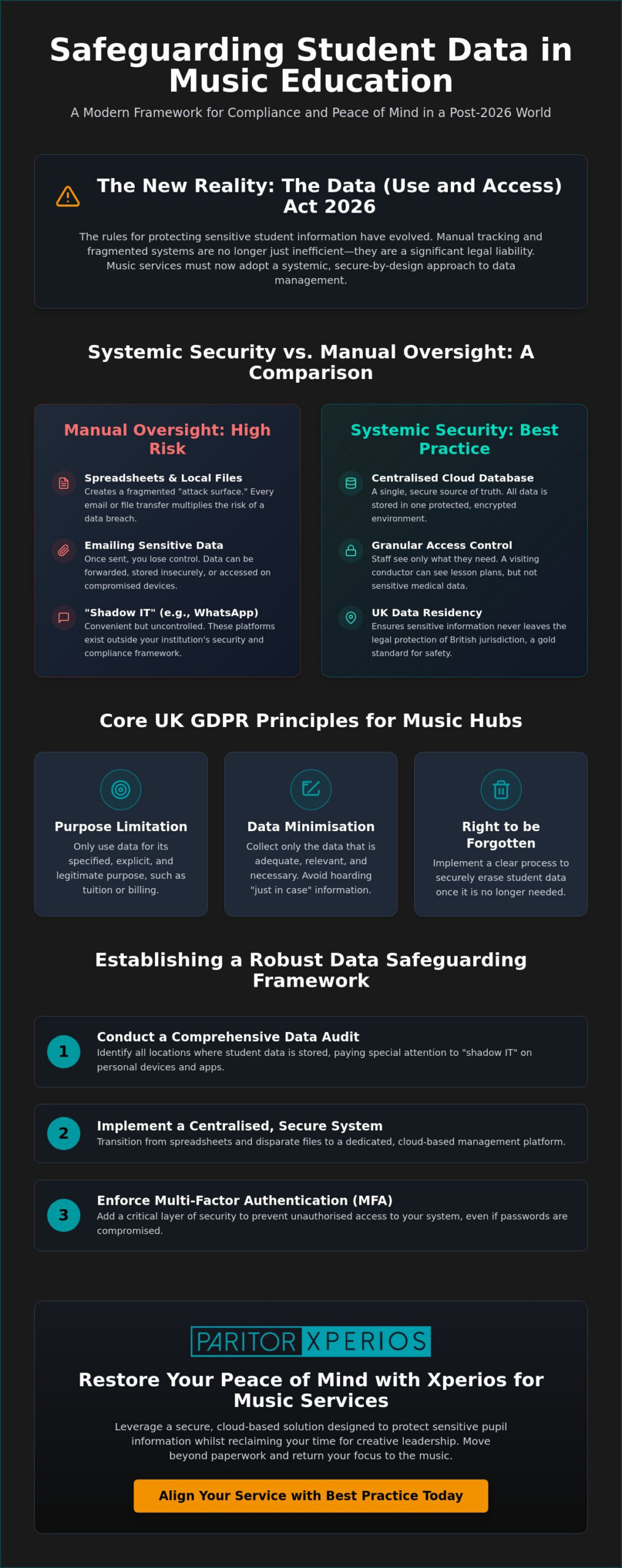
Creating a secure environment isn’t a one-time event; it’s a structural commitment. A robust framework for safeguarding student data in music education begins with a comprehensive data audit. You must map out exactly where your information lives. Does it reside in a locked filing cabinet, a staff member’s personal email, or an unencrypted spreadsheet? Identifying these “data leaks” is the first step toward aligning with the Data (Use and Access) Act 2026. Without a clear map, you cannot defend your perimeter.
Once you’ve identified your data locations, technical barriers must be erected. Implementing Multi-Factor Authentication (MFA) across every administrative account is now a non-negotiable standard. It provides an essential layer of protection that passwords alone cannot offer. Simultaneously, you should review your third-party processor agreements. Ensure that every external partner, from your cloud host to your email provider, adheres to 2026 UK GDPR standards. Establishing clear retention and disposal schedules ensures that you aren’t hoarding sensitive information longer than legally necessary, which significantly reduces your liability if a breach occurs.
Access Control and User Permissions
Modern security relies on the principle of “Least Privilege.” This means giving staff access only to the specific data they need to perform their roles. A peripatetic teacher needs their student’s medical alerts and lesson times, but they don’t require access to the hub’s full financial records. Granular permissions allow you to shield sensitive data whilst maintaining operational flow. This security extends to your families as well. By using a secure parent portal, you ensure that guardians can only view and update their own child’s information, preventing accidental exposure of other pupils’ details.
Staff Training and Behavioural Standards
Technology is only as strong as the people using it. You must move beyond “tick-box” compliance and foster a genuine culture of data safety. Your team needs to understand the risks of accessing student records on public Wi-Fi or leaving devices unlocked whilst visiting school sites. Regular training on phishing awareness and secure digital behaviour is vital. Staff should feel empowered to report “near-misses” without fear of retribution. A transparent reporting procedure allows you to address vulnerabilities before they become headline-making breaches.
If you’re ready to move away from fragmented systems and secure your organisation’s future, request a consultation with our safeguarding experts today.
Scaling Securely with Xperios for Music Services
True excellence in safeguarding student data in music education requires more than just good intentions; it demands a technical partner that understands the specific nuances of the sector. Xperios for Music Services is designed to be that partner. It integrates protection into every administrative workflow, ensuring that security is never an afterthought. By moving your operations into a purpose-built environment, you transition from reactive damage control to proactive institutional safety. This approach doesn’t just protect your pupils; it empowers your staff to focus on their primary mission of tuition.
The administrative burden of manual compliance is a significant drain on resources. Following the Royal Assent of the Data (Use and Access) Act 2026, the complexity of managing legitimate interests and automated processing has only increased. Xperios simplifies this by performing the labor-intensive tasks for you. It acts as a stable, reassuring presence behind the scenes, providing the infrastructure needed to meet modern service standards without the repetitive paperwork. Future-proofing your organisation against evolving cyber threats starts with choosing a system built on collaborative user insights and industry-leading technology.
Built on Microsoft Azure Infrastructure
Security is only as strong as its foundation. Xperios is hosted on the Microsoft Azure cloud platform, providing a level of resilience that local servers or office-based spreadsheets simply cannot match. This world-class infrastructure includes encryption-at-rest, which means your data is unreadable even if the physical storage were accessed. Additionally, data redundancy ensures that your information is backed up across multiple secure UK locations, protecting you against hardware failure or site-specific issues. We prioritise these high standards of reliability so you don’t have to manage the technicalities of cloud architecture yourself.
Automated Compliance and Reporting
Managing the Xperios ecosystem allows you to automate the most taxing parts of data oversight. Generating comprehensive safeguarding reports or detailed audit logs now happens at the touch of a button. This speed is vital when responding to regulatory enquiries or internal audits. The system also streamlines the management of consents and permissions, ensuring that your hub remains the “Cloud Management Standard” for 2026.
- Instant Audit Trails: Every access point is logged, providing a clear narrative for compliance officers.
- Modular Simplicity: Manage Parent, Teacher, and Student portals within one secure, unified framework.
- Regulatory Agility: Updates to UK GDPR requirements are reflected in the system, keeping you ahead of legislative shifts.
By adopting this infrastructure-first approach to safeguarding student data in music education, you reclaim your time and protect your professional reputation. It’s time to let the software handle the burden of compliance, allowing your music service to grow with confidence and clarity.
Securing the Future of Your Music Hub
Protecting your pupils is no longer a matter of simply locking a filing cabinet. It requires a modern, infrastructure-first approach that eliminates the risks of human error. We’ve explored how centralised cloud systems outperform manual oversight and how the 2026 legislative shifts demand a more rigorous framework. True safeguarding student data in music education is about creating a secure environment where information flows safely between teachers and parents without the burden of constant administrative anxiety.
You don’t have to carry the weight of compliance alone. Xperios is designed specifically for the unique needs of UK Music Hubs, providing a stable platform built on collaborative user input. Hosted on Microsoft Azure for maximum security and fully UK GDPR compliant, it performs the labour-intensive tasks that currently drain your team’s time. It’s time to modernise your hub and return your focus to the creative excellence of your students. Discover how Xperios secures your music service data today and experience the relief of a truly professional management system.
Frequently Asked Questions
What are the main GDPR risks for music services in 2026?
The primary risks involve the use of “shadow IT”, such as personal messaging apps or unencrypted spreadsheets, which lack institutional oversight. Following the Data (Use and Access) Act 2026, music services must also ensure they have a lawful basis for any automated processing. Failing to maintain accurate records of processing activities can lead to significant ICO fines. Centralising your data ensures that these vulnerabilities are managed within a secure, compliant framework.
Is cloud-based software safer than keeping student data on a local computer?
Cloud-based software is significantly safer than local storage because it removes the risk of physical device theft or hardware failure. Whilst a local computer might lack encryption, professional cloud platforms like Microsoft Azure provide encryption-at-rest and automatic data redundancy. This ensures your information is protected by enterprise-grade security protocols. It also allows for secure, remote access from multiple sites without the need for risky file transfers via USB or email.
How can I manage student medical info and SEND requirements securely?
Managing sensitive information requires the use of granular permissions within a centralised system. You should ensure that Special Category Data, such as SEND requirements or medical alerts, is only visible to authorised staff members who strictly need it for the student’s safety. Professional management software allows you to “flag” these records without exposing the full details to the wider teaching pool. This ensures safeguarding student data in music education remains a top priority during ensembles and tours.
What is Multi-Factor Authentication and why does our music hub need it?
Multi-Factor Authentication (MFA) is a security process that requires two or more forms of identification before granting access to a system. Your music hub needs it because passwords alone are often vulnerable to phishing or brute-force attacks. By requiring a second check, such as a code sent to a mobile device, you add a vital layer of protection. It’s a simple step that drastically reduces the likelihood of an unauthorised data breach and protects sensitive pupil records.
How long should a music service keep student data after they leave?
Data should only be kept for as long as is necessary for the original purpose it was collected. Whilst financial records might need to be retained for six years for tax purposes, sensitive personal data should often be deleted sooner once a pupil leaves. You must establish a clear data retention and disposal schedule that aligns with UK GDPR. Automating this process ensures that you aren’t hoarding unnecessary information and increasing your institutional liability.
Can peripatetic teachers see all student data in a centralised system?
No, a well-configured system follows the principle of “Least Privilege”, meaning teachers only see the data they need. A peripatetic tutor should be able to view their specific student’s medical alerts and lesson schedules, but they won’t have access to financial records or other students’ details. This modular approach ensures operational efficiency whilst maintaining high standards of privacy. It protects the student’s sensitive information and reduces the risk of accidental data exposure by staff.
What should I do if I suspect a data breach in our performing arts school?
If you suspect a breach, you must immediately follow your internal reporting procedure and inform your Data Protection Officer (DPO). You need to identify what data was involved and the potential risk to the individuals affected. Under UK GDPR, if the breach is likely to result in a risk to people’s rights and freedoms, you must report it to the ICO within 72 hours. Prompt action is essential to mitigate damage and maintain institutional trust.
How does Xperios help with Subject Access Requests (SARs)?
Xperios simplifies SARs by providing a “single version of truth” for every student and parent. Instead of hunting through fragmented spreadsheets or email threads, administrators can generate a comprehensive report of all held data at the touch of a button. This automation ensures that you meet the legal deadline for response whilst reducing the administrative burden on your team. It’s a core benefit of safeguarding student data in music education through a unified digital ecosystem.